Last updated: September 2026
How Much Is a Silver Quarter Worth?
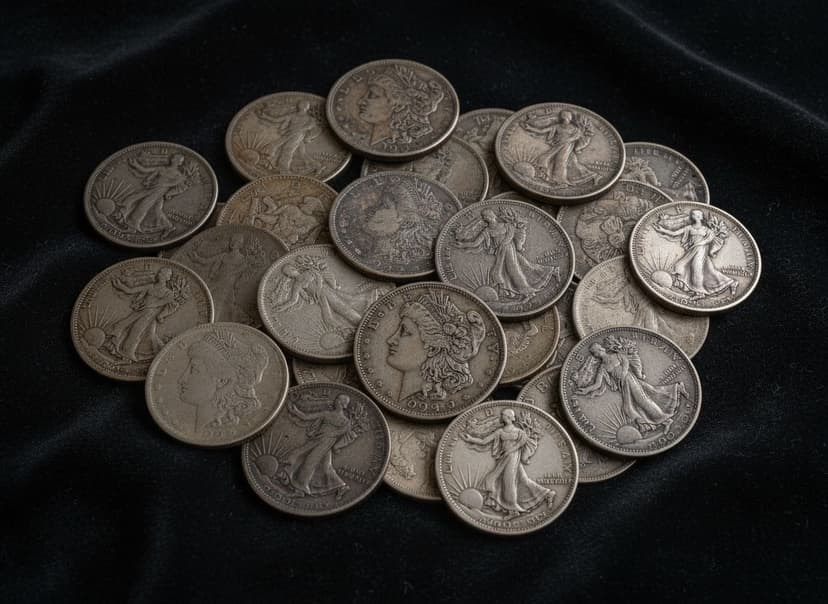
Every U.S. quarter minted in 1964 or earlier contains 90% silver, giving even the most common dates a melt value of approximately $5-$7 at current silver prices. The series spans several iconic designs. Barber (1892-1916), Standing Liberty (1916-1930), and Washington (1932-1964). with key dates and high-grade examples worth $50 to $30,000+ depending on rarity and condition.
Get the free app for unlimited scans


Compare real prices
See what silver quarter (pre-1965) are listed for right now
Affiliate link: we earn a commission if you buy, at no extra cost to you.
What do you want to value?
Get the free app for unlimited scans
Why Knowing Your Silver Quarter (Pre-1965) Value Matters

Silver quarters represent one of the most accessible precious metals investments and numismatic collectibles. With approximately 0.1808 troy ounces of silver per coin, every pre-1965 quarter has a minimum value well above its 25-cent face value. At current silver prices, this melt value ranges from $5-$7 per coin, meaning a $10 face-value roll of 40 silver quarters contains $200-$280 in silver. Beyond melt value, many silver quarters carry substantial numismatic premiums. The Washington quarter series (1932-1964) includes key dates like the 1932-D and 1932-S that sell for $100-$400+ even in lower grades. Standing Liberty quarters (1916-1930) are prized for their beautiful design, with the rare 1916 commanding $3,000-$30,000+ depending on condition. Barber quarters (1892-1916) have numerous semi-key and key dates worth $20-$500+. Many Americans have inherited or accumulated silver quarters without realizing their true value. A coffee can of old quarters, a bag from a grandparent's collection, or even a single find in pocket change could contain coins worth far more than their silver content. Understanding the difference between common dates worth melt value and scarce dates worth collector premiums is essential before selling to a dealer or precious metals buyer.
Key Factors That Affect Silver Quarter (Pre-1965) Value
Understanding what drives the price of silver quarter (pre-1965) helps you get the most accurate valuation.
Silver Melt Value
Every pre-1965 quarter contains 0.1808 troy oz of 90% silver. At a silver price of $28/oz, melt value is approximately $5.06 per coin. At $32/oz, it is $5.79. A roll of 40 quarters ($10 face value) contains 7.23 troy oz of silver, worth $200-$230+ at current prices. Dealers typically pay 85-95% of melt for common-date 'junk silver' quarters. The melt value provides a price floor. No silver quarter is worth less than its metal content.
Design Type & Era
Washington quarters (1932-1964): Common dates in circulated grades $5-$8 (melt). Key dates: 1932-D ($100-$400), 1932-S ($80-$300). Standing Liberty quarters (1916-1930): Common dates $8-$20, 1916 ($3,000-$30,000+), 1918/7-S overdate ($1,000-$10,000+). Barber quarters (1892-1916): Common $6-$15, keys like 1896-S ($100-$2,000), 1901-S ($3,000-$30,000+). Earlier designs command higher premiums due to age and collector demand.
Date, Mint Mark & Rarity
Specific dates and mint marks dramatically affect value. The mintage of each issue determines base rarity: the 1932-D Washington quarter had a mintage of only 436,800 compared to 5.4 million for the 1932 Philadelphia. For Standing Liberty quarters, the 1916 had only 52,000 minted. Even within common series, certain years from the Denver and San Francisco mints had lower production and are worth 2-10x more than Philadelphia issues of the same year.
Condition & Grading
Condition creates enormous value differences for silver quarters. A 1944-S Washington quarter in Good condition is worth $5 (melt). In MS65, it is worth $30-$60. In MS67, it jumps to $500-$2,000+. For key dates, the multiplier is even larger: a 1932-D in Good is $100, but in MS65 it can bring $10,000-$20,000+. Professional grading by PCGS or NGC is recommended for any silver quarter that appears uncirculated or is a known key date.
Full Details & Strike Quality
For Standing Liberty quarters, a 'Full Head' (FH) designation. Showing complete detail in Liberty's head. Adds 50-200% to the coin's value. For Washington quarters, attractive original toning and sharp strike quality enhance value. Barber quarters with full 'LIBERTY' visible on the headband are graded Very Fine or better. These detail designations can mean the difference between a $50 coin and a $500 coin for the same date and approximate grade.
Tips for Valuing Silver Quarter (Pre-1965)
Get the most accurate valuation by following these tips when photographing your silver quarter (pre-1965).
Check the date on all quarters in your collection. Any dated 1964 or earlier is 90% silver and worth at least $5+. Look at the edge: a solid silver edge vs. a copper stripe identifies silver vs. clad.
Separate your silver quarters by design type: Barber (eagle reverse, Liberty head), Standing Liberty (standing figure), and Washington (familiar profile). Each type has different key dates.
Photograph the obverse clearly to show the full date. On Standing Liberty quarters, the date often wore away due to its raised position. Dateless Standing Liberty quarters are still worth $3-$5 for silver content.
Do not clean silver quarters. Original toning and patina are valued by collectors, and cleaning reduces grade and desirability.
For Washington quarters, check specifically for 1932-D and 1932-S. These are worth $80-$400+ even in well-circulated condition and are the most valuable regular-issue dates in the series.
Silver Quarter (Pre-1965) Market Insights
The silver quarter market operates on two levels: the bullion market for common dates and the numismatic market for key dates and high-grade examples. Junk silver quarters (common dates in circulated condition) track silver spot prices closely and are popular with precious metals investors as an affordable, fractional way to hold physical silver. Premiums over melt for junk silver have fluctuated from 5% to 30% depending on retail demand and availability. The numismatic market for key dates remains strong, with Standing Liberty and early Washington quarters seeing consistent demand at auction. PCGS and NGC registry sets drive competition for top-graded examples, pushing prices for MS67+ coins to significant premiums. Online platforms have made the market more transparent, with eBay sold listings providing real-time price discovery for most dates and grades.
Notable Silver Quarter (Pre-1965) Values
Real-world examples of what specific silver quarter (pre-1965) have sold for, so you can benchmark your own.
| Silver Quarter (Pre-1965) | Condition | Typical Value |
|---|---|---|
| 1932-D Washington Quarter | Fine (F-12) | $800 - $1,800 |
| 1932-S Washington Quarter | Fine (F-12) | $700 - $1,500 |
| 1916 Standing Liberty Quarter | Good (G-4) | $4,000 - $10,000 |
| 1918/7-S Standing Liberty Quarter | Very Good (VG-8) | $3,500 - $9,000 |
| 1901-S Barber Quarter | Good (G-4) | $2,500 - $7,000 |
| Common Date Washington Quarter (1950s) | Circulated | $5 - $8 |
| 1950-D/S Washington Quarter (OMM) | Extra Fine (EF-40) | $60 - $200 |
| 1964 Washington Quarter | MS-65 | $25 - $80 |
| 1796 Draped Bust Quarter | Good (G-4) | $10,000 - $30,000+ |
Based on PCGS Price Guide, NGC price guide, and recent eBay sold listings for graded and raw examples.
Find Out What Your Silver Quarter (Pre-1965) Are Worth
Upload a photo now and get a free AI-powered valuation in seconds. No sign-up required.
Silver Quarter (Pre-1965) Valuation FAQ
How much is a silver quarter worth in melt value?
A pre-1965 silver quarter contains 0.1808 troy ounces of 90% silver. At recent silver prices ($28-$32/oz), each coin has a melt value of approximately $5.06-$5.79. A roll of 40 silver quarters ($10 face value) contains 7.23 troy oz of silver, worth $202-$231. A bag of $1,000 face value (4,000 quarters) contains 723 troy oz, worth approximately $20,000-$23,000. Dealers typically pay 85-95% of melt value for common-date junk silver quarters.
What years of quarters are silver?
All U.S. quarters dated 1964 and earlier are 90% silver. This includes: Washington quarters (1932-1964), Standing Liberty quarters (1916-1930), Barber quarters (1892-1916), and Seated Liberty quarters (1838-1891). Starting in 1965, the Mint switched to copper-nickel clad with no silver content. The only silver quarters after 1964 are special proof issues from San Francisco: Silver Proof State/National Park quarters (1999-present, 90% silver) sold in special sets, not found in circulation.
Which silver quarters are worth the most?
The most valuable silver quarters: 1916 Standing Liberty ($3,000-$30,000+ depending on grade), 1901-S Barber ($3,000-$30,000+), 1896-S Barber ($100-$2,000+), 1918/7-S Standing Liberty overdate ($1,000-$10,000+), 1932-D Washington ($100-$20,000+ depending on grade), 1932-S Washington ($80-$15,000+), 1927-S Standing Liberty ($50-$3,000+). Even 'common' dates in gem uncirculated condition (MS67+) can bring $500-$5,000+ due to condition rarity.
How can I tell if a quarter is silver without looking at the date?
The easiest method is the edge test: look at the coin's edge (the thin side). A silver quarter has a uniform solid silver edge with no visible layers. A clad quarter (1965+) shows a visible copper-orange stripe sandwiched between nickel layers. This works even on heavily worn coins where the date may be difficult to read. Other methods: silver quarters weigh 6.25 grams vs. 5.67 grams for clad. Silver coins produce a distinctive high-pitched ring when dropped on a hard surface. A silver quarter also feels slightly different in texture compared to modern clad coins.
Should I sell silver quarters for melt value or as collectibles?
It depends on the specific coins. Sell for melt value if: the coins are common-date Washington quarters (1940s-1964) in circulated grades. Dealers pay 85-95% of melt, and individual eBay sales aren't worth the effort for $5-$7 coins. Sell as collectibles if: you have key dates (1932-D, 1932-S Washington; any Standing Liberty or Barber quarter), uncirculated examples, or coins with attractive toning. These can be worth 2-100x melt value. A good strategy is to sort your silver quarters: sell common dates in bulk to a precious metals dealer and sell any potentially valuable dates individually through a coin dealer or auction house for maximum return.
Value anything, anytime
Unlimited valuations, saved history and full reports in the free app.