Last updated: September 2026
How Much Are My Silver Coins Worth?
Silver coins are worth significantly more than their face value. Pre-1965 US dimes, quarters, and half dollars contain 90% silver, making them worth $2-$20+ each in silver content alone. Rare dates, mint marks, and high-grade examples can be worth hundreds or thousands. A common Morgan silver dollar is worth $25-$50, while key dates like the 1893-S sell for $3,000-$50,000+. Our AI analyzes your silver coin photos to identify the type, date, mint mark, and condition for an accurate valuation.
Get the free app for unlimited scans


Compare real prices
See what silver coins are listed for right now
Affiliate link: we earn a commission if you buy, at no extra cost to you.
What do you want to value?
Get the free app for unlimited scans
Why Knowing Your Silver Coins Value Matters
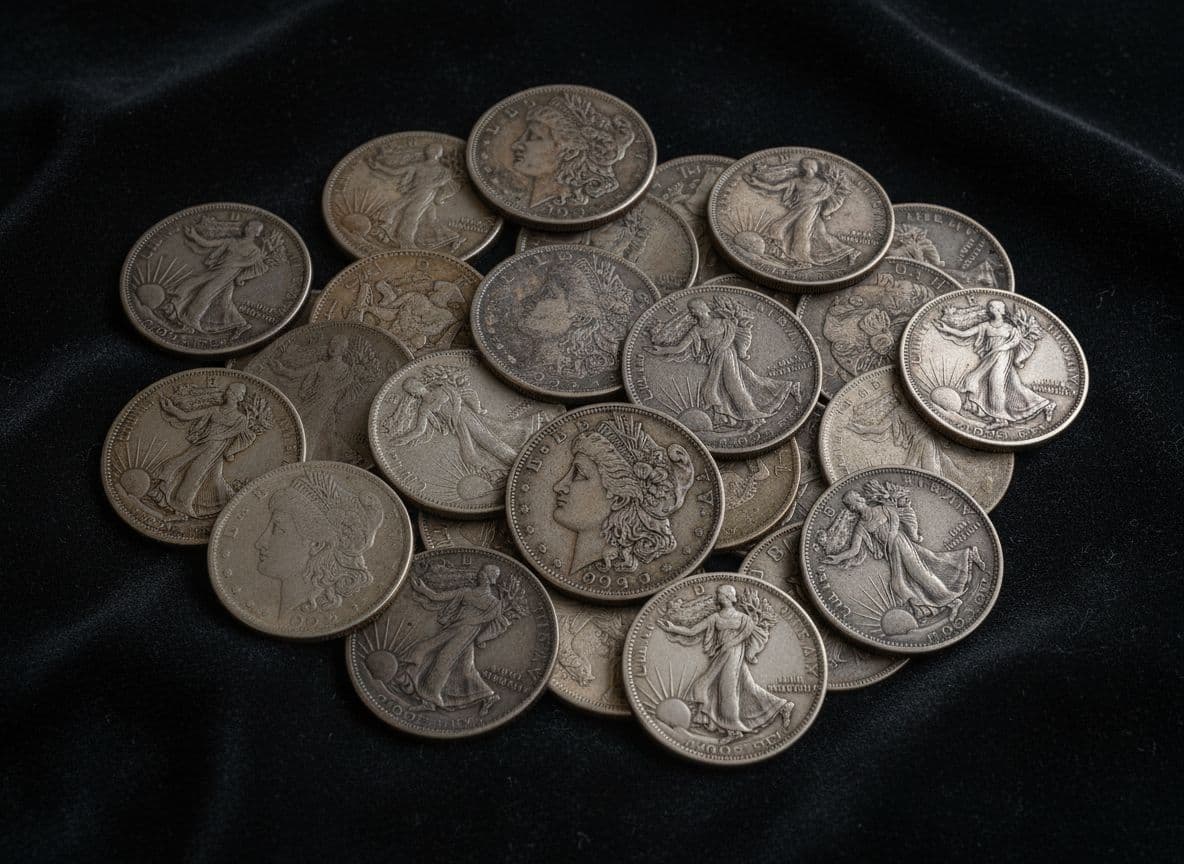
With silver prices at elevated levels, even common US silver coins have significant melt value. Many people inherit or find silver coins without knowing their worth. A jar of pre-1964 quarters could contain $100-$500+ in silver value. Beyond melt value, numismatic premiums for rare dates, errors, and high-grade coins can multiply a coin's value 10-100x over silver content. Understanding which coins are worth melt value versus collector premiums ensures you don't sell rare coins at scrap prices.
Key Factors That Affect Silver Coins Value
Understanding what drives the price of silver coins helps you get the most accurate valuation.
Silver Content & Spot Price
US silver coin composition: Pre-1965 dimes, quarters, half dollars: 90% silver. 1965-1970 Kennedy half dollars: 40% silver. Silver dollars (Morgan, Peace): 90% silver (0.77 troy oz each). Silver Eagles (1986-present): 99.9% pure silver (1 troy oz). At current silver prices, a 90% silver quarter has roughly $5-$7 in melt value, a half dollar $10-$14, and a Morgan/Peace dollar $23-$30.
Date, Mint Mark & Rarity
Key date coins are worth far more than common dates. Morgan dollar key dates: 1893-S ($3,000-$50,000+), 1889-CC ($500-$10,000), 1895 proof ($25,000+). Peace dollar key: 1928 ($200-$2,000). Walking Liberty half: 1916-S ($50-$3,000). Mercury dime: 1916-D ($500-$10,000). Even common dates in uncirculated condition carry significant premiums.
Condition & Grade
Coin grade dramatically affects value. A common Morgan dollar: Good (G4): $25-$35. Very Fine (VF30): $35-$50. About Uncirculated (AU55): $50-$80. Mint State (MS63): $60-$150. MS65: $150-$500+. Professionally graded coins (PCGS, NGC) in sealed holders command 20-50% premiums over ungraded ('raw') coins due to guaranteed authenticity and condition.
Toning, Errors & Varieties
Attractive natural toning (rainbow, crescent, or bull's-eye patterns) can add 25-200% to a coin's value among collectors. Error coins (doubled dies, off-center strikes, wrong planchets) can be worth 10-100x normal. Notable varieties: 1921 Peace dollar (high relief), 1878 Morgan 8 tail feathers, and VAM varieties all carry collector premiums.
Tips for Valuing Silver Coins
Get the most accurate valuation by following these tips when photographing your silver coins.
Never clean your silver coins. Cleaning destroys the natural patina and surface, reducing collector value by 30-70%. Even if a coin looks dirty or tarnished, leave it as-is.
Photograph both sides of each coin in good lighting, focusing on the date and mint mark (small letter on the reverse or below the wreath). these details determine value.
Sort your silver coins by type first: Morgan dollars, Peace dollars, Walking Liberty halves, Franklin halves, Kennedy halves, Washington quarters, Mercury dimes, and Roosevelt dimes. Each has different value ranges.
For bulk 90% silver coins (common dates in circulated condition), sell based on silver content multiplied by the spot price. Dealers typically pay 85-95% of melt value for junk silver.
Silver Coins Market Insights
Silver coin values are driven by both the precious metals market and the numismatic collector market. Silver prices have been volatile, trading between $22-$35/oz in recent years. The 'junk silver' market (common-date circulated US silver coins) closely tracks spot silver prices and is popular among precious metals investors as an affordable way to own physical silver. The numismatic market for rare dates and high-grade examples has been strong, with key-date Morgan dollars setting auction records. PCGS and NGC graded coins dominate the high-end market, with online platforms like eBay, Heritage Auctions, and GreatCollections making the market more accessible.
Notable Silver Coins Values
Real-world examples of what specific silver coins have sold for, so you can benchmark your own.
| Silver Coin | Condition | Typical Value |
|---|---|---|
| 1921-D Morgan Dollar | Circulated (VF-XF) | $35 - $65 |
| 1878-S Morgan Dollar | MS-63 Graded (PCGS/NGC) | $150 - $350 |
| 1895-O Morgan Dollar | Circulated (VG-Fine) | $300 - $700 |
| 1921 Peace Dollar | Circulated (VF) | $80 - $150 |
| 1934-D Peace Dollar | Circulated (EF-AU) | $120 - $275 |
| 1916 Walking Liberty Half Dollar | Circulated (Fine-VF) | $200 - $500 |
| 1942-S Walking Liberty Half Dollar | Circulated (VF-EF) | $18 - $40 |
| 1893-S Morgan Dollar | Circulated (VG) | $4,000 - $12,000+ |
| 1964 Kennedy Half Dollar | Circulated (90% silver) | $8 - $15 |
Based on eBay sold listings, PCGS CoinFacts price guides, and major auction records (Heritage, Stack's Bowers).
Find Out What Your Silver Coins Are Worth
Upload a photo now and get a free AI-powered valuation in seconds. No sign-up required.
Silver Coins Valuation FAQ
How much is a silver dollar worth?
Morgan silver dollars (1878-1921) in circulated condition: common dates (1881-S, 1882, 1884-O, 1885) are worth $30-$50. Better dates: $50-$200. Key dates (1893-S, 1889-CC, 1895): $500-$50,000+. Uncirculated common dates: $60-$300+ depending on grade. Peace silver dollars (1921-1935): common dates in circulated condition are worth $25-$45. Key date 1928: $200-$2,000. Eisenhower 'silver' dollars (1971-1976 40% silver proofs): $8-$15. American Silver Eagles (1986-present, 1 oz .999 silver): $30-$45+ depending on date and condition. The minimum value of any Morgan or Peace dollar is approximately $23-$30 based on silver content alone.
What US coins contain silver?
US coins with silver content: (1) All dimes, quarters, and half dollars dated 1964 and earlier: 90% silver. (2) Kennedy half dollars 1965-1970: 40% silver. (3) Morgan dollars (1878-1921): 90% silver. (4) Peace dollars (1921-1935): 90% silver. (5) War nickels (1942-1945, with large mint mark above Monticello): 35% silver. (6) Eisenhower dollars (only special mint/proof versions, 1971-1976): 40% silver. (7) American Silver Eagles (1986-present): 99.9% silver. (8) Various commemorative coins. The easiest test: any US dime, quarter, or half dollar dated 1964 or earlier is 90% silver. Check the edge. Silver coins have a uniform silver edge, while clad coins show a copper stripe.
Should I sell silver coins or hold them?
It depends on the coin type and your goals. Sell if: silver prices are at multi-year highs and you need cash, the coins are common-date circulated pieces worth only melt value, or you're liquidating an inherited collection you don't want to manage. Hold if: you have rare dates or high-grade coins (numismatic value tends to appreciate over time), silver prices are at multi-year lows (silver historically cycles), or you view silver as an inflation hedge in your portfolio. Strategy: sell common 'junk silver' when spot prices are high, but hold rare dates and graded coins for numismatic appreciation. Consider selling bulk junk silver to precious metals dealers (85-95% of melt) and rare coins through specialized coin dealers or auction houses for best results.
Silver Coins Price Guides
Value anything, anytime
Unlimited valuations, saved history and full reports in the free app.