Last updated: September 2026
What Grade Would My Card Get?
Professional grading (PSA, BGS, CGC) can increase your card's value 2x to 50x. But it costs $20-$150+ per card and takes weeks. Upload a photo and our AI evaluates centering, corners, edges, and surface to estimate what grade your card might receive. Know before you submit whether grading is worth the investment.
Get the free app for unlimited scans


Compare real prices
See what card grading are listed for right now
Affiliate link: we earn a commission if you buy, at no extra cost to you.
What do you want to value?
Get the free app for unlimited scans
Why Knowing Your Card Grading Value Matters
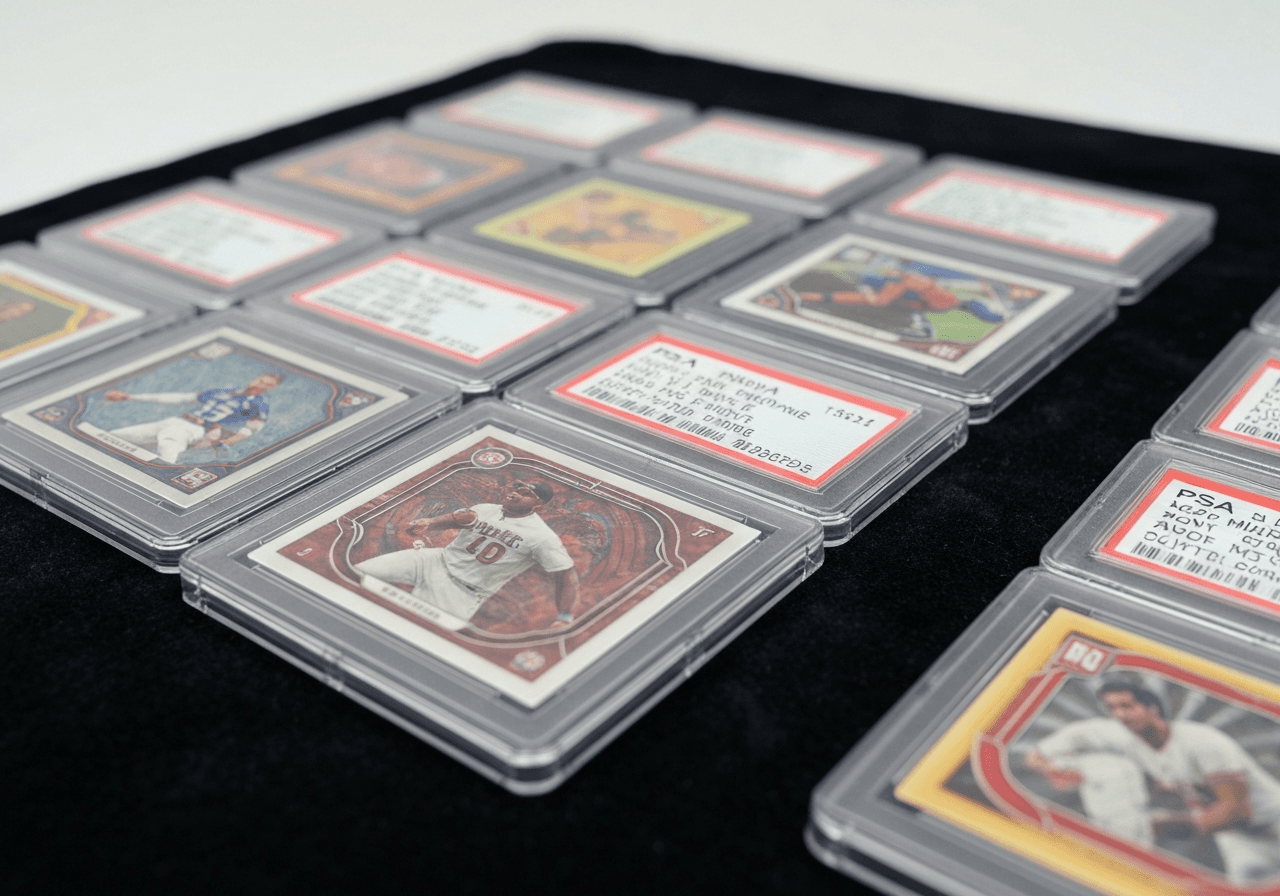
The difference between a PSA 9 and PSA 10 can be 3x to 10x in value. A base Charizard in PSA 9: $500. In PSA 10: $5,000. Knowing your likely grade before submitting saves money on cards that won't grade high and identifies hidden gems that could be worth significantly more after grading. Grading fees range from $20 (economy, 6+ month turnaround) to $150+ (express, 5-day turnaround), so you want to be strategic about which cards to submit.
Key Factors That Affect Card Grading Value
Understanding what drives the price of card grading helps you get the most accurate valuation.
Centering
Cards must be evenly centered front and back. PSA 10 requires 60/40 centering or better on the front and 75/25 on the back. Off-center cards are the #1 reason for grade reductions. Even a card in otherwise perfect condition gets downgraded to PSA 8-9 if centering is off.
Corners
All four corners must be sharp and free of wear, dings, or whitening. Even microscopic corner wear visible under magnification will prevent a PSA 10 grade. Corner condition is the second most common reason for grade reductions.
Edges
Card edges should be clean and free of nicks, chips, or peeling. White edges on dark-bordered cards (like many Pokemon and MTG cards) show wear more easily. Edge wear is common from handling and shuffling.
Surface
The card surface must be free of scratches, print defects, stains, and indentations. Holographic cards are particularly prone to surface scratching. Print lines (factory defects in the printing) can also lower grades even on unplayed cards.
Grading Service
PSA (most popular, highest liquidity, 1-10 scale). BGS/Beckett (sub-grades for each category, BGS 10 Black Label is the holy grail). CGC (newer service, growing in popularity, competitive pricing). SGC (popular for vintage cards). Each service has slightly different standards.
Tips for Valuing Card Grading
Get the most accurate valuation by following these tips when photographing your card grading.
Photograph the front and back of the card on a clean, flat surface
Use good lighting without glare. Avoid flash on holographic cards
Include a close-up of each corner showing the sharpness
Photograph any visible flaws (scratches, whitening, print lines)
Card Grading Market Insights
The card grading industry has grown from a niche service to a multi-hundred-million-dollar business. PSA graded over 14 million cards in 2024. The grading backlog that peaked in 2021 (12+ month wait times) has largely cleared, with most services now at 2-8 week turnaround for standard submissions. AI pre-screening tools are becoming common. Several companies now offer photo-based grade estimates. The consensus is that any card potentially worth $100+ ungraded should be considered for grading.
Find Out What Your Card Grading Are Worth
Upload a photo now and get a free AI-powered valuation in seconds. No sign-up required.
Card Grading Valuation FAQ
How much does card grading cost?
PSA: $20 (economy, 65+ business days), $50 (regular, 30 days), $100 (express, 10 days), $150+ (super express, 5 days). BGS: $25 (standard, 40 days), $50 (10-day), $100+ (2-day). CGC: $15-$100 depending on tier. Bulk submissions (20+ cards) get discounted rates.
Is it worth grading my card?
General rule: grade a card if the graded value in the expected grade exceeds the raw value by more than the grading fee + shipping. For example: a raw card worth $50 that would be worth $200 in PSA 10 is worth grading if you expect it to get a 10. Upload a photo to estimate your grade first.
What is a PSA 10?
PSA 10 (Gem Mint) means the card is virtually perfect: sharp corners, centered within tolerance (60/40 front, 75/25 back), clean edges, and flawless surface. Only about 10-20% of submitted cards receive a PSA 10, depending on the set and era.
PSA vs BGS vs CGC: which is best?
PSA: highest market liquidity, most recognized, best for selling. BGS: sub-grades give more detail, BGS 10 Black Label is the most exclusive grade. CGC: competitive pricing, growing market acceptance. For resale value, PSA generally commands a 10-20% premium over equivalent BGS/CGC grades.
Similar Valuations
Value anything, anytime
Unlimited valuations, saved history and full reports in the free app.