Last updated: September 2026
How Much Are My Football Cards Worth?
Whether you have a shoebox of 1980s Topps cards, a prized Patrick Mahomes rookie, or a vintage Joe Montana, our AI analyzes your football card's player, year, set, condition, and grading to deliver an accurate market valuation. From Tom Brady RCs to rare 1958 Jim Brown cards, get values in seconds without paying a dealer or waiting for a PSA submission.
Get the free app for unlimited scans


Compare real prices
See what football cards are listed for right now
Affiliate link: we earn a commission if you buy, at no extra cost to you.
What do you want to value?
Get the free app for unlimited scans
Why Knowing Your Football Cards Value Matters
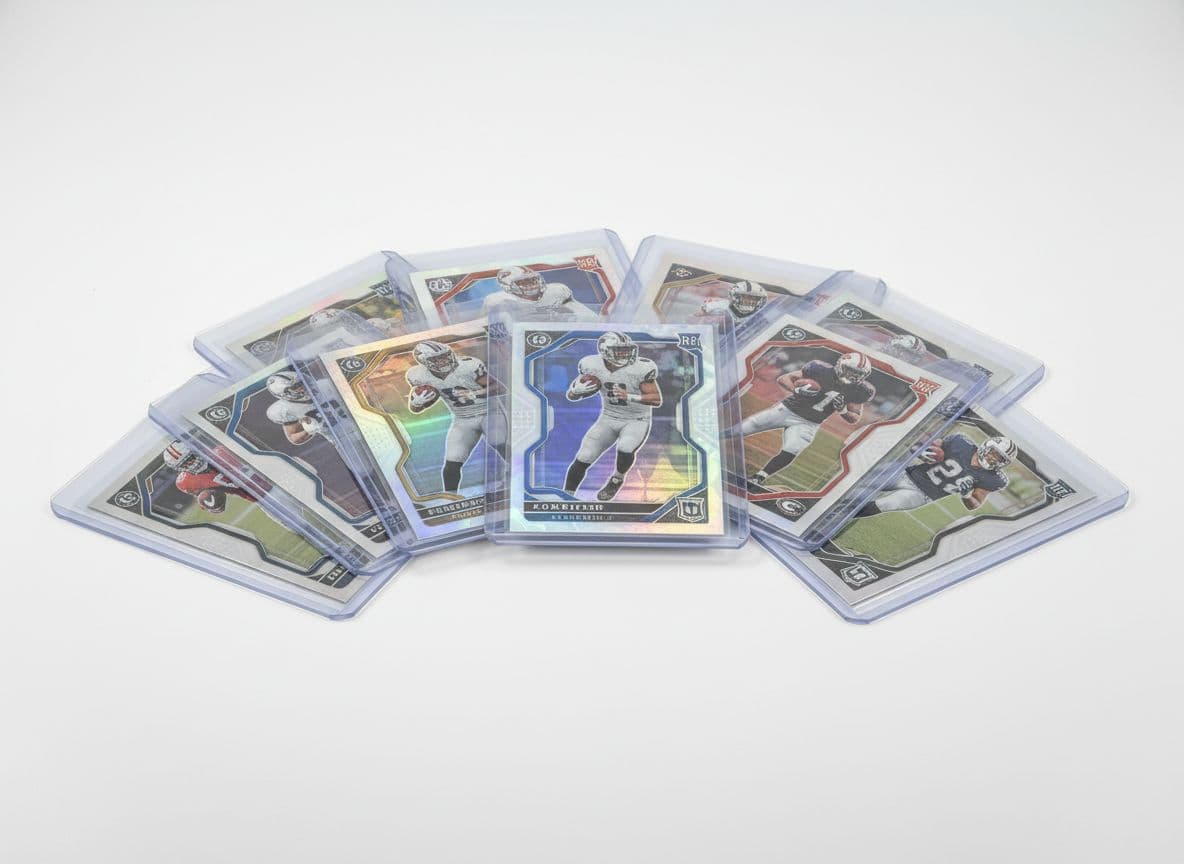
Football cards are one of the fastest-growing segments of the sports card market, with the hobby exploding since 2020. A single Patrick Mahomes 2017 Panini Prizm Silver rookie PSA 10 has sold for over $10,000, while a 2000 Playoff Contenders Championship Ticket Tom Brady auto sold for $3.1 million. Even common vintage cards from the 1950s-1970s in good condition can be worth $50-$500. Many people inherit boxes of football cards without knowing some could be worth serious money. Professional grading through PSA or BGS costs $20-$150+ per card and takes weeks or months. Our free AI tool gives you an instant estimate so you can decide which cards are worth the investment of professional grading, which to sell raw, and which to hold as long-term investments.
Key Factors That Affect Football Cards Value
Understanding what drives the price of football cards helps you get the most accurate valuation.
Player & Rookie Status
The player depicted is the single biggest driver of football card value. Rookie cards (RCs) of Hall of Famers and current superstars command the highest premiums. A Patrick Mahomes rookie can be worth 50-100x more than a same-year card of an average player. Key names that drive value include Tom Brady, Joe Montana, Jerry Rice, Peyton Manning, Josh Allen, and emerging stars like CJ Stroud and Caleb Williams.
Year, Set & Variation
The specific product and variation dramatically affect value. Premium brands like Panini Prizm, National Treasures, Select, and Optic command higher prices than base Donruss or Score. Within a set, parallel variations matter enormously. A base Prizm card might be worth $5, while the Silver Prizm is $200, Gold /10 is $2,000, and Black 1/1 is $10,000+. Numbered cards (serial-numbered out of a limited quantity) are always more valuable.
Condition & Grading
Card condition is critical to value. A PSA 10 (Gem Mint) card can be worth 5-20x more than the same card in PSA 8 (Near Mint-Mint). Key condition factors include centering, corners, edges, and surface quality. Professional grading by PSA, BGS, or SGC authenticates and encapsulates the card, making it easier to sell at premium prices. BGS 9.5 and PSA 10 are the most sought-after grades.
Autographs & Memorabilia
Cards featuring on-card autographs (not sticker autos) and game-used memorabilia patches command significant premiums. A base rookie card might be worth $20, while the same player's autographed rookie patch card from National Treasures could be worth $5,000-$50,000. The quality and size of the patch piece also affects value. A multi-color logo patch is worth far more than a plain white swatch.
Market Timing & Hype
Football card values fluctuate with player performance and NFL seasons. Cards spike during breakout performances, playoff runs, and MVP seasons. A player's cards can double or triple in value during a Super Bowl run and decline sharply after injuries or retirement. Buying and selling based on these cycles is a key strategy for football card investors.
Tips for Valuing Football Cards
Get the most accurate valuation by following these tips when photographing your football cards.
Focus on rookie cards of star quarterbacks. They hold value best long-term, while other position players' cards tend to depreciate faster after retirement
Check recent sold listings on eBay (not asking prices) to get accurate current market values. Football card prices change weekly based on player performance
Keep cards in penny sleeves and toploaders to protect condition. Even minor corner damage can reduce value by 50% or more at grading
Consider getting cards professionally graded only if the raw card value exceeds $50-$100, since grading fees plus shipping can cost $30-$75 per card
Football Cards Market Insights
The football card market has undergone a massive transformation since 2020, growing from a niche hobby into a multi-billion-dollar industry. Panini held the exclusive NFL license for trading cards from 2016-2025, making their products the standard for modern football cards. Fanatics acquired the NFL license and is now producing cards, creating a transitional period in the market. Vintage football cards (pre-1980) remain strong, with 1958 Topps Jim Brown rookies selling for $100,000-$500,000+ depending on grade. The modern market is driven by three key products: Prizm (the most popular and liquid set), National Treasures (the ultra-premium product), and Optic (the mid-tier staple). Online platforms like eBay, PWCC, and MySlabs have made buying and selling football cards more accessible than ever, while tools like 130point and Market Movers help track real-time sales data. Card grading backlogs at PSA and BGS have improved but still take 2-8 weeks for standard submissions.
Notable Football Cards Values
Real-world examples of what specific football cards have sold for, so you can benchmark your own.
| Football Card | Condition | Typical Value |
|---|---|---|
| 1958 Topps Jim Brown Rookie Card #62 | Near Mint (PSA 7) | $3,000 - $8,000 |
| 1986 Topps Jerry Rice Rookie Card #161 | Graded PSA 9 | $800 - $2,500 |
| 2000 Playoff Contenders Tom Brady Rookie Ticket Auto #144 | Graded PSA 8 | $15,000 - $40,000+ |
| 2017 Panini National Treasures Patrick Mahomes Rookie Auto Patch | Graded BGS 9 | $5,000 - $20,000+ |
| 1965 Topps Joe Namath Rookie Card #122 | Good to Very Good | $400 - $2,000 |
| 2018 Panini Prizm Lamar Jackson Base Rookie Card | Near Mint Ungraded | $40 - $120 |
| 1984 Topps USFL Reggie White Rookie Card #52 | Near Mint | $150 - $500 |
| 2021 Panini Prizm Trevor Lawrence Silver Prizm Rookie | Graded PSA 10 | $80 - $250 |
| 1957 Topps Johnny Unitas Rookie Card #138 | Good (PSA 2-3) | $300 - $900 |
Based on eBay sold listings, PSA auction records, and PWCC marketplace historical sales data.
Find Out What Your Football Cards Are Worth
Upload a photo now and get a free AI-powered valuation in seconds. No sign-up required.
Football Cards Valuation FAQ
Which football cards are worth the most money?
The most valuable football cards include: 2000 Playoff Contenders Championship Ticket Tom Brady Auto (up to $3.1 million), 1958 Topps Jim Brown Rookie PSA 9 ($500,000+), 2017 Panini National Treasures Patrick Mahomes RPA 1/1 ($800,000+), 1935 National Chicle Bronko Nagurski ($500,000+ in high grade), and 1965 Topps Joe Namath Rookie ($50,000-$200,000 in PSA 8+). For modern affordable cards, Patrick Mahomes, Josh Allen, Joe Burrow, and Justin Herbert rookies are the most actively traded, with Prizm Silver versions ranging from $200 to $5,000+ depending on grade.
Are football cards from the 1980s and 1990s worth anything?
Most football cards from the 1980s-1990s 'junk wax era' are worth very little ($0.01-$1.00) because they were massively overproduced. However, key rookie cards remain valuable: 1986 Topps Jerry Rice RC ($100-$2,000+ depending on condition), 1984 Topps John Elway RC and Dan Marino RC ($50-$500+), and 1989 Score Barry Sanders RC ($20-$200). Late 1990s cards from premium sets like Playoff Contenders, SP Authentic, and Bowman Chrome have held up better. The key is condition. Even valuable cards from this era are often worth very little if they're not in PSA 9 or 10 condition.
Should I get my football cards graded by PSA or BGS?
PSA is the most popular and liquid grading service for football cards. PSA-graded cards typically sell for 10-20% more than BGS-graded cards of equivalent grade on the secondary market. BGS (Beckett) is preferred by some collectors because it offers half-point grades (like 9.5) and the coveted BGS 10 Black Label, which commands massive premiums. SGC is a solid budget alternative with faster turnaround times and lower fees. Only submit cards worth $50+ raw for grading, as standard grading costs $20-$50+ per card plus shipping. For cards worth $500+, the grading premium is almost always worth the investment.
How do I sell my football card collection?
For individual valuable cards ($100+), eBay auction is the best platform. Use quality photos, accurate descriptions, and start auctions at $0.99 to drive bidding. For bulk collections, reach out to local card shops (expect 40-60% of market value) or sell on Facebook groups like 'Football Card Buy/Sell/Trade.' For high-value cards ($1,000+), consignment through PWCC Marketplace or Heritage Auctions can maximize returns with seller fees of 5-15%. Platforms like MySlabs and ALT offer fixed-price sales for graded cards. Before selling a collection, identify and separate the valuable cards. Most collections are 95% bulk worth pennies and 5% cards worth real money.
What football card brands and products should I collect?
For investment and resale value, focus on Panini Prizm (the most liquid and widely traded set), National Treasures (the ultra-premium product with RPAs), and Optic (rated rookie cards). Select and Mosaic offer good mid-range options with popular parallel designs. For Fanatics-produced cards (2025+), the new Topps NFL products are establishing themselves in the market. Avoid retail-only products like Donruss base and Score if you're looking for investment-grade cards. These are great for casual collecting but rarely hold significant value. Always prioritize rookie cards of quarterbacks taken in the first round of the NFL Draft.
Football Cards Price Guides
Football Cards Guides & Articles
Similar Valuations
Value anything, anytime
Unlimited valuations, saved history and full reports in the free app.