Last updated: September 2026
How Much Are My Basketball Cards Worth?
Basketball cards represent one of the largest and most dynamic segments of the sports card market, with a rich history spanning from the 1948 Bowman set to today's ultra-premium Panini products. Our AI analyzes your card's player, year, set, condition, parallel, and special features to provide an accurate market valuation. Whether you've uncovered a shoebox of 1980s Fleer cards, pulled a LeBron James rookie from a pack, or inherited a collection spanning decades, understanding what your basketball cards are truly worth is essential before selling, insuring, or grading.
Get the free app for unlimited scans


Compare real prices
See what basketball cards are listed for right now
Affiliate link: we earn a commission if you buy, at no extra cost to you.
What do you want to value?
Get the free app for unlimited scans
Why Knowing Your Basketball Cards Value Matters
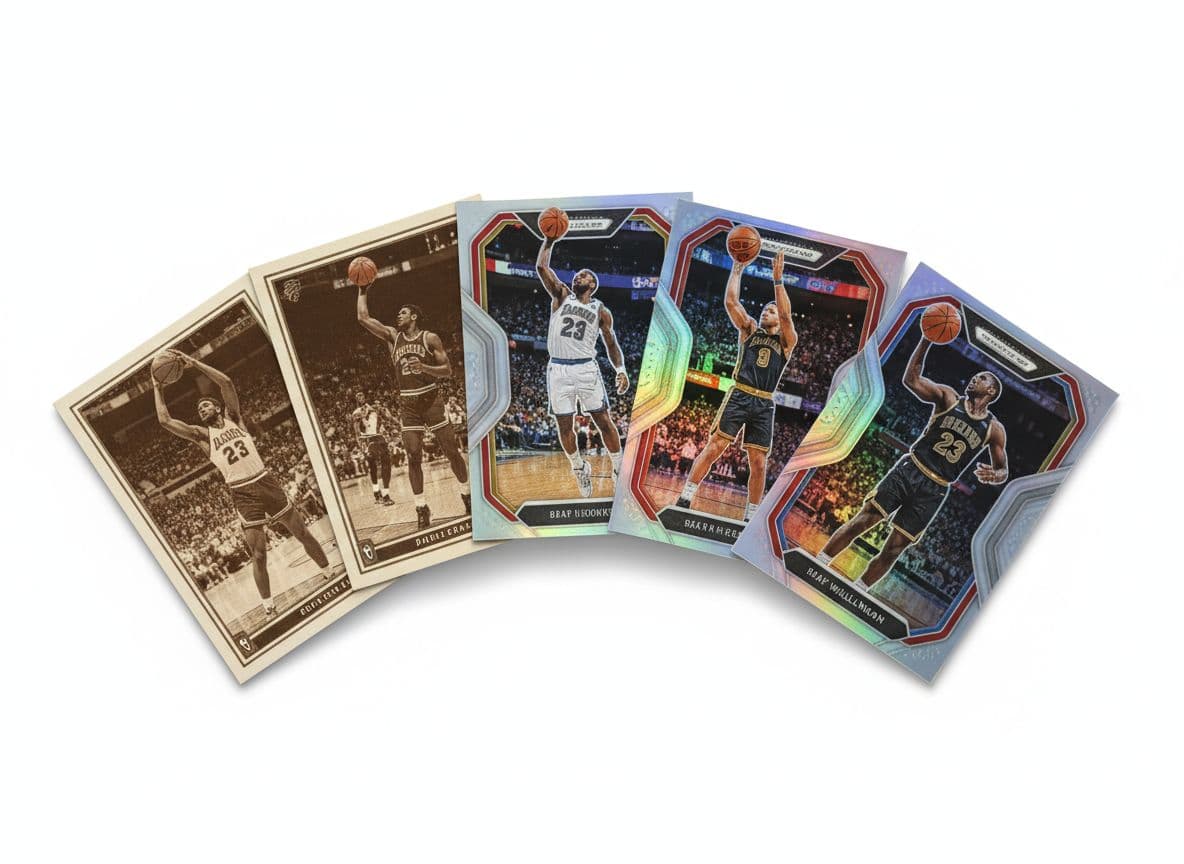
Basketball cards are a multi-billion dollar market where values range from pennies to millions. A 2003 Upper Deck Exquisite LeBron James Rookie Patch Auto sold for $5.8 million, making it the most expensive basketball card ever. A 1986 Fleer Michael Jordan rookie in PSA 10 sells for $300,000–$700,000, while even a PSA 7 is worth $10,000–$20,000. But value isn't limited to superstars. A common 1986 Fleer base set in near-mint condition is worth $2,000–$4,000, and modern Panini Prizm Silver rookie cards of emerging stars can be worth $100–$5,000+. Many collectors have cards they bought years ago that have appreciated significantly, or inherited collections they've never had appraised. Professional card appraisals cost $50–$200+, and card shops routinely offer 40–60% of market value when buying. Grading through PSA or BGS costs $20–$300 per card but can multiply a card's value 2–10x. Our free estimator gives you an unbiased baseline so you can make informed decisions about which cards to grade, sell, hold, or insure.
Key Factors That Affect Basketball Cards Value
Understanding what drives the price of basketball cards helps you get the most accurate valuation.
Player & Rookie Cards
The player is the most important value factor. Michael Jordan cards anchor the vintage market. His 1986 Fleer rookie (#57) is the most iconic basketball card ever ($3,000 raw to $700,000 in PSA 10). LeBron James dominates the modern market, with his 2003 Topps Chrome rookie worth $2,000–$200,000+ depending on condition and refractor status. Kobe Bryant cards saw massive price increases after his passing in 2020. Current stars like Luka Doncic, Giannis Antetokounmpo, and Victor Wembanyama drive the active market. Rookie cards (RC) are always the most valuable card of any player, typically worth 5–50x more than cards from other seasons.
Set & Product Line
The card's product line dramatically impacts value. Vintage benchmarks include 1948 Bowman, 1961 Fleer, 1969 Topps, and 1986 Fleer. Modern premium products include Panini Prizm (the modern standard), National Treasures (ultra-premium with patches and autographs), Flawless (diamond-embedded cards), and Optic. Topps Chrome was the dominant product before Panini's exclusive NBA license began in 2010. Within each product, insert sets and parallels create tiers of rarity and value.
Condition & Grade
Condition is measured on a 1–10 scale by PSA, BGS, or SGC. The grade difference is enormous: a 1986 Fleer Jordan in PSA 8 sells for $15,000–$25,000, while a PSA 10 commands $300,000–$700,000. For modern cards, PSA 10 is the target. It can be worth 3–10x a PSA 9. Centering, corners, edges, and surface quality are the four grading criteria. Vintage cards (pre-1980) are rarely found in high grades, making high-grade examples exponentially more valuable.
Parallel & Serial Number
Parallels are limited-edition color variations of base cards. For Panini Prizm, the hierarchy includes Silver, Red/White/Blue, Pink, Green, Gold (/10), Gold Vinyl (/5), and Black (1/1). Each tier multiplies value. A base Wembanyama Prizm rookie might sell for $100, while a Gold /10 could fetch $20,000–$50,000. Serial-numbered cards (stamped with their production number, e.g., 05/25) guarantee scarcity and command proportional premiums.
Autographs & Memorabilia
Cards featuring authentic player autographs and game-worn jersey patches are among the most valuable in the hobby. A LeBron James Rookie Patch Auto (RPA) from National Treasures is worth $100,000–$5,000,000+. On-card autographs (signed directly on the card) are worth 2–5x more than sticker autographs. Multi-color jersey patches showing team logos or letters command premiums over single-color swatches. The combination of a rookie card with an autograph and a patch. The 'RPA'. is the pinnacle of modern basketball card collecting.
Tips for Valuing Basketball Cards
Get the most accurate valuation by following these tips when photographing your basketball cards.
Photograph the front and back of the card in even lighting, ensuring the player name, year, card number, and any parallel colors or serial numbers are clearly visible
If the card is in a graded slab, include the label showing the grade, certification number, and player details
Handle raw cards by the edges only or use clean cotton gloves. Fingerprints and oils permanently damage card surfaces
For older cards, note any defects such as rounded corners, creases, staining, or off-center printing, as these significantly affect grade and value
Basketball Cards Market Insights
The basketball card market is the second-largest sports card market globally (behind baseball) and experienced explosive growth during 2020–2021, with some segments appreciating 300–1,000%. While the market has cooled from those peaks, it remains robust and significantly above pre-2020 levels. Panini holds the exclusive NBA license through 2025, with Fanatics set to take over. This transition creates both uncertainty and potential opportunity in the market. The vintage market (1986 Fleer and earlier) tends to be more stable, as supply is fixed and Jordan/Bird/Magic cards have enduring demand. The modern market is more volatile, with prices closely tied to player performance and media attention. International collecting has grown significantly, with strong demand from Asia, Europe, and the Middle East for top NBA players. Key trends include the rise of case breaks and group breaks (which have democratized access to premium products), growing acceptance of SGC as a grading alternative to PSA and BGS, and increasing interest in 1990s insert cards (Finest Refractors, SPx, EX Century) as a value play relative to vintage.
Notable Basketball Cards Values
Real-world examples of what specific basketball cards have sold for, so you can benchmark your own.
| Basketball Card | Condition | Typical Value |
|---|---|---|
| 1986-87 Fleer Michael Jordan Rookie #57 | Graded PSA 10 | $350,000 - $600,000+ |
| 1986-87 Fleer Michael Jordan Rookie #57 | Graded PSA 8 | $8,000 - $15,000 |
| 2003-04 Upper Deck Exquisite LeBron James Rookie Patch Auto /99 | Graded BGS 9 | $150,000 - $400,000+ |
| 1996-97 Topps Chrome Kobe Bryant Rookie Refractor | Graded PSA 10 | $25,000 - $60,000 |
| 2018-19 Panini Prizm Luka Doncic Rookie Silver Prizm | Graded PSA 10 | $800 - $2,500 |
| 2018-19 Panini Prizm Luka Doncic Rookie Silver Prizm | Raw / Ungraded | $80 - $250 |
| 1969-70 Topps Lew Alcindor (Kareem Abdul-Jabbar) Rookie #25 | Graded PSA 7 | $2,000 - $5,000 |
| 1980-81 Topps Larry Bird / Magic Johnson Rookie #34 | Graded PSA 9 | $5,000 - $12,000 |
| Common 1990s NBA Hoops / Topps Base Card | Ungraded | $0.25 - $2 |
Based on eBay sold listings, PWCC auction records, and PSA Population Report price data.
Find Out What Your Basketball Cards Are Worth
Upload a photo now and get a free AI-powered valuation in seconds. No sign-up required.
Basketball Cards Valuation FAQ
How much is a Michael Jordan rookie card worth?
The 1986 Fleer Michael Jordan rookie card (#57) is the most iconic basketball card ever made. Values range dramatically by condition: PSA 10 (Gem Mint) sells for $300,000–$700,000, PSA 9 for $15,000–$30,000, PSA 8 for $8,000–$20,000, PSA 7 for $4,000–$10,000, and lower grades from $1,000–$3,000. Even damaged copies sell for $500+. The 1986 Fleer sticker (#8) is also valuable: $3,000–$50,000+ depending on grade. Jordan's other notable cards include the 1984 Star Company set (his true first cards, worth $1,000–$30,000) and 1997 Precious Metal Gems (Green /100 worth $50,000–$300,000).
Are 1990s basketball cards worth anything?
The 1990s basketball card market is split. Mass-produced base cards from 1989–1994 (Hoops, Fleer, Upper Deck, Topps) were printed in enormous quantities and are generally worth $0.10–$2 each, even for star players. However, premium 1990s inserts and parallels can be extremely valuable: 1996 Topps Chrome Kobe Bryant refractor ($5,000–$50,000), 1997 Precious Metal Gems Michael Jordan ($50,000–$300,000), 1993 Finest Refractors ($50–$5,000), and 1997 EX2001 Jambalaya inserts ($100–$3,000). Key rookie cards from the 1990s. Shaq (1992), Penny Hardaway (1993), Jason Kidd/Grant Hill (1994), Kevin Garnett (1995), Kobe/Iverson (1996), Tim Duncan (1997). remain strong performers in high grades.
Should I get my basketball cards graded?
Grading is worthwhile for cards with a raw value of $50+ or star player rookies you believe are in near-mint to mint condition. The cost-benefit analysis: if grading costs $30 and a PSA 10 would triple the card's value from $100 to $300, it's a strong investment. PSA is the most liquid grading service (highest resale premiums), BGS offers half-point grades and the coveted BGS 10 Black Label, and SGC is faster and cheaper with growing acceptance. Before submitting, check centering (use a centering tool), corners (use a loupe), and surface (check under angled light for scratches). For vintage cards (pre-1980), even lower grades (PSA 5–7) justify grading because authentication adds value.
What basketball cards should I invest in right now?
While card investing carries risk, several categories show strong fundamentals: (1) Victor Wembanyama rookie cards. As the consensus generational talent, his Prizm and National Treasures rookies have long-term upside. (2) Vintage Jordan, Bird, and Magic cards in high grades. Fixed supply with enduring demand. (3) Kobe Bryant cards. Values stabilized after the post-2020 surge and represent a strong hold. (4) Emerging stars like Anthony Edwards, Paolo Banchero, and Chet Holmgren rookies at current prices. (5) Undervalued 1990s inserts (Finest Refractors, SPx, Metal Universe) which are scarce and visually stunning. Avoid overproduced modern base cards and unproven rookie classes. Diversify across eras and players, and never invest more than you can afford to lose.
Basketball Cards Price Guides
Basketball Cards Guides & Articles
Similar Valuations
Value anything, anytime
Unlimited valuations, saved history and full reports in the free app.