Last updated: September 2026
How Much Are My WNBA Cards Worth?
The WNBA trading card market has experienced an unprecedented boom, driven by superstar rookies and growing mainstream attention for women's basketball. Our AI analyzes your card's player, year, set, parallel, condition, and special features to provide an accurate market valuation. Whether you have early WNBA cards from the league's founding, modern Prizm and Select rookies, or the red-hot Caitlin Clark cards, understanding the true value of your collection is essential in this rapidly appreciating market.
Get the free app for unlimited scans


Compare real prices
See what wnba cards are listed for right now
Affiliate link: we earn a commission if you buy, at no extra cost to you.
What do you want to value?
Get the free app for unlimited scans
Why Knowing Your WNBA Cards Value Matters
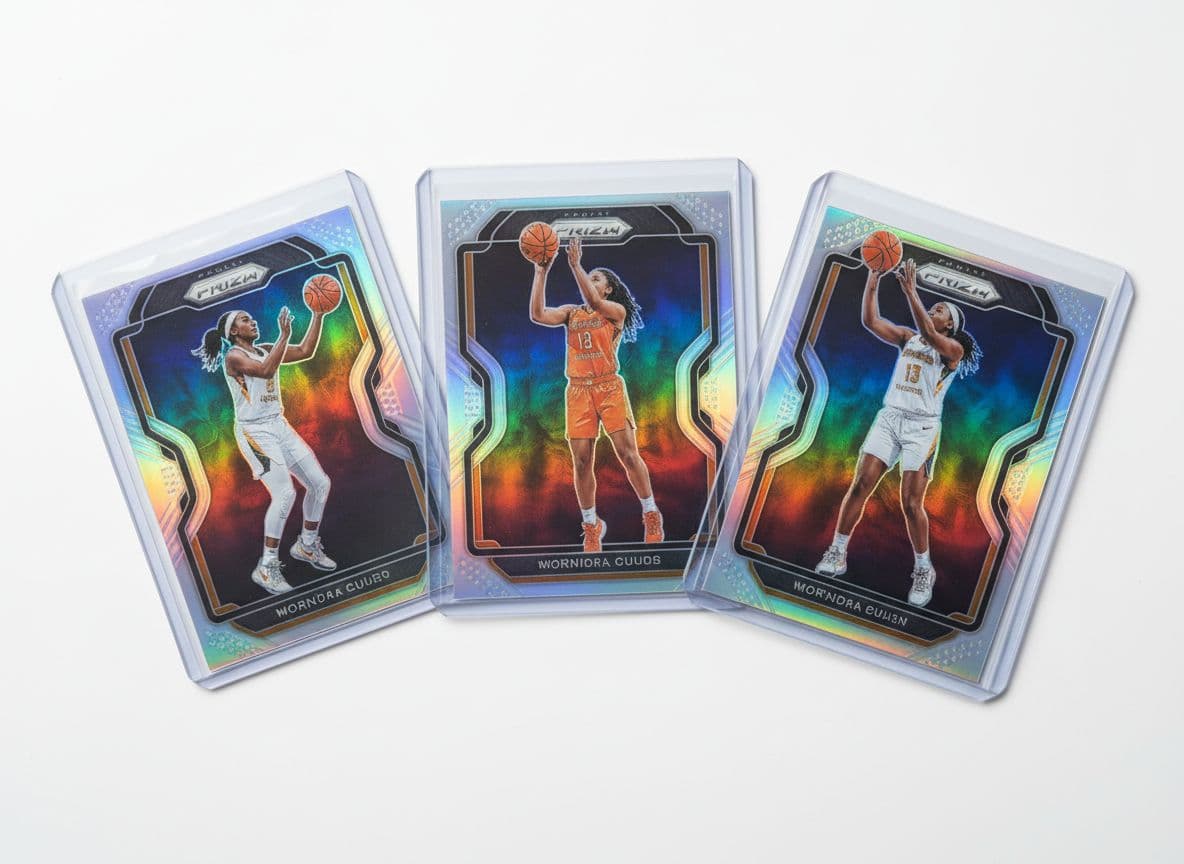
WNBA cards are the fastest-growing segment in the entire sports card hobby. Caitlin Clark rookie cards have sold for $5,000–$78,000+ for premium parallels, and her base Prizm rookies sell for $50–$300 depending on condition and parallel. A'ja Wilson, Breanna Stewart, and Sabrina Ionescu cards have also appreciated 200–500% over the past two years. The WNBA card market was virtually nonexistent before 2020. Early WNBA sets from 1997–2005 were printed in tiny quantities, making vintage stars like Lisa Leslie, Sheryl Swoopes, Diana Taurasi, and Sue Bird increasingly valuable ($20–$2,000+ for key cards). Professional grading costs $20–$150 per card but can multiply value 3–8x for star player rookies in PSA 10. Many collectors acquired WNBA cards casually or pulled them from mixed hobby boxes without realizing their current value. Our free estimator helps you identify which WNBA cards are worth grading, selling, or holding as the market continues its historic growth.
Key Factors That Affect WNBA Cards Value
Understanding what drives the price of wnba cards helps you get the most accurate valuation.
Player & Rookie Status
The player featured is the dominant value factor. Caitlin Clark cards lead the market ($50–$78,000+ depending on parallel and grade), followed by A'ja Wilson ($20–$5,000), Angel Reese ($30–$3,000), and Breanna Stewart ($10–$1,000). Rookie cards. A player's first officially licensed card. Are always the most valuable, typically worth 5–20x more than cards from subsequent seasons. Draft pick cards from a player's draft year carry the strongest premiums.
Card Set & Product
Panini Prizm is the gold standard for WNBA cards, with base cards worth $5–$50 and Silver Prizm parallels worth $50–$500+ for star rookies. Panini Select offers tiered parallels (Concourse, Premier, Courtside) with escalating values. Optic and Mosaic sets are mid-tier products. Topps produced early WNBA sets (1999–2005) that are now vintage collectibles. Panini's limited-release products like Flawless and National Treasures produce the highest individual card values ($500–$50,000+).
Parallel & Serial Number
Parallels are color variations printed in limited quantities. For Prizm WNBA, the hierarchy from common to rare is: Base → Silver → Red/White/Blue → Pink → Green → Gold (/10) → Gold Vinyl (/5) → Black (1/1). Each step up in rarity multiplies value by 2–10x. Serial-numbered cards (e.g., /25, /10, /5) command premiums proportional to their scarcity. A base Clark rookie might sell for $50, while a Gold /10 could fetch $10,000–$30,000.
Condition & Grade
Card condition is graded on a 1–10 scale by PSA, BGS, or SGC. For WNBA cards, PSA 10 commands the strongest premiums. Often 3–8x more than raw cards for star players. Centering is the most common grading issue with Panini products. Cards with perfect centering, sharp corners, and clean surfaces score highest. For cards worth $100+ raw, professional grading is almost always worthwhile given the potential value multiplication.
Tips for Valuing WNBA Cards
Get the most accurate valuation by following these tips when photographing your wnba cards.
Photograph the front and back of the card in good lighting, ensuring the player name, parallel color, and any serial numbers are clearly visible
If the card is graded, include the full slab label in your photo showing the grade, certification number, and player details
Handle ungraded cards with clean hands and store them in penny sleeves inside top-loaders to maintain mint condition
Note any special features such as autographs, jersey patches, or rookie designation badges. These significantly increase value
WNBA Cards Market Insights
The WNBA card market is in a historic growth phase, driven by several converging factors: Caitlin Clark's unprecedented popularity (she broke NCAA scoring records and became the most-watched WNBA rookie ever), increasing media coverage and broadcast deals for women's basketball, and a broader societal shift toward supporting women's sports. Panini has responded by producing more WNBA products and increasing print runs, but demand has consistently outpaced supply. Hobby boxes of Prizm WNBA have appreciated 100–400% from retail price within months of release. The collector base is diversifying beyond traditional sports card collectors to include women's sports fans, investors, and mainstream consumers. Key market risks include potential overproduction in future years, player performance fluctuations, and the general cyclical nature of the sports card market. However, most analysts view WNBA cards as undervalued relative to NBA equivalents, suggesting continued growth potential.
Notable WNBA Cards Values
Real-world examples of what specific wnba cards have sold for, so you can benchmark your own.
| WNBA Card | Condition | Typical Value |
|---|---|---|
| Caitlin Clark 2024 Parkside WNBA Rookie Base Card | Near Mint | $5 - $25 |
| Caitlin Clark 2024 Parkside WNBA Rookie Autograph | Near Mint | $300 - $800 |
| Caitlin Clark 2024 Panini Prizm WNBA Rookie Prizm | Near Mint | $40 - $150 |
| Caitlin Clark 2024 Panini Prizm WNBA Rookie PSA 10 | Graded PSA 10 | $200 - $600 |
| A'ja Wilson 2020 Panini Prizm WNBA Base Rookie | Near Mint | $10 - $40 |
| A'ja Wilson 2020 Panini Prizm WNBA Gold Prizm /10 | Near Mint | $400 - $1,200 |
| Breanna Stewart 2016 Rittenhouse WNBA Autograph Rookie | Authenticated | $30 - $100 |
| Diana Taurasi 2004 Rittenhouse WNBA Rookie Autograph | Near Mint | $50 - $200 |
| Sabrina Ionescu 2021 Panini Prizm WNBA Prizm Rookie | Near Mint | $15 - $60 |
Based on eBay sold listings, COMC transaction history, and PSA population report auction records.
Find Out What Your WNBA Cards Are Worth
Upload a photo now and get a free AI-powered valuation in seconds. No sign-up required.
WNBA Cards Valuation FAQ
How much are Caitlin Clark cards worth?
Caitlin Clark card values range enormously depending on the product, parallel, and condition. Base Prizm WNBA rookies sell for $50–$150 raw and $200–$500+ in PSA 10. Silver Prizm parallels range from $200–$1,000. Numbered parallels like Gold (/10) have sold for $10,000–$30,000+. Her most expensive card to date. A 2024 Panini Flawless Logoman autograph 1/1. Sold for $78,000. Even her Panini Instant and Donruss base cards sell for $10–$50. The Clark market remains extremely active, with prices fluctuating based on her on-court performance and media coverage.
Are old WNBA cards from the 1990s worth anything?
Yes, early WNBA cards from 1997–2005 are increasingly valuable because they were produced in very small quantities when few people collected women's basketball cards. Key cards include: Lisa Leslie rookies ($20–$500), Sheryl Swoopes early cards ($15–$300), Diana Taurasi 2004 rookies ($50–$1,000+), and Sue Bird 2002 rookies ($30–$500).complete sets from the inaugural 1997 WNBA season sell for $50–$200. These vintage cards are becoming harder to find in high grade, which increases their scarcity premium as the market grows.
Should I get my WNBA cards professionally graded?
Grading is recommended for WNBA cards with a raw value of $30 or more. The grading fee ($20–$50 for standard service) is justified by the 3–8x premium that PSA 10 cards command. Before submitting, examine the card for centering (Panini cards are notorious for off-center prints), corner sharpness, surface scratches, and edge wear. PSA is the most liquid grading service for WNBA cards, meaning PSA-graded cards sell faster and for higher prices than BGS or SGC. For ultra-high-value cards ($1,000+ raw), consider BGS for the possibility of a BGS 10 'Black Label,' which commands an extreme premium.
Will WNBA card values keep going up?
While no investment is guaranteed, several factors support continued WNBA card market growth: the league signed an $80 million annual media deal (up from $60 million), attendance and viewership are at all-time highs, new expansion teams are adding markets, and the collector base is still small relative to NBA cards (suggesting room for growth). However, risks include potential overproduction by Panini, the cyclical nature of sports card markets, and individual player performance variance. A balanced approach. Holding key rookie cards of established stars while selectively investing in promising rookies. Is the most prudent strategy.
Similar Valuations
Value anything, anytime
Unlimited valuations, saved history and full reports in the free app.