Last updated: September 2026
How Much Is My Paper Money Worth?
From pre-Civil War large-size notes to modern misprints with fancy serial numbers, our AI identifies your paper currency and provides a current market valuation. Whether you found old bills in a relative's estate, discovered a silver certificate in your wallet, or are curious about that star note in your change, get an instant appraisal based on denomination, series, condition, and rarity.
Get the free app for unlimited scans


Compare real prices
See what paper money & old bills are listed for right now
Affiliate link: we earn a commission if you buy, at no extra cost to you.
What do you want to value?
Get the free app for unlimited scans
Why Knowing Your Paper Money & Old Bills Value Matters
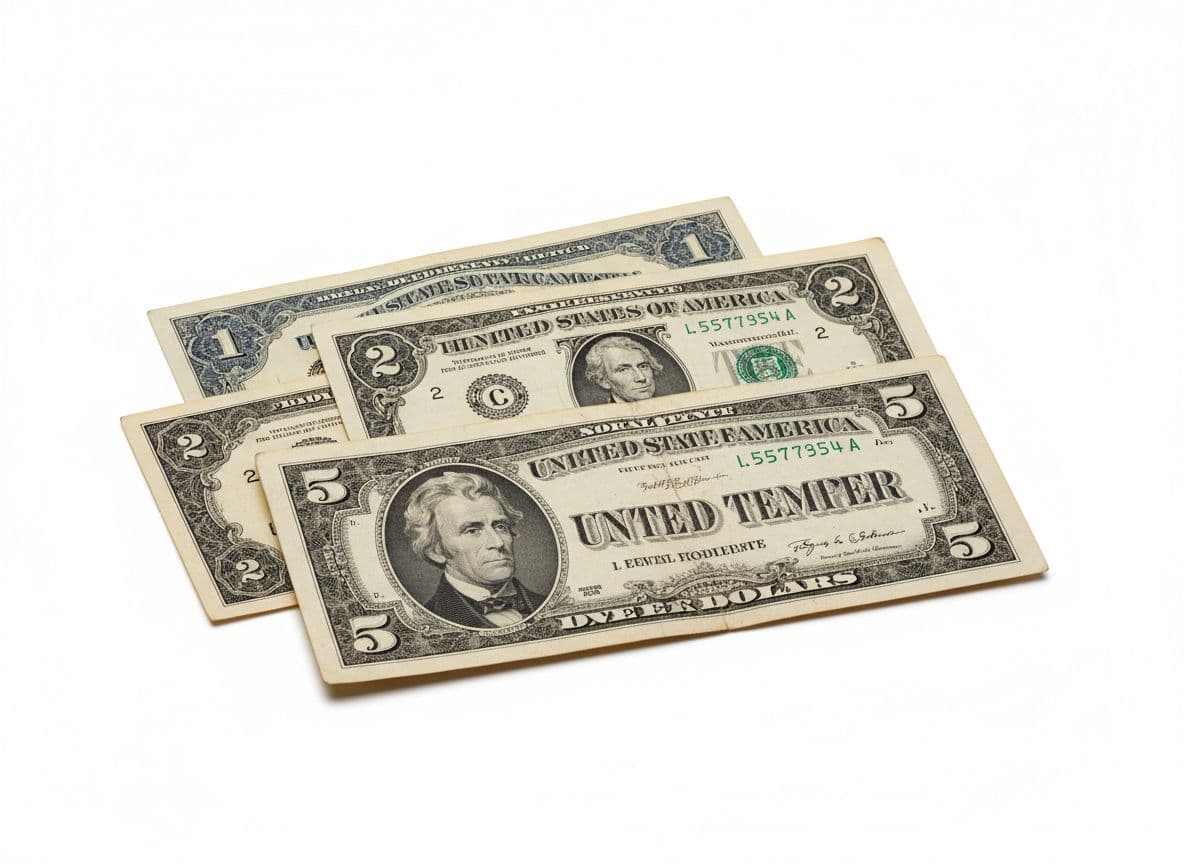
Paper money is one of the most overlooked collectibles hiding in plain sight. Many people unknowingly spend or deposit bills worth far more than face value. A $1 silver certificate from 1896 (the 'Educational' series) can sell for $500-$5,000 depending on condition. Star notes, ladder serial numbers (like 12345678), and solid serial numbers (like 88888888) can turn a $1 bill into a $50-$500+ collectible. Confederate currency ranges from $5 for common notes to $20,000+ for rare denominations. Even relatively modern bills with printing errors. Such as misaligned seals, inverted overprints, or missing ink. Regularly sell for $100-$5,000. Professional appraisals from currency dealers cost $25-$100 per note, and many dealers offer below-market prices to maximize their margins. Our free AI tool gives you an unbiased estimate so you know exactly what your paper money is worth before selling.
Key Factors That Affect Paper Money & Old Bills Value
Understanding what drives the price of paper money & old bills helps you get the most accurate valuation.
Series & Year
The series year printed on the bill determines its era and potential rarity. Pre-1928 large-size notes are generally more valuable than modern small-size bills. Key series include National Bank Notes (1863-1935), Silver Certificates (1878-1964), Gold Certificates (1863-1933), and Legal Tender Notes. A 1928 $500 bill can fetch $800-$2,500, while a 1934 $10,000 bill. The highest denomination ever publicly circulated. Sells for $60,000-$140,000.
Serial Number
Fancy serial numbers dramatically increase a bill's value. Solid serials (all same digit), ladders (12345678), radars (palindromes like 82344328), binary numbers (only two digits), super repeaters, and low serial numbers (00000001-00000100) are all highly sought after. A modern $1 bill with a solid serial number can sell for $300-$3,000.
Condition & Grade
Paper money is graded on a scale from Poor (P-1) to Superb Gem Uncirculated (CU-68). Crisp, uncirculated notes with sharp corners and no folds command 5-50x the value of heavily circulated examples. Even a single center fold can cut a note's value by 30-50%. Third-party grading from PMG or PCGS Currency costs $20-$50 per note and is recommended for notes worth $100+.
Star Notes & Errors
Star notes (replacement notes identified by a star symbol in the serial number) were printed to replace defective bills and have lower print runs.combined with a short run, star notes can be worth $5-$500+ over face value. Printing errors such as miscuts, missing seals, double prints, inverted backs, and mismatched serial numbers are rare and highly collectible, selling for $100-$10,000+.
Type & Denomination
The type of note significantly affects value. Silver Certificates, Gold Certificates, National Bank Notes, and Fractional Currency all carry premiums over standard Federal Reserve Notes. Higher denominations ($500, $1,000, $5,000, $10,000) are inherently scarce since they were recalled from circulation in 1969 and command substantial premiums.
Tips for Valuing Paper Money & Old Bills
Get the most accurate valuation by following these tips when photographing your paper money & old bills.
Photograph both the front and back of each bill under even lighting
Make sure the serial number, series year, and seal color are clearly visible
Handle old bills with clean, dry hands and never fold, tape, or write on them
Do not iron, wash, or attempt to flatten wrinkled bills. This destroys collector value
Paper Money & Old Bills Market Insights
The paper money collecting market (notaphily) has grown steadily with the expansion of online marketplaces and grading services. Heritage Auctions, Stack's Bowers, and eBay are the primary venues for buying and selling collectible currency. Large-size notes and high-denomination bills have appreciated significantly, with $500 and $1,000 bills consistently outperforming inflation. The fancy serial number market has exploded thanks to social media awareness. Collectors actively search their change for ladder notes, binary notes, and low serial numbers. Confederate and obsolete currency has a dedicated collector base, with pristine examples commanding strong premiums. If you have old bills from an estate or collection, now is an excellent time to assess their value.
Notable Paper Money & Old Bills Values
Real-world examples of what specific paper money & old bills have sold for, so you can benchmark your own.
| Paper Money & Old Bill | Condition | Typical Value |
|---|---|---|
| 1928 $1 Silver Certificate (Red Seal) | Fine to Very Fine | $15 - $80 |
| 1934 $10 Silver Certificate (Blue Seal) | Very Fine | $25 - $120 |
| 1899 $1 Black Eagle Silver Certificate | Fine | $100 - $400 |
| 1934-A $500 Federal Reserve Note | Very Fine to Extremely Fine | $800 - $2,500 |
| 1928 $1,000 Federal Reserve Note | Fine | $2,000 - $5,000+ |
| Confederate $500 1864 Note (T-64) | Fine to Very Fine | $80 - $350 |
| 1976 $2 Federal Reserve Note (First Day Issue, stamped) | Uncirculated | $5 - $30 |
| Low Serial Number Note (00000001-00000100, any modern denomination) | Uncirculated | $150 - $1,500+ |
| 1918 $2 Federal Reserve Bank Note (Battleship) | Very Fine | $200 - $700 |
Based on eBay sold listings, Heritage Auctions records, and Standard Catalog of United States Paper Money price guide references.
Find Out What Your Paper Money & Old Bills Are Worth
Upload a photo now and get a free AI-powered valuation in seconds. No sign-up required.
Paper Money & Old Bills Valuation FAQ
Are old $1 and $2 bills worth more than face value?
Many old $1 and $2 bills are worth more than face value. $1 Silver Certificates (with a blue seal) from 1957 or earlier are worth $2-$15 in circulated condition and $20-$50+ in uncirculated condition. The 1896 'Educational' $1 Silver Certificate can bring $300-$5,000. $2 bills are often hoarded because people mistakenly believe they are rare. Most post-1976 $2 bills are worth face value unless they have fancy serial numbers. However, older $2 United States Notes (red seal) from 1928 or earlier can be worth $10-$500+ depending on series and condition.
How do I identify a valuable serial number?
Look for these patterns in the serial number: solid numbers (all same digit, e.g., 88888888), ladders (sequential like 12345678 or 87654321), radars (palindromes like 06288260), repeaters (e.g., 27832783), super repeaters (e.g., 27272727), binary numbers (only two digits used), low numbers (00000001-00000100), and birthday notes matching significant dates. You can also check if your bill is a star note. Indicated by a small star symbol before or after the serial number. Which means it was a replacement note with a typically lower print run.
What is a Silver Certificate and is it worth more than a regular bill?
Silver Certificates were a type of paper currency issued by the U.S. government between 1878 and 1964. They feature a blue Treasury seal instead of the standard green seal on Federal Reserve Notes. Originally redeemable for their face value in silver, this redemption ended in 1968. In circulated condition, common dates (1935, 1957 series) sell for $2-$8 over face value. Older large-size Silver Certificates (pre-1928) are worth $30-$5,000+ depending on denomination, series, and condition. They are absolutely worth checking. You may find them mixed in with regular bills in estates and old collections.
Where is the best place to sell valuable paper money?
For notes worth under $100, eBay is efficient and has a large buyer base. Just be sure to photograph both sides and list the series, serial number, and condition clearly. For notes worth $100-$1,000, Heritage Auctions' weekly internet sales and specialized currency dealers offer competitive prices. For notes worth $1,000+, consigning to a major auction house (Heritage, Stack's Bowers, Lyn Knight) typically achieves the strongest prices, though expect seller fees of 5-15%. Local coin and currency shops are convenient but typically pay 50-70% of retail value. Always get multiple offers and know your bill's approximate value before selling.
Are Confederate bills worth anything?
Yes, Confederate currency has a dedicated collector market.common notes from 1864 in average condition sell for $5-$30, while rarer early-issue notes from 1861 can bring $100-$20,000+. The most valuable Confederate notes include the $1,000 denomination, early Montgomery, Alabama issues, and notes in exceptional condition. Beware of reproductions. Genuine Confederate notes have a distinctive feel and show signs of age. The paper often has a slightly waxy texture, and many authentic notes have manuscript endorsements on the back. Third-party authentication from PMG is recommended for notes valued over $100.
Paper Money & Old Bills Guides & Articles
Value anything, anytime
Unlimited valuations, saved history and full reports in the free app.