February 22, 2026 · Updated March 2026
Rare Dollar Bills Worth Money: Serial Numbers, Stars & Misprints
Paper Money Can Be Valuable Too
While coin collecting gets most of the attention, paper money has its own thriving market of collectors willing to pay substantial premiums for the right bills. Rare serial numbers, printing errors, old series, and special designations can make ordinary-looking bills worth far more than face value.
The best part: unlike rare coins that require decades of age, some of the most valuable modern bills were printed within the last few years. A bill with the right serial number could pass through your hands at any time.
Star Notes: What They Are and What They're Worth
A "star note" is a replacement bill printed to substitute for a defective bill in a production run. Star notes are identified by a small star symbol (★) at the end (or beginning, on some older series) of the serial number.
Star notes are produced in much smaller quantities than standard bills, making them collectible. However, most star notes are only worth a small premium ($1.50 to $5 for common runs). The value increases significantly for:
- Short-run star notes: Some star note print runs are as small as 320,000 or 640,000 bills (compared to millions for standard runs). These can be worth $5 to $50+ depending on series and condition.
- Very short runs: Runs under 320,000 are highly sought after and can be worth $25 to $200+.
- Uncirculated condition: A crisp, uncirculated star note is worth much more than a worn one.
You can check if your star note is from a short run at online star note lookup tools by entering the serial number.
Fancy Serial Numbers
Collectors of "fancy serial numbers" look for specific patterns in the 8-digit serial number on bills. The rarer the pattern, the higher the premium. Here are the main categories:
Solid Numbers (Most Valuable)
All eight digits are the same: 11111111, 22222222, etc. These are extraordinarily rare. Only about 9 possible per series letter and district. A solid serial number bill can sell for $2,000 to $15,000 depending on the denomination and condition.
Ladder Numbers
Sequential digits: 12345678 or 87654321. True eight-digit ladders are among the rarest fancy serials. A perfect ascending ladder can sell for $3,000 to $7,000.
Radar Numbers
A palindrome that reads the same forwards and backwards: 12344321, 79800897, etc.common radars sell for $10 to $50. Radars with repeating patterns (like 01100110) bring higher premiums.
Repeater Numbers
The first four digits repeat in the last four: 35213521, 72987298. Worth $10 to $75.
Super Repeaters
Two digits alternating through all eight positions: 18181818, 27272727. Worth $50 to $300.
Binary Numbers
Only two different digits appear in the serial number: 10011010, 27727272. Worth $10 to $100 depending on how clean the pattern is.
Low Serial Numbers
Bills with very low serial numbers (00000001 through 00000100) are highly collectible. Serial number 00000001 can be worth $1,000 to $5,000+. Numbers under 00000100 typically sell for $50 to $500.
Birthday and Date Notes
Serial numbers that match dates (like 07041776 for July 4, 1776, or 12251995 for Christmas 1995) sell for $5 to $50 to collectors who want that specific date.
Silver Certificates
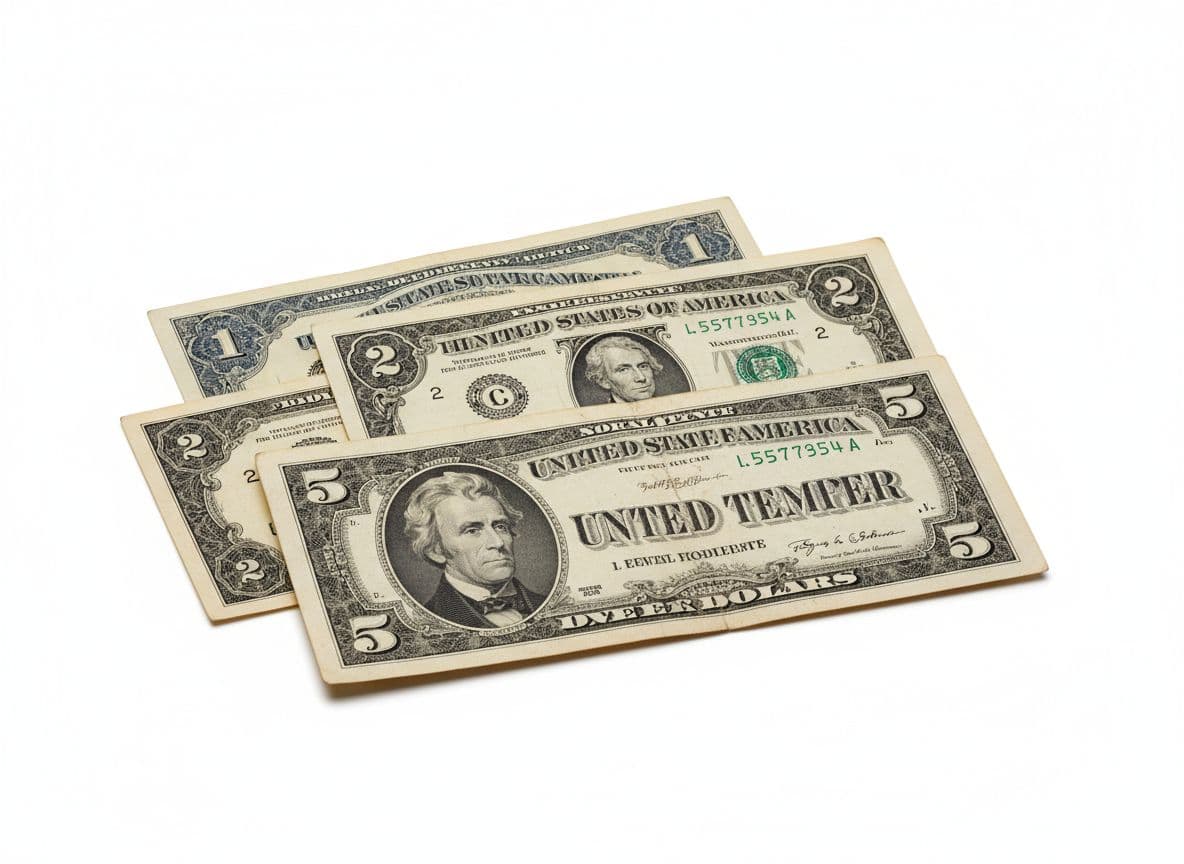
Silver certificates were U.S. paper bills that could be redeemed for physical silver. They were issued from 1878 to 1964 in denominations from $1 to $1,000. While they can no longer be redeemed for silver, they are collectible and trade at premiums above face value:
| Series | Denomination | Circulated Value | Uncirculated Value |
|---|---|---|---|
| 1957 / 1957-A / 1957-B | $1 | $1.50–$3 | $5–$12 |
| 1935 (various letters) | $1 | $2–$5 | $8–$25 |
| 1934 | $5 | $6–$10 | $30–$75 |
| 1934 | $10 | $12–$20 | $50–$150 |
| 1899 "Black Eagle" | $1 | $100–$250 | $500–$1,500 |
| 1896 "Educational" | $1 | $200–$500 | $1,000–$3,000 |
The most visually stunning silver certificates are the 1896 "Educational" series, featuring elaborate allegorical designs. These are highly prized by collectors regardless of denomination.
Two Dollar Bills
Two dollar bills are a frequent source of confusion. Many people believe all $2 bills are rare and valuable. The reality:
- Modern $2 bills (Series 1976 and later): These are still printed and are worth exactly $2 in circulated condition. Uncirculated examples sell for $3 to $5.
- Red seal $2 bills (1928 and 1953 series): Worth $5 to $20 in circulated condition, $15 to $50 uncirculated.
- Large-size $2 bills (pre-1929): Worth $50 to $500+ depending on series and condition.
The main exception is $2 star notes, which follow the same scarcity rules as other star notes. Short-run $2 star notes can be worth $25 to $100.
Error Bills
Printing errors on paper currency create some of the most dramatic and valuable varieties:
Misaligned or Shifted Printing
When the front or back printing is significantly off-center, the bill can be worth $25 to $200 depending on how dramatic the shift is.
Ink Smears and Ink Marks
Large ink smears or extra ink marks from the printing process can add $10 to $100 to a bill's value.
Missing Print (Blank Backs or Fronts)
A bill that went through the press without receiving one side of the printing is a dramatic error worth $100 to $500+.
Overprints on Wrong Denomination
Occasionally, the serial number, seal, and denomination overprint end up on the wrong base denomination (e.g., a $10 overprint on a $5 base). These can sell for $1,000 to $5,000.
Cutting Errors
Bills cut incorrectly from the sheet, showing parts of adjacent notes, are worth $25 to $200.
Dual Denomination or "Butterfly" Foldover Errors
When a sheet folds during printing, part of the front design ends up on the back or vice versa. These dramatic errors can sell for $500 to $2,000.
Large-Size Notes (Pre-1929)
Before 1929, U.S. paper money was about 40% larger than modern bills. These "horse blanket" notes are inherently collectible:
- Common large-size notes: $20 to $100 in average condition
- National Bank Notes: $50 to $500+ (from specific banks in small towns, these have local collector appeal)
- Gold Certificates: $100 to $1,000+ depending on denomination and condition
- Treasury Notes (Coin Notes): $200 to $2,000+ for scarce varieties
Quick Reference: What to Look For
| Feature | What Makes It Valuable | Typical Premium |
|---|---|---|
| Star note (★) | Short print run | $5–$200 |
| Solid serial number | All 8 digits the same | $2,000–$15,000 |
| Ladder serial | 12345678 or 87654321 | $3,000–$7,000 |
| Radar serial | Palindrome (reads same both ways) | $10–$50 |
| Low serial | Under 00000100 | $50–$5,000 |
| Silver certificate | Blue seal, various series | $1.50–$3,000 |
| Printing error | Misalignment, missing ink, foldover | $10–$2,000 |
| Large-size note | Pre-1929, larger format | $20–$2,000+ |
Think you might have valuable paper money? Upload a photo to our free AI valuation tool and get an instant estimate.