Last updated: September 2026
How Much Is a Liberty V Nickel Worth?
Liberty Head nickels, also known as V nickels (1883-1913), feature Lady Liberty on the obverse and a large Roman numeral V on the reverse. Most circulated examples are worth $2-$20, but key dates like the 1885 and 1886 bring $100-$1,000+, and the legendary 1913 Liberty nickel. With only 5 known examples. Is worth $3-$5 million. Our AI identifies your coin's date, condition, and variety for an accurate valuation.
Get the free app for unlimited scans


Compare real prices
See what liberty v nickels are listed for right now
Affiliate link: we earn a commission if you buy, at no extra cost to you.
What do you want to value?
Get the free app for unlimited scans
Why Knowing Your Liberty V Nickels Value Matters
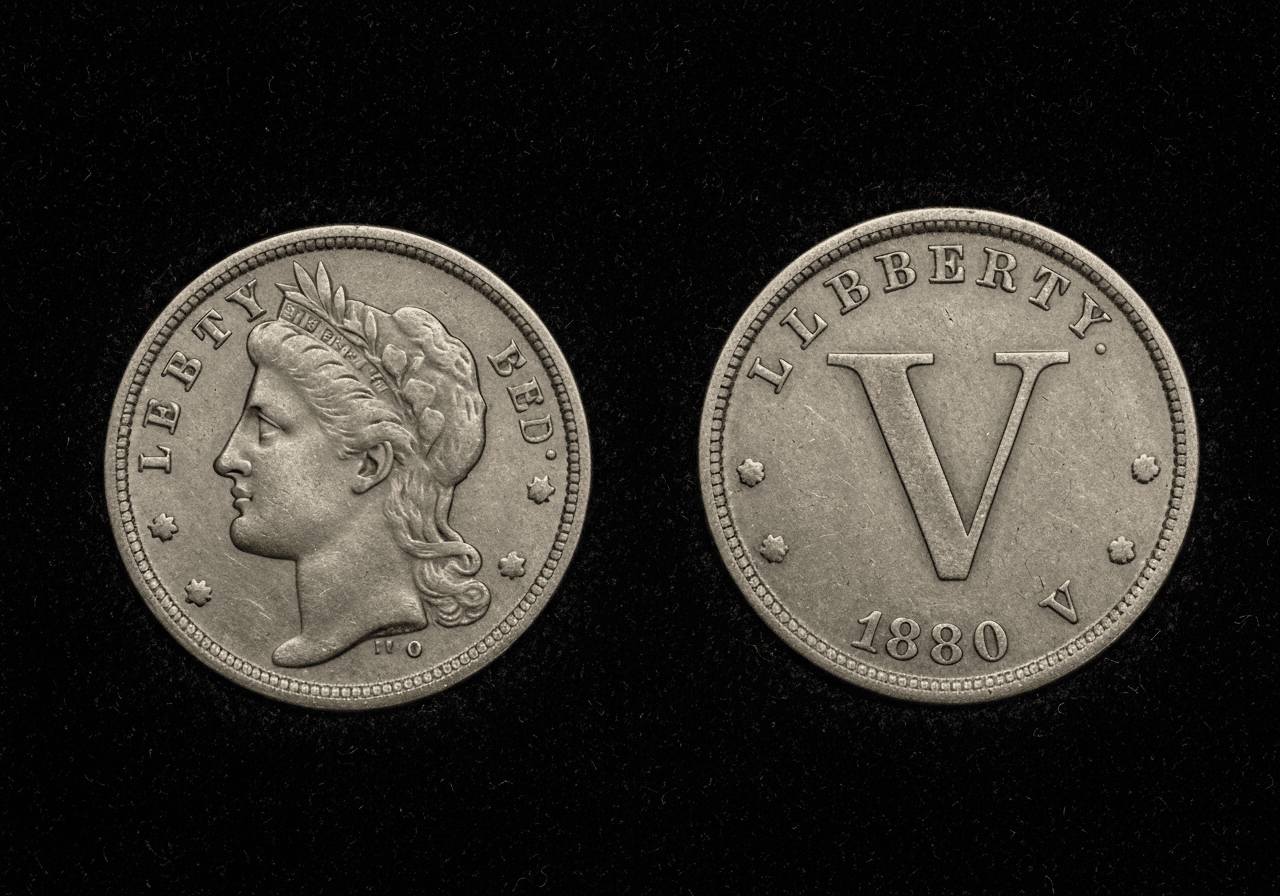
Liberty V nickels are popular with collectors because the series is short (31 years), affordable to start, and contains genuine rarities. The first year (1883) comes in two varieties: 'No CENTS' and 'With CENTS.' When the coin debuted without the word CENTS, enterprising people gold-plated them and passed them as $5 gold pieces, forcing the Mint to add CENTS mid-year. The 1913 Liberty nickel is one of the most famous US coins. Only 5 were secretly struck by a Mint employee, and they're each worth $3-$5 million. Even common dates in Good condition are worth $2-$5, making them a fun series to collect.
Key Factors That Affect Liberty V Nickels Value
Understanding what drives the price of liberty v nickels helps you get the most accurate valuation.
Key Dates
1885 (mintage 1.47M): $300-$2,000+ in Fine. 1886 (mintage 3.33M): $150-$800 in Fine. 1912-S ($50-$300). 1883 No CENTS ($5-$50). 1913 (5 known): $3-$5 million. Most other dates: $2-$20 in circulated grades.
1883 No CENTS vs With CENTS
The 1883 No CENTS variety is actually common (5.47M struck) but historically interesting. Worth $5-$50. Gold-plated versions ('racketeer nickels') are worth $50-$200 as conversation pieces. The 1883 With CENTS is the scarcer variety at $15-$40 in Good.
Condition & Grade
Good (G-4): $2-$5 for common dates. Fine (F-12): $5-$20. Extremely Fine (EF-40): $20-$60. Uncirculated (MS-63): $75-$200. Gem (MS-65): $200-$800+ for common dates. The series is challenging in high grade because the design wore quickly.
Die Varieties
Repunched dates, doubled dies, and overdate varieties exist throughout the series. The most notable is the 1888/7 overdate, visible under magnification, worth $50-$300 depending on grade.
Strike Quality & Eye Appeal
Well-struck Liberty nickels with full head detail and sharp stars command premiums. Many were weakly struck, making fully-detailed examples scarce. Attractive toning on uncirculated examples adds 20-50% over typical pricing.
Tips for Valuing Liberty V Nickels
Get the most accurate valuation by following these tips when photographing your liberty v nickels.
Check the date carefully. Worn V nickels often have faint dates that determine value
Look for the 1883 No CENTS variety. Check if 'CENTS' appears at the bottom of the reverse
Photograph both sides in good lighting to reveal the date and condition details
Don't clean V nickels. The natural patina is expected and valued by collectors
Liberty V Nickels Market Insights
Liberty V nickels have a dedicated collector base that values the series for its history, accessibility, and the legendary 1913 rarity. The series benefits from strong type collector demand. Anyone building a US type set needs one. Key dates like the 1885 and 1886 have shown steady appreciation. The 1913 Liberty nickel remains one of the most famous coins in the world, regularly making headlines when one changes hands.
Find Out What Your Liberty V Nickels Are Worth
Upload a photo now and get a free AI-powered valuation in seconds. No sign-up required.
Liberty V Nickels Valuation FAQ
What is the most valuable Liberty nickel?
The 1913 Liberty nickel is worth $3-$5 million. Only 5 exist. For coins you're likely to encounter, the 1885 ($300-$2,000+) and 1886 ($150-$800) are the most valuable.common dates are worth $2-$20 depending on condition.
Why do some 1883 nickels not have CENTS on them?
When the Liberty nickel debuted in 1883, the reverse showed only the Roman numeral V with no denomination. Because it was the same size as a $5 gold piece, con artists gold-plated them and spent them as $5. The Mint quickly added CENTS to the reverse mid-year, creating two distinct 1883 varieties.
How can I read the date on a worn V nickel?
The date is on the obverse below Liberty's portrait. On worn coins, try angling a bright light across the surface to reveal faint digits. A magnifying glass helps. If the date is completely gone, the coin is worth $0.50-$1 as a 'dateless' V nickel.
Are V nickels silver?
No. Liberty V nickels are made of 75% copper and 25% nickel, the same composition used for nickels today. They have no precious metal content, so their value is purely numismatic.
Where can I find Liberty V nickels?
V nickels occasionally turn up in old coin collections, estate sales, and antique shops. They're too old to find in circulation but are readily available from coin dealers and on eBay for $2-$20 for common dates. Coin shows are great places to find nice examples at fair prices.
Liberty V Nickels Guides & Articles
Value anything, anytime
Unlimited valuations, saved history and full reports in the free app.