Last updated: September 2026
How Much Is an Eisenhower Dollar Worth?
Eisenhower dollars (1971-1978) were the last large-format US dollar coins. While most circulated Ike dollars are worth face value to a few dollars, certain varieties. Especially 40% silver issues, proof versions, and error coins. Can be worth significantly more. Our AI identifies your Eisenhower dollar's year, mint mark, variety, and condition to give you an accurate value.
Get the free app for unlimited scans


Compare real prices
See what eisenhower dollars are listed for right now
Affiliate link: we earn a commission if you buy, at no extra cost to you.
What do you want to value?
Get the free app for unlimited scans
Why Knowing Your Eisenhower Dollars Value Matters
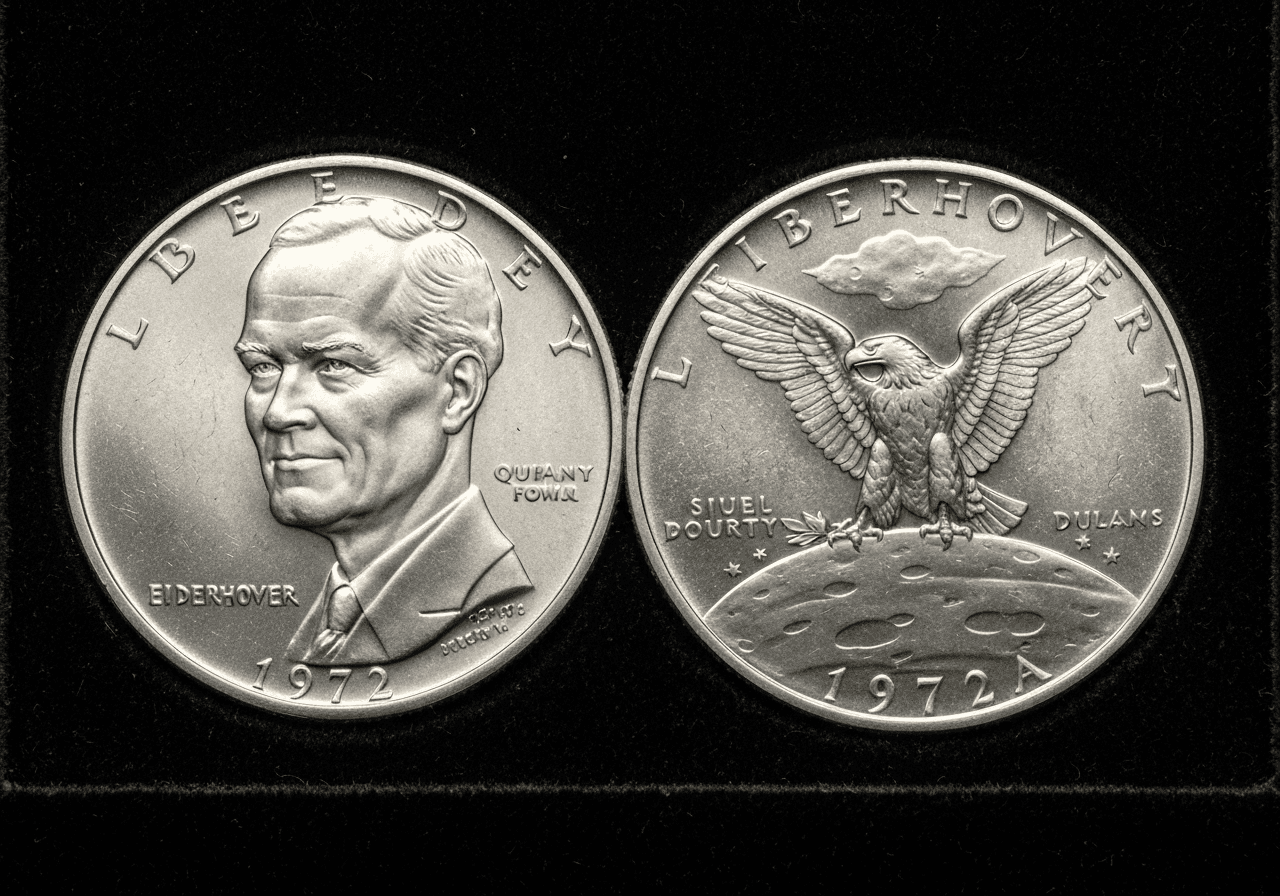
Many people have Eisenhower dollars stashed away thinking they're silver dollars, and while most business-strike Ike dollars are worth only $1-$3, the series has several coins worth genuine money. The 1971-S and 1972-S silver-clad versions contain 40% silver and are worth $8-$15 for their metal content alone. The 1972 Type 2 Philadelphia variety is worth $50-$500+ because of a distinctive reverse design used briefly. Proof sets and uncirculated silver versions in original government packaging command $15-$40. Understanding which Ike dollars have premium value prevents you from spending a $50 coin at face value.
Key Factors That Affect Eisenhower Dollars Value
Understanding what drives the price of eisenhower dollars helps you get the most accurate valuation.
Silver vs Clad Composition
Business-strike Ike dollars from Philadelphia (no mint mark) and Denver (D) are copper-nickel clad and worth $1-$3. San Francisco (S) issues from 1971-1974 were struck in 40% silver and are worth $8-$15 for silver content. Check the edge. Silver Ikes show a uniform gray edge, while clad coins show the copper core layer.
Key Varieties
The 1972 Type 2 (Philadelphia) is the most valuable business-strike Ike dollar, worth $50-$500+. It's identified by the Earth design on the reverse. On Type 2, Florida and the Caribbean islands are clearly visible and sharply detailed. Other valuable varieties include the 1971-S silver proof and 1974-D doubled die obverse.
Proof & Special Issues
Proof Eisenhower dollars (S mint mark, mirror finish) in original brown or blue government packaging are worth $10-$40. Silver proof versions are worth more than clad proofs.complete proof sets and uncirculated mint sets containing Ike dollars also carry premiums.
Condition & Grade
Most Ike dollars circulated heavily and show significant bag marks due to their large size. Gem uncirculated examples (MS-65 and above) are surprisingly scarce and valuable: a common-date MS-65 can bring $20-$50, while key dates in MS-65+ command $100-$500+.
Bicentennial Reverse (1776-1976)
Ike dollars dated 1776-1976 feature a special Liberty Bell and Moon reverse for the US Bicentennial. While common in circulated grades ($1-$2), the 40% silver versions struck at San Francisco (Type 1 and Type 2 lettering varieties) are worth $10-$20, and proof silver versions bring $15-$30.
Tips for Valuing Eisenhower Dollars
Get the most accurate valuation by following these tips when photographing your eisenhower dollars.
Check the edge of the coin. A solid gray edge means silver, a visible copper stripe means clad
For 1972 Philadelphia coins, examine the reverse Earth closely for the Type 2 variety
Photograph both sides with the date and mint mark clearly visible
Look for S mint marks. These San Francisco issues are most likely to have premium value
Eisenhower Dollars Market Insights
Eisenhower dollars are an underappreciated series that offers collectors affordable entry with upside potential. The series has gained renewed interest as collectors discover the many varieties and errors that exist. The 1972 Type 2 remains the star of the series, with prices climbing steadily as more collectors learn to identify it. Silver Ike dollars benefit from both numismatic and precious metal demand. As one of the last 'big' US coins, Eisenhower dollars have nostalgic appeal that supports long-term collecting interest.
Find Out What Your Eisenhower Dollars Are Worth
Upload a photo now and get a free AI-powered valuation in seconds. No sign-up required.
Eisenhower Dollars Valuation FAQ
Are Eisenhower dollars silver?
Most are not. Business strikes from Philadelphia and Denver are copper-nickel clad (no silver). Only coins struck at San Francisco (S mint mark) from 1971-1974 contain 40% silver. Check the edge: silver Ike dollars show a uniform gray edge, while clad versions show a visible copper core stripe.
What is the most valuable Eisenhower dollar?
The 1972 Type 2 (Philadelphia, no mint mark) is the most valuable business-strike Ike dollar, worth $50-$500+ depending on grade. It's identified by the sharply detailed Earth on the reverse where Florida and the Caribbean are clearly visible. In MS-65, it can bring $500+.
How do I identify a 1972 Type 2 Eisenhower dollar?
Look at the Earth on the reverse (back). Type 2 shows clear, well-defined continents with Florida and Caribbean islands visible. Type 1 (common) shows a less detailed, flatter Earth. Type 3 (also common) shows moderate detail. Type 2 was used briefly, making it scarce.
Are bicentennial Eisenhower dollars valuable?
Most 1776-1976 Ike dollars are worth $1-$3 in circulated condition. However, 40% silver versions (S mint mark) are worth $10-$20, and proof silver versions bring $15-$30. Uncirculated examples in original mint packaging carry modest premiums of $5-$10.
Should I save my Eisenhower dollars?
Yes, at minimum for their novelty and numismatic interest. Check for silver content (S mint mark, gray edge), the 1972 Type 2 variety, and any coins in uncirculated condition. Even common Ike dollars are worth holding onto as the last US large-format dollar coins. They make great conversation pieces and may appreciate modestly over time.
Value anything, anytime
Unlimited valuations, saved history and full reports in the free app.