March 23, 2026 · Updated March 2026
Most Valuable State Quarters: Errors Worth $100 to $10,000+
Why State Quarters Are Still Worth Checking
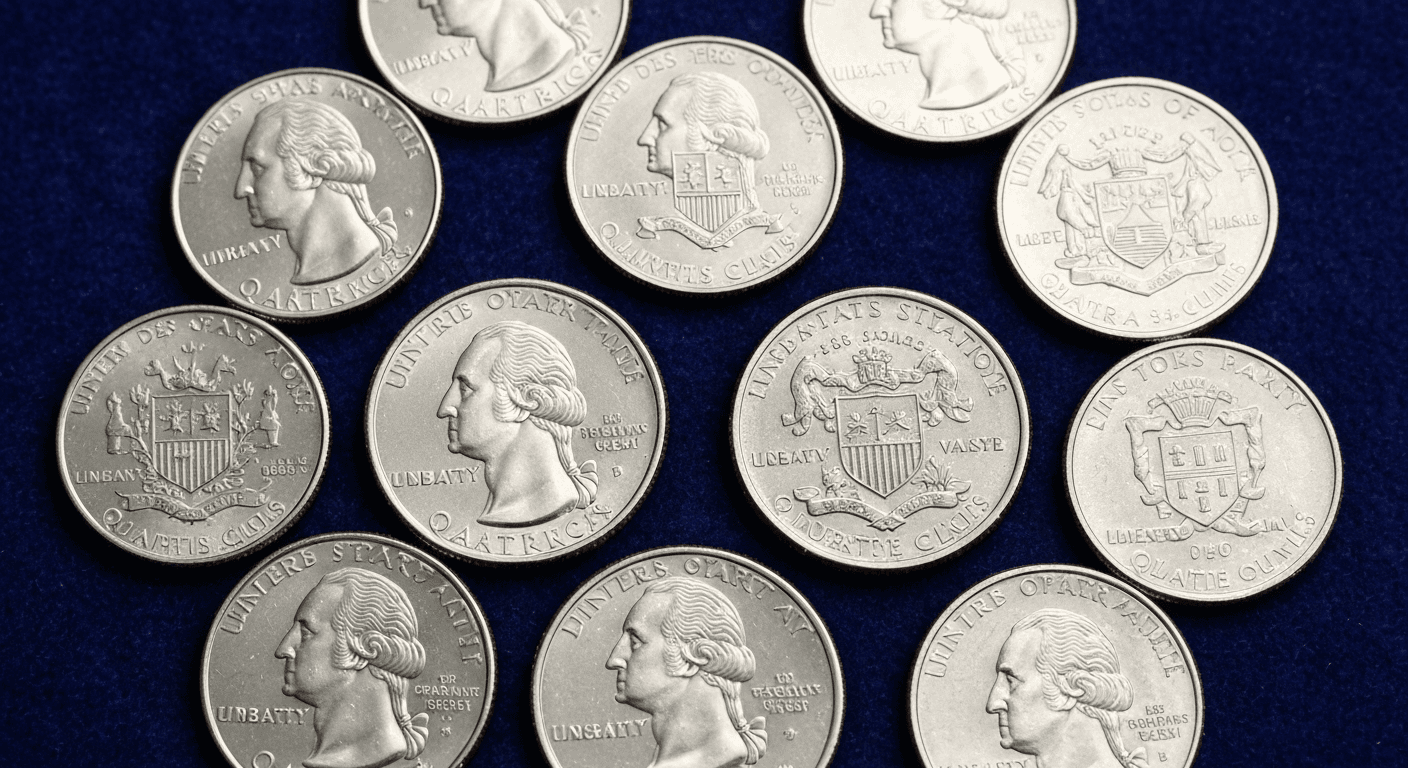
Between 1999 and 2008, the US Mint produced 50 different state quarter designs. One for each state in the order they ratified the Constitution or joined the Union. Over 34 billion state quarters were minted, making them the most widely collected coins in history. While most are worth exactly 25 cents, certain errors and varieties have made some state quarters worth $100 to $10,000 or more.
The sheer volume produced meant more opportunities for minting errors. Die cracks, off-center strikes, wrong planchets, and doubled dies all occurred. Because millions of Americans actively collected these coins at the time, many errors were spotted early, but plenty remain in circulation waiting to be found.
The Most Valuable State Quarter Errors
1. 2004-D Wisconsin Extra Leaf Quarter. $100 to $1,500
The most famous state quarter error. Some 2004-D Wisconsin quarters show an extra leaf on the ear of corn on the reverse. Two varieties exist: the “Extra Leaf High” and “Extra Leaf Low.” The High Leaf variety is slightly scarcer. In MS-63, the Extra Leaf High sells for $200 to $300. In MS-66 or higher, prices reach $1,000 to $1,500. Circulated examples sell for $100 to $200.
2. 1999 Delaware Spitting Horse Quarter. $50 to $500
A die crack on the 1999 Delaware quarter creates what appears to be a line of drool coming from the horse’s mouth. In MS-64 to MS-65, these sell for $200 to $500. Circulated examples with clear “spit” bring $50 to $100.
3. 2000 New Hampshire Quarter on Nickel Planchet. $1,000 to $3,000
Wrong planchet errors occur when a quarter die strikes a planchet intended for a different denomination. State quarters struck on nickel planchets (smaller and lighter than quarter planchets) are rare and valuable. They weigh 5.0 grams instead of the normal 5.67 grams. Prices range from $1,000 to $3,000 depending on the state and condition.
4. State Quarters Struck on Silver Planchets. $2,000 to $10,000
Some state quarters were accidentally struck on 90% silver planchets intended for proof sets. These are heavier than normal (6.25 grams vs. 5.67 grams) and have a distinctly different ring when dropped on a hard surface. The silver content is also visible on the edge. A solid silver color rather than the copper-nickel sandwich. Authentic examples sell for $2,000 to $10,000 depending on the state and grade.
5. 2005 Minnesota Doubled Die Quarter. $50 to $500
Several doubled die varieties exist for the 2005 Minnesota quarter. The most prominent shows doubling on the trees and extra “branches” that appear as extra tree trunks. In MS-63: $100 to $200. In MS-66: $300 to $500.
6. 2005 Kansas “In God We Rust” Quarter. $50 to $200
Grease-filled die errors on 2005 Kansas quarters caused the T in TRUST to be partially or fully missing, creating the humorous “IN GOD WE RUST” motto. While not as valuable as other errors, their novelty makes them popular. In MS-63: $50 to $100. Strong examples with a completely missing T bring $100 to $200.
7. Off-Center State Quarters. $20 to $500
Quarters struck off-center (where the design is not properly centered on the planchet) are collectible errors. The value depends on how far off-center the strike is and whether the date remains visible. A 10% off-center quarter is worth $20 to $50. A 50% off-center quarter with a visible date can bring $200 to $500.
8. 2000-P South Carolina Quarter. Die Crack Variety. $25 to $100
Multiple die crack varieties exist on the 2000-P South Carolina quarter, with the most prominent running through the palmetto tree on the reverse. These are worth $25 to $100 depending on the severity and location of the crack.
9. Broadstrike State Quarters. $25 to $200
A broadstrike occurs when the coin is struck without the collar die that normally forms the reeded edge. The result is a coin that is slightly larger than normal with a smooth edge. Broadstrike state quarters sell for $25 to $200 depending on the severity.
10. 2008 Arizona Cactus Errors. $50 to $300
Several die varieties exist on the 2008 Arizona quarter, including extra “arms” on the saguaro cactus caused by die cracks or die chips. Well-defined examples sell for $50 to $300.
How to Find Valuable State Quarters
- Check every state quarter you get in change. Look at the edges first for silver planchet errors (solid silver edge vs. copper sandwich).
- Weigh suspicious coins. Normal quarters weigh 5.67 grams. Silver planchet errors weigh 6.25 grams. Nickel planchet errors weigh 5.0 grams.
- Use a magnifying glass. Extra leaves, doubled dies, and die cracks require magnification to spot confidently.
- Check the 2004-D Wisconsin quarters carefully. Look at the left side of the corn ear for the extra leaf.
- Buy rolls from banks. Many collectors buy rolls of quarters from banks and search through them. This is called “coin roll hunting” and is a popular hobby with its own community.
- Look for proof coins in circulation. Silver proof state quarters occasionally enter circulation. They have mirror-like surfaces and are noticeably different from regular quarters.
State Quarters Worth Collecting (Even Without Errors)
While error-free state quarters are generally worth face value, complete sets in uncirculated condition have modest collector value. A complete set of 50 uncirculated state quarters (both P and D mints) sells for $30 to $50. Double face value. Proof sets with silver quarters command $100 to $150 for the complete run.
Think your state quarters might have errors? Upload a photo to our free AI coin valuation tool and get an instant assessment. Our AI can detect common error types and give you an estimated value.

Shop & Compare Prices
See current listings and recently sold items on eBay