March 23, 2026 · Updated March 2026
How to Identify Jewelry Hallmarks: Complete Guide to Stamps & Markings
What Are Jewelry Hallmarks?
Hallmarks are tiny stamps pressed into jewelry that identify the metal content, maker, country of origin, and sometimes the year of manufacture. Reading these marks correctly is essential for determining a piece’s value. The difference between a 10K gold stamp and an 18K gold stamp means nearly double the gold content and a significant price difference.
Hallmarking has been practiced for over 700 years. The oldest continuous hallmarking system is the British system, dating to 1300. Different countries use different marking systems, which can be confusing when evaluating international jewelry.
Gold Hallmarks
US Karat System
| Stamp | Gold Content | Meaning |
|---|---|---|
| 24K or 999 | 99.9% | Pure gold (too soft for most jewelry) |
| 22K or 916 | 91.7% | High-purity gold, common in Asian jewelry |
| 18K or 750 | 75.0% | High-end jewelry, European standard |
| 14K or 585 | 58.5% | Most common US jewelry standard |
| 10K or 417 | 41.7% | Minimum standard to be called “gold” in the US |
| 9K or 375 | 37.5% | Common in UK and Australia |
European Fineness System
European countries use a millesimal fineness system (parts per thousand). Instead of “14K,” you will see “585.” Instead of “18K,” you will see “750.” This system is more precise and is the international standard for precious metals.
Gold-Filled and Gold-Plated Marks
| Stamp | Meaning | Value |
|---|---|---|
| GF, 1/20 14K GF | Gold-filled: 5% gold by weight bonded to base metal | Some gold value, much less than solid |
| GP, GEP, HGE | Gold-plated or electroplated: microscopically thin gold layer | Minimal gold value |
| RGP | Rolled gold plate: thicker than GP but less than GF | Very little gold value |
| Vermeil | Sterling silver with gold plating (minimum 2.5 microns) | Worth the silver + slight premium |
Silver Hallmarks
| Stamp | Silver Content | Meaning |
|---|---|---|
| 999 or Fine Silver | 99.9% | Pure silver, used in bullion |
| Sterling, 925, or .925 | 92.5% | Standard sterling silver |
| 900 or Coin Silver | 90.0% | Old American silver standard |
| 835 | 83.5% | European continental silver standard |
| 800 | 80.0% | German and Italian silver standard |
| EPNS | 0% | Electroplated nickel silver (no silver) |
| Silver Plate, SP | 0% | Silver-plated base metal (no significant silver) |
Platinum Hallmarks
- PLAT, Pt, 950: 95% platinum (standard jewelry grade)
- 900: 90% platinum
- 850: 85% platinum
- IRID PLAT: Iridium-platinum alloy
Platinum is denser than gold and significantly more valuable per gram. A platinum ring will feel noticeably heavier than a similar white gold ring.
British Hallmarks
The British hallmarking system is the most comprehensive in the world and includes multiple marks on each piece:
- Sponsor’s/Maker’s mark: Initials of the maker in a distinctive shape
- Standard mark: Indicates metal and fineness (crown for gold, lion passant for sterling silver)
- Assay office mark: Identifies which office tested the metal (leopard’s head for London, anchor for Birmingham, rose for Sheffield, castle for Edinburgh)
- Date letter: A letter in a specific font and shield shape indicating the year of hallmarking. Charts are available online to decode these letters.
British hallmarks are particularly valuable for dating antique jewelry precisely. A complete set of British hallmarks can date a piece to the exact year of manufacture.
French Hallmarks
French hallmarks use animal and symbol stamps:
- Eagle head: 18K gold (750)
- Owl: Foreign gold imported into France
- Horse head: Gold below 18K
- Minerva head: Sterling silver (950 or 800)
Italian Hallmarks
Italian jewelry uses a star followed by a number indicating the province, then the maker’s initials. For example: “*1 AR 750” means 18K gold from the Arezzo province. Italian gold jewelry is highly regarded for craftsmanship and typically marked with fineness numbers (750, 585, 375).
How to Find and Read Hallmarks
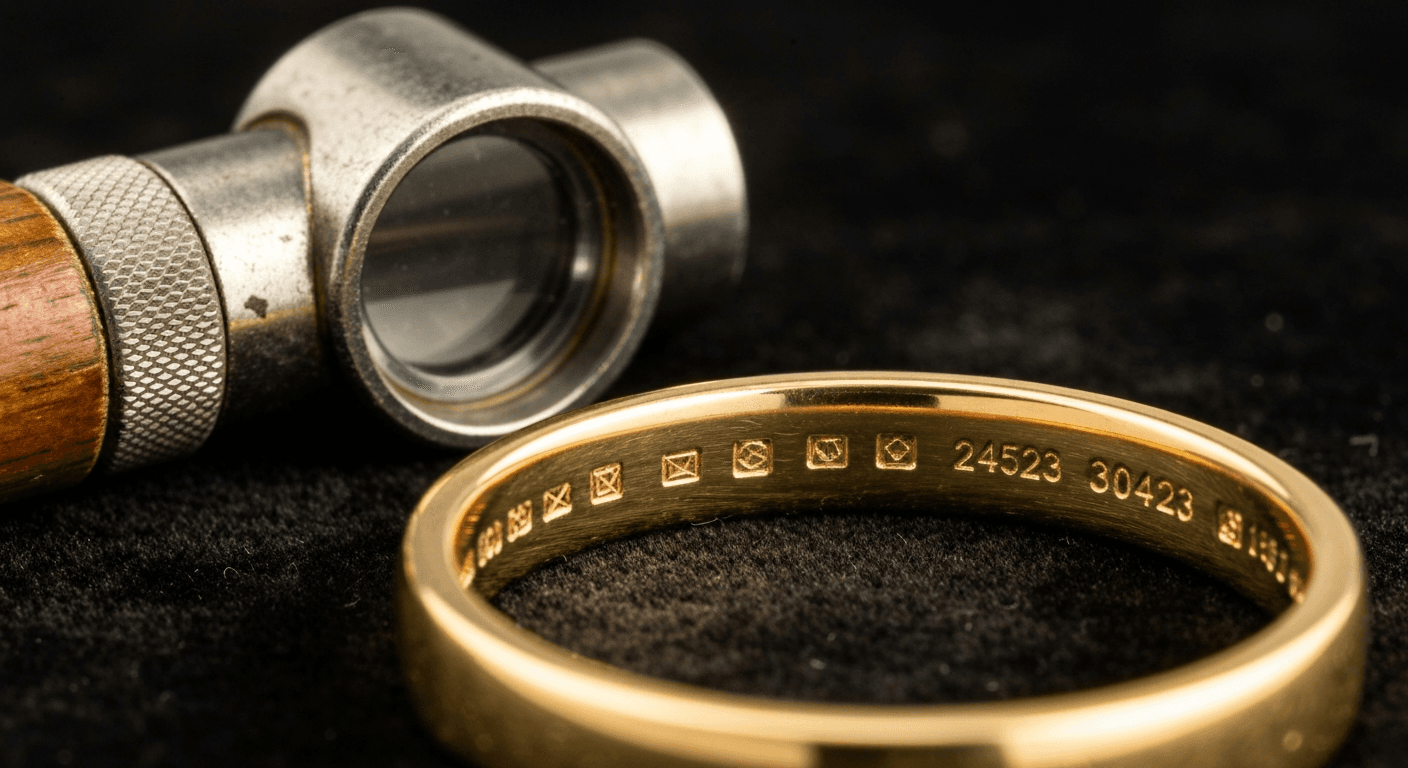
- Use a jeweler’s loupe (10x magnification). Most hallmarks are too small to read with the naked eye. A 10x loupe costs $5–$15 and is the essential tool.
- Know where to look. On rings: inside the band. On necklaces: on the clasp or near the clasp. On bracelets: on the clasp or inside the clasp. On earrings: on the post or back. On brooches: on the back near the pin.
- Clean the area first. Hallmarks can be filled with dirt or polish. Clean gently with a soft brush to reveal the marks.
- Photograph with macro mode. Take a close-up photo with your phone’s macro mode or through a loupe for easier reading.
- Cross-reference multiple marks. A single mark can be misleading. Look for all marks on the piece and check that they are consistent with each other and the style of the jewelry.
Red Flags in Hallmarks
- No hallmarks at all: Could be costume jewelry, very old, or deliberately unmarked. Test with our AI gold valuation tool or take to a jeweler.
- Faded or partial marks: May indicate heavy wear (genuine) or stamped too lightly (sometimes seen on plated pieces trying to appear solid).
- “18K” on a $20 piece: If the price seems too low for the claimed metal content, it is likely fake or plated.
- Greenish skin discoloration: If jewelry turns your skin green, it contains copper and is not genuine gold, despite any markings.
Want to know what your jewelry is worth? Upload a photo to our free AI valuation tool for an instant estimate based on hallmarks, metal content, and design.