March 8, 2026 · Updated March 2026
How to Tell If a Diamond Is Real: 8 Easy Home Tests
Why Diamond Authentication Matters
Diamonds are among the most valuable gemstones in the world, with engagement rings alone averaging $5,500 in the United States. But the market is flooded with simulants and synthetics that can fool the untrained eye. Cubic zirconia (CZ), moissanite, white sapphire, and lab-grown diamonds all look similar to natural diamonds but have very different values.
Understanding the difference matters for insurance, resale, and peace of mind. A 1-carat natural diamond of good quality might be worth $4,000 to $8,000, while a 1-carat CZ is worth less than $20. Even lab-grown diamonds, which are chemically identical to natural diamonds, sell for 60% to 80% less than their mined counterparts.
The tests below will help you determine if a diamond is likely real. No single home test is 100% conclusive, but combining several tests gives you a strong indication. For absolute certainty, professional testing with specialized equipment is recommended.
The 8 Home Tests
Test 1: The Fog Test
Hold the stone close to your mouth and breathe on it, as if you were fogging a mirror. A real diamond disperses heat almost instantly, so the fog should clear within 1 to 2 seconds. A fake stone (CZ, glass, or quartz) will stay fogged for 3 to 5 seconds or longer because it does not conduct heat as efficiently.
To make this test more reliable, compare the stone in question to a piece of glass at the same time. Fog both surfaces and watch how quickly each clears. The difference should be obvious.
What it detects: CZ, glass, quartz. Will NOT detect: Moissanite (also has high thermal conductivity) or lab-grown diamonds.
Test 2: The Read-Through (Newspaper) Test
Place the loose stone (unmounted) flat-side down on a piece of printed text. Try to read the letters through the stone. A real diamond refracts light so strongly that you should not be able to see the text clearly. The letters will be distorted beyond recognition. With CZ or glass, you can often read the letters through the stone.
What it detects: CZ, glass. Will NOT detect: Moissanite (also has very high refraction) or lab-grown diamonds.
Test 3: The UV Light Test
Many natural diamonds exhibit blue fluorescence under ultraviolet light. Turn off the lights and hold the stone under a UV blacklight (available for $5 to $15 online). If you see a blue glow, there is a good chance the stone is a real diamond. About 25% to 35% of natural diamonds show medium to strong blue fluorescence.
Limitations: Not all real diamonds fluoresce, so the absence of fluorescence does not mean it is fake. CZ does not typically fluoresce blue. Lab-grown diamonds may or may not fluoresce depending on the manufacturing process.
Test 4: The Water (Density) Test
Fill a glass with water and gently drop the loose stone in. A real diamond has a density of about 3.52 g/cm3 and will sink quickly to the bottom. CZ has a density of about 5.7 g/cm3 and will also sink (but noticeably faster). Glass has a density of about 2.5 g/cm3 and may sink more slowly. Moissanite has a density of 3.21 g/cm3, very close to diamond.
What it detects: Very lightweight fakes like plastic. Limitations: Most common diamond simulants also sink in water, making this test only useful for eliminating obvious fakes.
Test 5: The Loupe Inspection
Examine the stone under a jeweler's loupe (10x magnification, available for $10 to $20). Look for:
- Inclusions: Natural diamonds almost always have small internal inclusions (tiny crystals, feathers, clouds). CZ is typically flawless under magnification. If the stone looks absolutely perfect, it may be fake or lab-grown.
- Facet edges: Diamond is the hardest natural material. Its facet edges should be sharp and crisp. CZ and glass tend to have slightly rounded or chipped facet edges over time.
- Doubling of facets: Look through the table (top flat facet) at the back facets. If you see double images of the back facets, the stone is likely moissanite, which has much higher birefringence (double refraction) than diamond.
What it detects: CZ (too perfect), moissanite (doubling), glass (rounded edges). Limitations: Lab-grown diamonds can have inclusions similar to natural diamonds.
Test 6: The Heat Test
Diamond is extremely resistant to thermal shock. If you heat the stone with a lighter for 30 seconds and then immediately drop it into cold water, a real diamond will be completely unaffected. Glass or CZ may crack or shatter due to the rapid temperature change.
Warning: This test is destructive to fakes and is irreversible. Only use it if you are willing to risk the stone. Never perform this test on a mounted stone, as it can damage the setting or any glue.
Test 7: The Sparkle Test
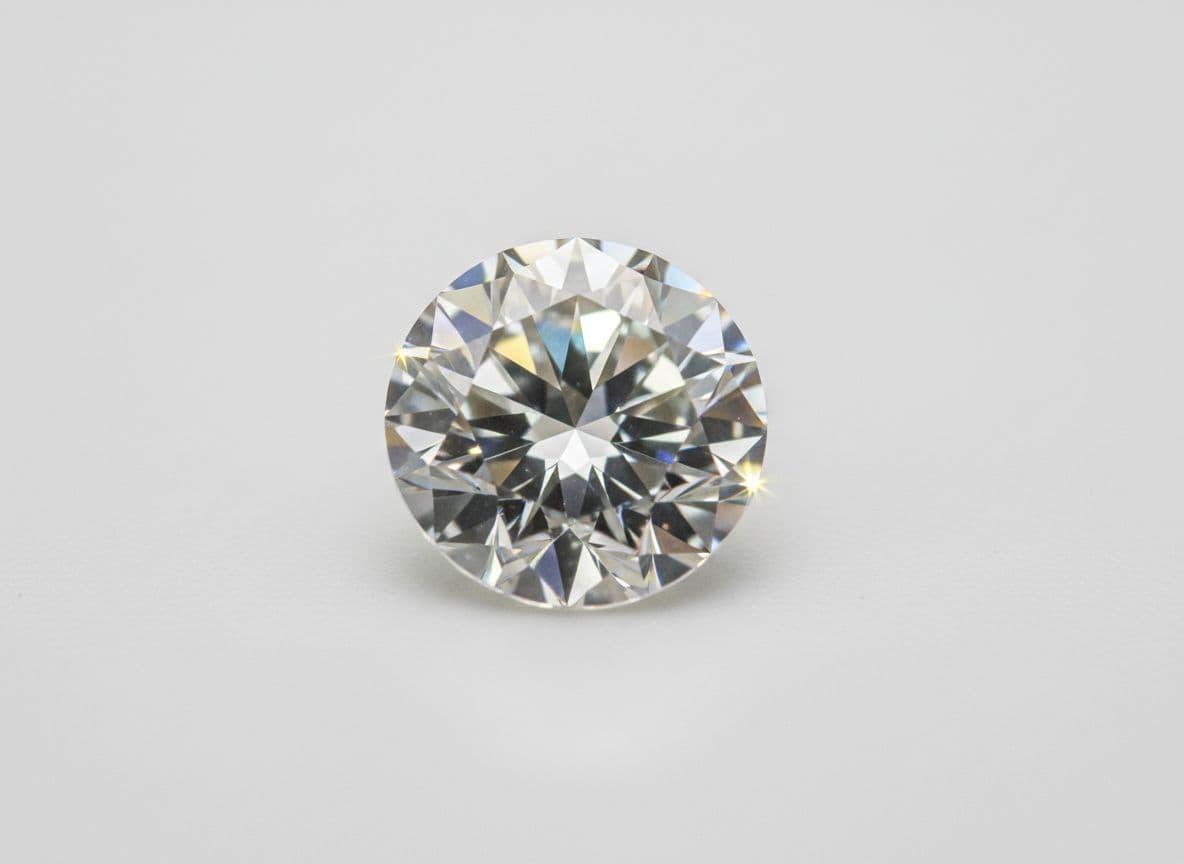
Hold the stone under a normal lamp and observe the light patterns. A real diamond produces exceptional brilliance (white light reflecting from within), fire (rainbow light dispersion), and scintillation (sparkle when the stone moves). Specifically:
- Diamond: Strong brilliance with balanced fire. The reflections inside the stone are primarily white and gray, with flashes of rainbow color.
- CZ: Excessive rainbow fire with less brilliance. CZ has a higher dispersion than diamond, so it throws more rainbow colors, which can actually look "too colorful."
- Moissanite: Even more fire and brilliance than diamond. Moissanite has 2.4 times the fire of diamond, producing a distinctive "disco ball" effect that experienced jewelers can spot immediately.
Test 8: The Weight Test
If you have a loose stone and a precise scale (measuring to 0.01 grams), weigh the stone and compare it to the expected weight for its size. CZ weighs about 75% more than diamond for the same dimensions. A 6.5mm round CZ (equivalent to a 1-carat diamond in size) would weigh approximately 1.75 carats instead of 1.00 carat. If the stone's weight is significantly higher than expected for its size, it is likely CZ.
Diamond vs. Simulant Comparison
| Property | Diamond | CZ | Moissanite | Lab-Grown Diamond |
|---|---|---|---|---|
| Hardness (Mohs) | 10 | 8–8.5 | 9.25 | 10 |
| Density (g/cm3) | 3.52 | 5.7 | 3.21 | 3.52 |
| Refractive Index | 2.42 | 2.16 | 2.65 | 2.42 |
| Dispersion | 0.044 | 0.066 | 0.104 | 0.044 |
| UV Fluorescence | Often blue | Usually none | Varies | Varies |
| Price (1ct equivalent) | $4,000–$8,000 | $10–$20 | $300–$600 | $800–$2,000 |
When to See a Professional
Home tests can narrow down the possibilities, but for definitive identification, take the stone to a certified gemologist or jewelry appraiser who has:
- A diamond tester: These electronic devices measure thermal or electrical conductivity. Basic models ($15-$30) test thermal conductivity but give false positives on moissanite. Advanced "multi-testers" ($100+) also measure electrical conductivity and can distinguish moissanite from diamond.
- A refractometer: Measures the exact refractive index, which is unique to each gem type.
- Advanced spectrometry: GIA (Gemological Institute of America) and similar labs can definitively distinguish natural, lab-grown, and treated diamonds.
A professional appraisal typically costs $50 to $150 per item and is well worth the investment for any stone you suspect may be valuable.
Think you might have valuable diamonds or engagement rings? Upload a photo to our free AI valuation tool and get an instant estimate.

Shop & Compare Prices
See current listings and recently sold items on eBay