March 23, 2026 · Updated March 2026
How to Tell If a Ruby Is Real: 8 Simple Tests at Home
Why Ruby Authentication Matters
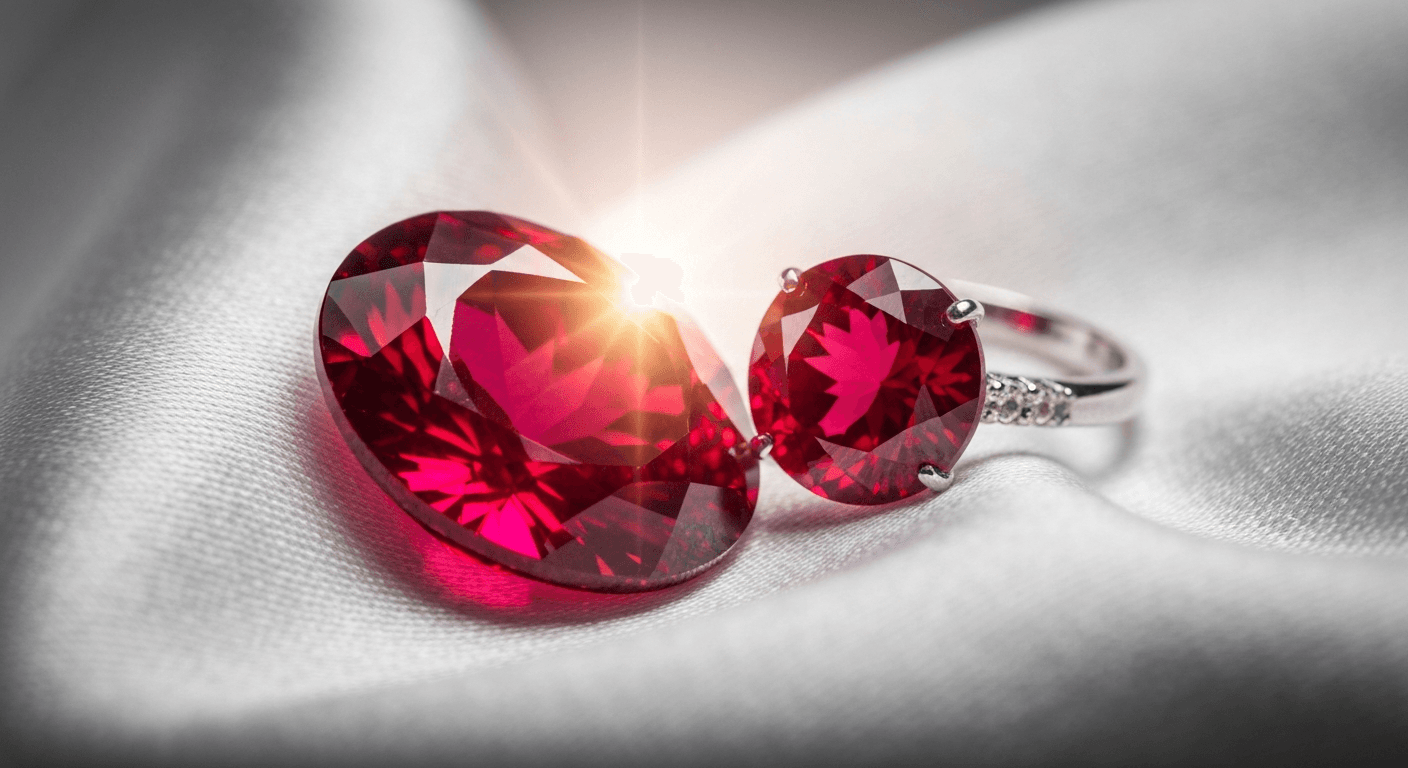
Ruby is one of the “Big Three” colored gemstones (with emerald and sapphire) and among the most valuable gems per carat. A fine natural Burmese ruby can be worth $10,000 to $100,000+ per carat. More expensive than diamonds of equivalent size. This extreme value makes rubies one of the most frequently faked and misrepresented gemstones. Synthetic rubies, glass-filled rubies, and red garnets are commonly sold as natural rubies.
8 Tests to Identify Real Rubies
1. The Scratch Test
Ruby is a 9 on the Mohs hardness scale. Second only to diamond. A genuine ruby cannot be scratched by anything except diamond or another corundum. Try scratching it with a steel file or a piece of quartz. If it scratches, it is not ruby. Likely glass (hardness 5.5) or garnet (hardness 6.5–7.5). Test on an inconspicuous area.
2. The Color Test
Genuine rubies have a rich, deep red color described as “pigeon blood” in the finest examples. Look for subtle color variations and a slight purplish or pinkish secondary hue. Perfectly uniform, intensely saturated red with no variation often indicates synthetic or glass. Natural rubies may show color zoning (bands of slightly different color intensity) under magnification.
3. The UV Light Test
Hold the stone under a UV blacklight in a dark room. Most natural rubies fluoresce red or orange-red under UV light due to their chromium content. Synthetic rubies also fluoresce (often even more strongly), so this test is best for ruling out glass and garnet, which do not fluoresce red. Very dark rubies with high iron content may show weak or no fluorescence.
4. The Magnification Test (10x Loupe)
This is one of the most important tests. Under 10x magnification, look for:
- Natural inclusions: Genuine rubies almost always have inclusions. Tiny “silk” (needle-like rutile inclusions), crystal inclusions, or fingerprint-like healing fractures. These are called “jardin” and are proof of natural origin.
- Too clean = suspicious: A perfectly clean ruby with no inclusions visible at 10x is likely synthetic (lab-grown). Natural rubies of this clarity would be extraordinarily expensive.
- Curved growth lines: Curved striations visible under magnification indicate flame-fusion synthetic ruby (the most common synthetic method). Natural rubies show straight or angular growth patterns.
- Bubbles: Round gas bubbles indicate glass or glass-filled ruby. Natural rubies never contain gas bubbles.
5. The Glass-Fill Test
Many commercial rubies are “lead glass-filled”. Heavily fractured natural rubies whose fractures are filled with glass to improve appearance. These are worth 90% less than untreated rubies. Under magnification, look for flash effects. Bright blue or orange flashes of color at fracture planes when you rotate the stone. This blue-orange flash is the hallmark of lead glass filling.
6. The Light Transmission Test
Hold the ruby up to a strong light. Genuine rubies transmit a deep, rich red glow. Glass will transmit light more evenly and may show a different hue. Red garnet transmits a darker, more brownish-red. Red spinel transmits a similar red but with a slightly different character that is hard to describe but recognizable with experience.
7. The Specific Gravity Test
Ruby (corundum) has a specific gravity of 3.97–4.05. This means it is denser than most imitations. A genuine ruby will feel noticeably heavier than a glass or garnet of the same size. This test is subjective by hand but can be made precise with a scale and water displacement.
8. The Price Test
Natural untreated rubies of good color and clarity are extremely expensive. A 1-carat unheated Burmese ruby of good quality: $5,000–$20,000. If you are offered a “natural ruby” ring at a tourist shop for $200, it is not a natural ruby. It may be synthetic, glass-filled, or a different stone entirely.
Common Ruby Imitations
| Material | How to Distinguish | Value vs. Natural Ruby |
|---|---|---|
| Synthetic ruby (lab-grown) | Curved growth lines, too clean, strong UV fluorescence | 1–5% |
| Glass-filled ruby | Blue-orange flash effects in fractures, bubbles | 5–10% |
| Red garnet | Lower hardness (6.5–7.5), no UV fluorescence, different hue | 1–3% |
| Red spinel | Different crystal structure, singly refractive (ruby is doubly refractive) | 5–30% (spinel has its own value) |
| Red glass | Bubbles, low hardness, warm to touch, lightweight | <1% |
| Composite ruby | Natural ruby top fused to glass or synthetic bottom | 5–10% |
When to Get Lab Certification
For any ruby you believe is worth $500 or more, professional gemological certification is essential. GIA (Gemological Institute of America), Gubelin, and SSEF reports are the most trusted. A GIA report for a colored stone costs $80–$200 and provides definitive identification of natural vs. synthetic, treatment disclosure, and origin determination (Burmese origin adds significant premium).
Want to know what your ruby is worth? Upload a photo to our free AI valuation tool for an instant estimate based on size, color, and quality assessment.

Shop & Compare Prices
See current listings and recently sold items on eBay