March 23, 2026 · Updated March 2026
How to Tell If Jade Is Real: 8 Simple Tests at Home
Why Jade Authentication Matters
Jade is one of the most counterfeited gemstones in the world. The problem is particularly severe because “jade” encompasses two different minerals. Jadeite and nephrite. And dozens of imitation materials are sold as jade to unsuspecting buyers. The price difference is staggering: a genuine imperial jadeite bangle can be worth $50,000 to $3,000,000, while a dyed quartz imitation costs $5 to $20.
Even mid-range genuine jade pieces worth $500 to $5,000 are frequently faked. Whether you are evaluating jewelry you already own, shopping at a market, or appraising inherited pieces, these tests will help you determine if your jade is real.
Jadeite vs. Nephrite: Understanding the Difference
Jadeite is the rarer and more valuable form of jade. It comes primarily from Myanmar (Burma) and is prized for its vivid green color, though it also comes in lavender, white, yellow, and black. Imperial jadeite. A translucent, vivid emerald green. Is the most valuable variety of jade, worth more per carat than diamonds in top qualities.
Nephrite is more common and found in China, Canada, Russia, New Zealand, and other locations. It is typically darker green, olive, or creamy white (known as “mutton fat jade”). Nephrite is tough and durable but generally less valuable than jadeite. A nephrite bangle might sell for $50 to $500, compared to $5,000 to $500,000+ for a comparable jadeite piece.
8 Tests to Identify Real Jade
1. The Temperature Test
Real jade feels cold to the touch and takes a long time to warm up. Hold the piece in your hand for 30 seconds, then set it down. Genuine jade will cool back to room temperature quickly when you release it. Plastic and resin imitations warm up fast and stay warm. Glass also feels cold initially but warms up and stays warm. This test is not definitive on its own but is a good first indicator.
2. The Sound Test
Tap two pieces of jade together or tap the piece gently with a coin. Genuine nephrite produces a clear, resonant, bell-like tone that sustains briefly. Jadeite also rings but with a slightly higher pitch. Imitation jade made from plastic, resin, or soft stone produces a dull, flat thud. This test works best with bangles and larger pieces.
3. The Scratch Test
Jade is very hard. Jadeite ranks 6.5 to 7 on the Mohs hardness scale, and nephrite ranks 6 to 6.5. You should not be able to scratch genuine jade with a steel knife blade (hardness 5.5). If a knife leaves a mark, the piece is likely serpentine (hardness 3-4), soapstone (hardness 1-2), or another soft imitation. Perform this test on an inconspicuous area to avoid damage to the visible surface.
4. The Light Test
Hold the jade up to a strong light source. Genuine jadeite often shows a fibrous, interlocking crystal structure that looks like tiny interwoven fibers. Nephrite shows a similar fibrous structure but finer and more uniform. Glass imitations show no internal structure. They appear perfectly clean and uniform. Dyed stones may show concentrated color along cracks and fissures where the dye has pooled.
5. The Density Test
Real jade is denser and heavier than most imitations. Jadeite has a specific gravity of 3.30 to 3.38, and nephrite is 2.90 to 3.03. To test at home: hold the piece and a similarly sized piece of glass or quartz. Genuine jade should feel noticeably heavier for its size. For a more precise test, weigh the piece in air and then suspended in water to calculate specific gravity.
6. The Magnification Test
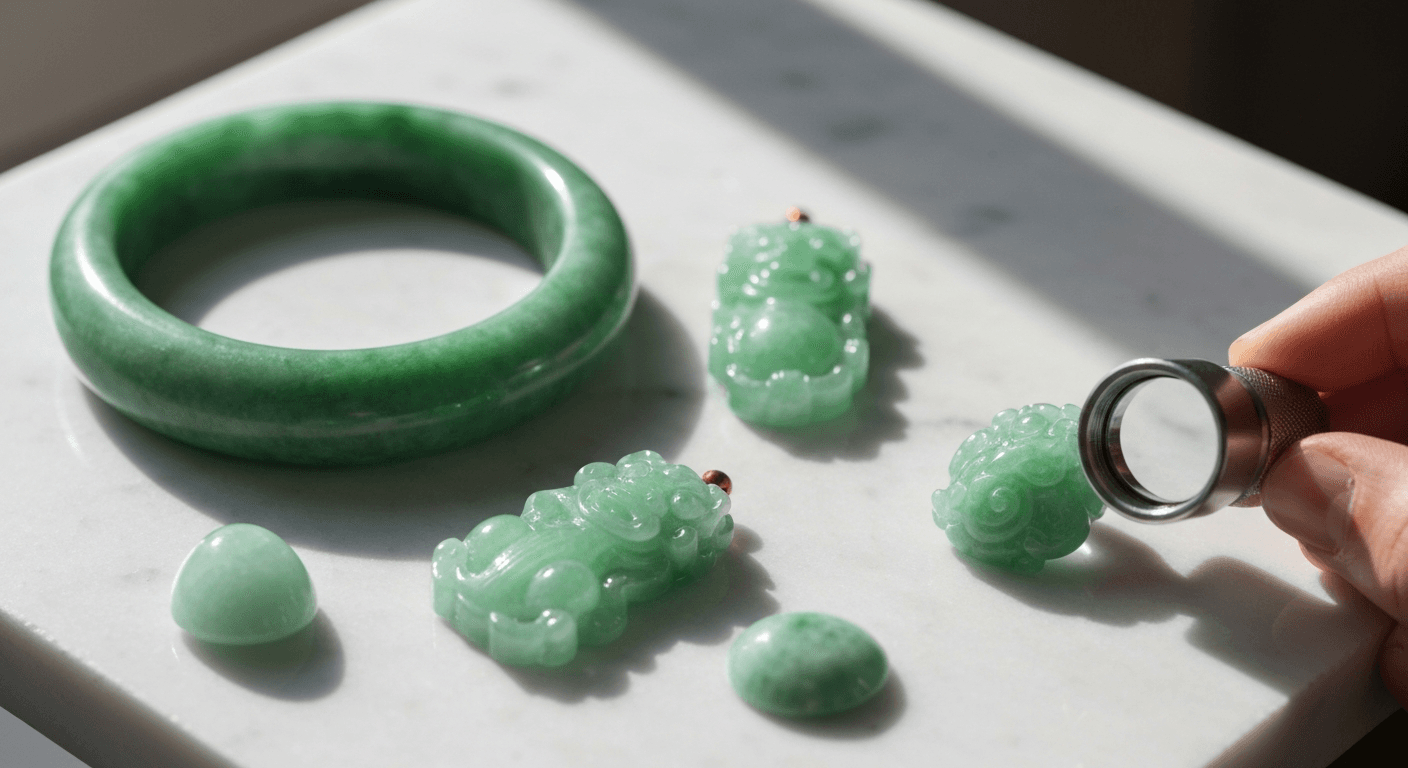
Examine the surface under a 10x jeweler’s loupe. Genuine jade has a slightly dimpled surface texture resembling an orange peel when polished. This is caused by the different hardnesses of the interlocking crystals. Glass and resin imitations have a perfectly smooth, glassy surface. Dyed jade may show color concentrations in pits, cracks, and along grain boundaries. Look for bubbles inside the stone. Bubbles indicate glass.
7. The Color Test
Natural jade color is never perfectly uniform. Even “imperial” green jadeite has subtle variations in color intensity when viewed closely. Dyed jade often shows unnaturally vivid, evenly distributed color that looks “too perfect.” Under strong light, dyed jade may show a reddish tint through a color filter (Chelsea filter). Natural jade color comes from trace elements distributed during formation over millions of years and always has some natural variation.
8. The Thermal Conductivity Test
Place a small ice cube on the surface of the stone. Genuine jade has high thermal conductivity and will melt the ice noticeably faster than glass, plastic, or resin imitations. This test is particularly good for separating jade from common plastic and resin fakes, though glass also conducts heat reasonably well.
Common Jade Imitations
| Material | How to Spot It | Value |
|---|---|---|
| Serpentine (“New Jade”) | Much softer (scratches with a knife), lighter weight | $5–$20 |
| Aventurine | Sparkly inclusions visible, different texture | $5–$30 |
| Dyed Quartzite | Color in cracks, looks unnatural under magnification | $5–$15 |
| Glass | Bubbles inside, perfectly smooth, warms quickly | $1–$5 |
| Chrysoprase | Translucent, lighter green, different structure | $20–$100 |
| Treated/Dyed Jade (Type B/C) | Acid-bleached and polymer-filled or dyed genuine jade | $10–$100 |
Jade Grading: Type A, B, and C
- Type A jade: Natural, untreated jade. Only wax polishing is acceptable. This is “real jade” in the collector’s sense and holds its value. This is the only type worth investing in.
- Type B jade: Real jade that has been acid-bleached to remove impurities and filled with polymer resin to improve transparency. It looks better than the original stone but deteriorates over time as the polymer yellows and cracks. Worth 10% to 20% of equivalent Type A.
- Type C jade: Dyed jade, often combined with Type B treatment. The color is artificial. Worth 5% to 10% of equivalent Type A.
When to Get Professional Testing
For any jade piece you believe might be worth $500 or more, professional gemological testing is strongly recommended. A certified gemologist can use:
- Refractometer: Measures refractive index to distinguish jadeite from nephrite and imitations
- Spectroscope: Shows absorption spectrum unique to natural vs. dyed jade
- Infrared spectroscopy: Detects polymer treatment (Type B jade)
- Specific gravity testing: Precise density measurement
GIA (Gemological Institute of America) and reputable local gemologists offer jade identification and grading reports for $50 to $200.
Want to know what your jade is worth? Upload a photo to our free AI valuation tool and get an instant estimate based on color, type, and quality assessment.

Shop & Compare Prices
See current listings and recently sold items on eBay