Last updated: September 2026
How Much Is Sterling Silver Flatware Worth?
Check current market values, learn what affects pricing, and get tips for buying and selling.
← All Silverware valuationsWhat do you want to value?
Get the free app for unlimited scans


Sterling Silver Flatware Price Guide
Current market values based on recent sales data and market trends.
| Item | Condition | Price Range |
|---|---|---|
| Sterling teaspoon, solid | Any | $18 - $30 |
| Sterling dinner fork, solid | Any | $35 - $60 |
| Sterling knife, hollow handle | Any | $12 - $28 |
| Sterling flatware, per troy ounce | Scrap | $26 - $34 per troy oz |
| Service for 8, common pattern | Good | $700 - $1,600 |
| Service for 12, popular pattern | Excellent, boxed | $1,400 - $3,500 |
| Discontinued pattern, per place piece | Excellent | $40 - $150 |
| Ornate Victorian serving piece | Excellent | $60 - $600 |
| Silverplate flatware | Any | $0.50 - $4 per piece |
| Weighted sterling candlestick | Any | $25 - $90 |
What Determines Sterling Silver Flatware Value
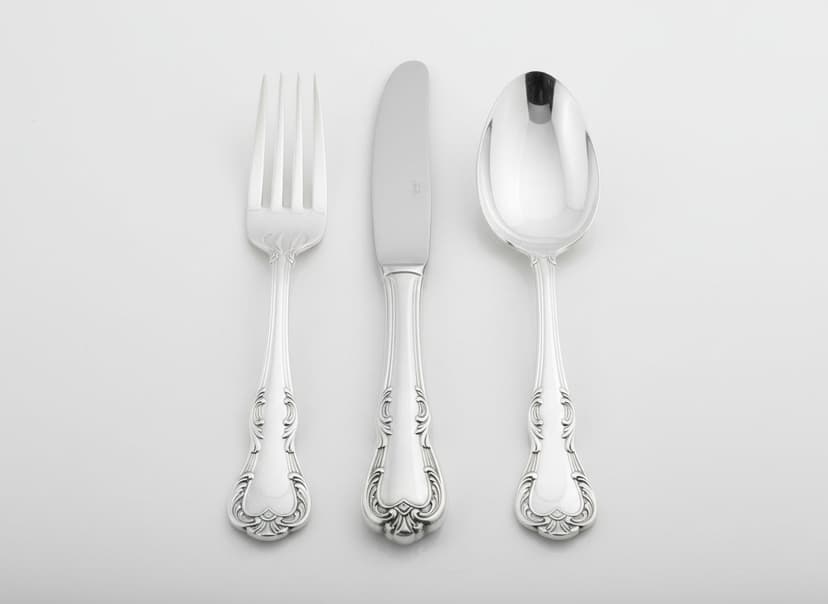
Sterling silver flatware has a hard floor that most household antiques lack: its metal content. Sterling is 92.5 percent silver, so a set's melt value can be calculated precisely from its weight, and no set sells below that number. The key distinction is between weighted and solid pieces. Knives almost always have hollow handles filled with cement or resin, so their listed weight vastly overstates their silver content, and the same is true of weighted candlesticks. Forks and spoons are solid sterling and are what actually carry the metal value. Above melt, pattern demand determines whether a set sells as silver or as flatware. Popular patterns from Gorham, Reed and Barton, Towle, and Wallace, particularly discontinued ones still needed by people completing sets, sell at a premium through replacement services. Ornate Victorian patterns and rare pieces like ice cream forks and berry spoons bring far more than standard place pieces.
Silver weight sets the floor and is calculated from the total weight of solid pieces multiplied by 0.925 and the current spot price. Knives and weighted pieces must be excluded from that calculation because their filled construction makes their gross weight meaningless. Pattern demand determines whether a set exceeds melt, and discontinued patterns with active replacement markets can bring two to three times metal value per piece. Maker matters modestly, with Gorham, Tiffany, Towle, Wallace, and Reed and Barton the recognized names. Piece type creates large spreads, and unusual Victorian serving implements are worth many times a teaspoon. Condition affects pattern-driven value but not melt value, and monogramming is a significant negative for resale as flatware though irrelevant for scrap. Completeness of a service in an original chest adds a premium. Silverplate has essentially no metal value and should never be confused with sterling.
Buying & Selling Tips
Buying
Check for the sterling mark. Genuine sterling is stamped sterling or 925, while EPNS and silverplate marks indicate no meaningful silver content.
Weigh only the solid pieces when calculating melt value. Hollow-handled knives will distort the total badly.
Look up the pattern before buying. Discontinued patterns with replacement demand sell well above melt.
Avoid monogrammed pieces if buying to resell as flatware. Monograms are a significant negative except for scrap.
Buy complete services in original chests. The set premium and the chest itself both add value.
Selling
Calculate the melt value yourself before getting offers. It is your negotiating floor and dealers will not volunteer it.
Look up the pattern on a replacement service before selling for scrap. Some patterns sell for triple melt per piece.
Sell serving pieces individually. Ornate Victorian implements bring far more than their weight suggests.
Do not polish aggressively before selling as antiques. Over-polishing removes detail and reduces collector value.
Get three quotes for scrap sales. Payouts for sterling vary widely between refiners, jewelers, and pawn shops.
Sterling Silver Flatware FAQ
How do I calculate what sterling flatware is worth?
Weigh the solid pieces in troy ounces, multiply by 0.925 for sterling purity, then multiply by the current silver spot price. Exclude hollow-handled knives and weighted pieces, whose gross weight is mostly filler.
Is sterling flatware worth more than melt value?
Sometimes. Discontinued patterns with active replacement demand sell for two to three times melt per piece, and ornate Victorian serving implements bring far more. Common patterns typically sell close to metal value.
Why are sterling knives worth so little?
Sterling knives have hollow handles filled with cement or resin and stainless steel blades, so despite their heft they contain only a small amount of actual silver. Their weight cannot be used in a melt calculation.
Does silverplate have any value?
Very little. Silverplate is a microscopically thin layer of silver over base metal, and refiners will not pay for it. Silverplate flatware typically sells for $0.50 to $4 per piece for decorative or craft use.
Do monograms reduce sterling flatware value?
For resale as flatware, yes, significantly, because buyers replacing pieces need unmonogrammed items. For scrap value, monograms make no difference since the piece is melted anyway.
Got Sterling Silver Flatware to Value?
Upload a photo and get a free AI-powered valuation in seconds. No sign-up required.