Last updated: September 2026
How Much Are Kennedy Half Dollars Worth?
Check current market values, learn what affects pricing, and get tips for buying and selling.
← All Kennedy Half Dollar valuationsWhat do you want to value?
Get the free app for unlimited scans


Kennedy Half Dollars Price Guide
Current market values based on recent sales data and market trends.
| Item | Condition | Price Range |
|---|---|---|
| 1964 (90% silver) | MS-63 | $14 - $20 |
| 1964 Accented Hair Proof | PR-65 | $60 - $110 |
| 1964-D | MS-65 | $25 - $45 |
| 1965-1970 (40% silver) | MS-63 | $5 - $9 |
| 1970-D | MS-65 | $25 - $40 |
| 1971-Present clad | Circulated | $0.50 - $1 |
| 1974-D Doubled Die Obverse | MS-64 | $60 - $150 |
| 1976 Bicentennial (silver) | MS-65 | $12 - $20 |
| 1998-S Matte Finish | SP-68 | $150 - $260 |
| 2014-W Gold Kennedy | SP-69 | $2,600 - $3,400 |
What Determines Kennedy Half Dollars Value
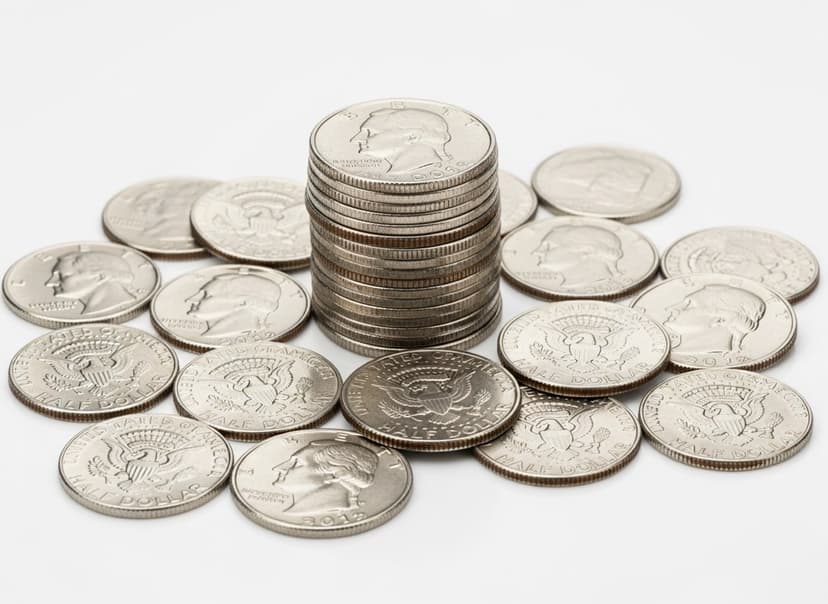
The Kennedy half dollar was rushed into production in 1964, just weeks after the assassination, and the public hoarded them so aggressively that they never circulated the way half dollars had before. That hoarding is the single most important fact about their value: nearly every year is common in uncirculated condition, so date rarity matters far less than silver content and grade. The 1964 issue is 90% silver and carries roughly 0.3617 troy ounces of pure silver. From 1965 through 1970 the composition dropped to a 40% silver clad sandwich, worth about 0.1479 troy ounces each. From 1971 onward, circulation strikes are copper-nickel clad and worth face value unless they are in gem condition or carry an error. Special silver proofs returned in 1992 and continue today in the annual silver proof sets.
Silver content sets the floor for anything dated 1964 through 1970, so those coins move with the spot price day to day. Above that floor, condition is everything: because so many Kennedys were saved, the market only pays real premiums at MS-65 and higher, and full strike detail on Kennedy's hair and the eagle's breast feathers separates a gem from an ordinary uncirculated coin. Original toning from decades in a mint set adds value when the color is attractive. Errors and die varieties are where the surprises live, especially doubled dies and off-metal strikes. Anything cleaned, whizzed, or polished loses most of its collector premium regardless of date.
Buying & Selling Tips
Buying
Buy 1964 halves in bulk by weight when silver is soft. You are essentially buying bullion with a small collector upside built in.
Ignore raw coins advertised as MS-65 or better. At that level the price gap between grades is wide enough that PCGS or NGC certification is mandatory.
Check the edge of any 1965-1970 half. A solid silver-gray edge means 40% silver, while a visible copper stripe means it is clad and worth face value.
For error hunting, buy unsearched original bank-wrapped rolls rather than picked-over dealer inventory.
The 2014-W gold Kennedy trades close to its gold content, so compare the asking price to spot before paying a numismatic premium.
Selling
Sell common-date 1964 halves to a bullion dealer by weight rather than listing them individually. The per-coin premium rarely covers shipping and fees.
Separate 40% silver 1965-1970 halves from clad before selling. Buyers pay by composition and will pay the lower rate on mixed lots.
Get any suspected doubled die authenticated before listing. Unverified error claims consistently sell for a fraction of certified examples.
List gem proofs and special finishes on eBay with clear macro photos of the fields. Buyers at that level are grading from your pictures.
Time bullion-grade sales to silver rallies. A 20% move in spot changes what your 1964 rolls are worth almost immediately.
Kennedy Half Dollars FAQ
Which Kennedy half dollars are silver?
Only 1964 halves are 90% silver. Coins dated 1965 through 1970 are 40% silver clad. Everything from 1971 onward struck for circulation is copper-nickel with no silver, though collector silver proofs resumed in 1992 and are sold in special sets.
Is a 1964 Kennedy half dollar rare?
No. Over 430 million were struck across Philadelphia and Denver, and the public saved them in enormous quantities. A circulated 1964 half is worth its silver content, typically $12 to $16. Only high-grade gems and the Accented Hair proof variety carry meaningful premiums.
How can I tell if my Kennedy half is 40% silver without weighing it?
Look at the edge. A 40% silver clad half shows a uniform light gray edge, while a copper-nickel clad half shows an obvious orange-copper stripe between the outer layers. The date range 1965 to 1970 is the other confirmation.
What is the most valuable Kennedy half dollar?
Excluding one-off specimens, the 2014-W gold Kennedy is the most expensive regular issue at roughly $2,600 to $3,400 depending on gold prices. Among circulation coins, the 1998-S matte finish and high-grade 1970-D examples are the ones worth checking for.
Are Kennedy half dollars still made?
Yes, but since 2002 they have been struck only for collectors and are not released into general circulation. You can buy them in rolls and bags directly from the Mint, which is why modern dates almost never turn up in change.
Got Kennedy Half Dollars to Value?
Upload a photo and get a free AI-powered valuation in seconds. No sign-up required.