Last updated: September 2026
How Much Are Antique Dolls Worth?
Check current market values, learn what affects pricing, and get tips for buying and selling.
← All Dolls valuationsWhat do you want to value?
Get the free app for unlimited scans


Antique Dolls Price Guide
Current market values based on recent sales data and market trends.
| Item | Condition | Price Range |
|---|---|---|
| Bru Jne bebe, French bisque | Original, excellent | $8,000 - $40,000 |
| Jumeau bebe, French bisque | Original, excellent | $2,500 - $15,000 |
| Kämmer & Reinhardt character doll | Excellent | $1,500 - $20,000 |
| Simon & Halbig, common mold | Excellent | $200 - $900 |
| Kestner, common mold | Excellent | $200 - $800 |
| Armand Marseille 390 | Excellent | $70 - $250 |
| China head doll, 1850s-1880s | Excellent | $100 - $700 |
| Composition doll, 1920s-40s | Minimal crazing | $80 - $500 |
| Any bisque doll with head hairline | Repaired or cracked | 20% - 40% of perfect |
| Doll in original costume and wig | Excellent | +50% - 150% |
What Determines Antique Dolls Value
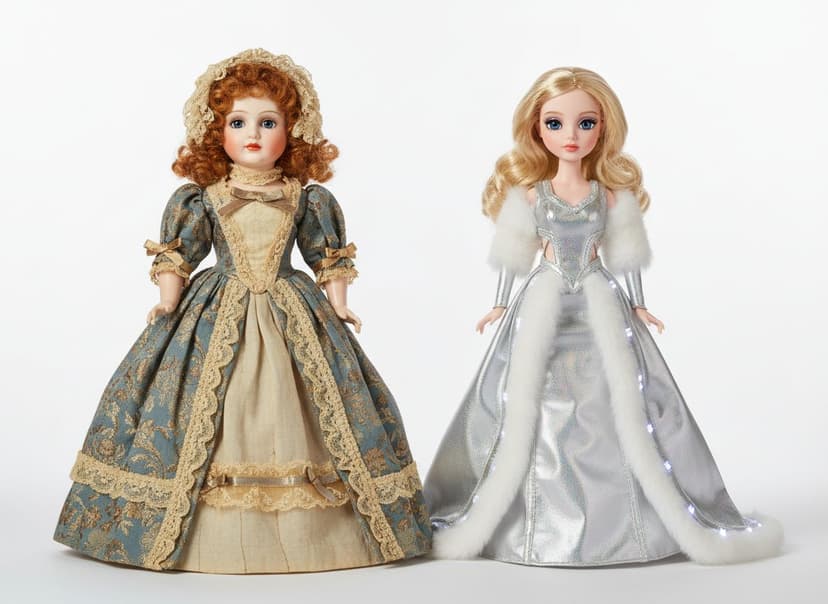
Antique doll collecting is organized around maker, material, and head condition, and those three facts determine most of any doll's value. French bisque dolls by Jumeau, Bru, and Steiner from the 1870s to 1890s occupy the top of the market and can reach five figures, prized for their hand-painted faces and elaborate original costumes. German bisque dolls by Kestner, Simon and Halbig, Armand Marseille, and Kämmer and Reinhardt were produced in far larger numbers and range from under a hundred dollars for common Armand Marseille models to thousands for rare character faces. Composition dolls from the 1920s to 1940s, made of sawdust and glue, suffer from an inherent flaw: the material crazes and crackles with humidity changes, so undamaged examples are scarce. The marks on the back of the head or neck identify the maker and mold number and are the first thing any appraiser checks, followed immediately by an inspection for hairline cracks.
Maker and mold number, read from the marks on the back of the head, establish the baseline and are checked before anything else. Head condition is the most consequential physical variable because bisque is fragile and hairline cracks, even repaired ones, reduce value by sixty to eighty percent. Collectors inspect by holding the head to a light and tapping gently, since a cracked head produces a dull rather than a ringing tone. Originality of the wig, eyes, body, and costume adds enormously, and a doll with its original mohair wig and period clothing can be worth double a redressed one. Body type and condition matter, with composition and kid leather bodies each having their own failure modes. Facial expression drives demand, with character faces showing realistic expressions worth far more than the standard idealized dolly face. Size affects value, with larger dolls generally worth more within the same mold.
Buying & Selling Tips
Buying
Check the head marks first. Maker and mold number determine the price range before condition is even considered.
Inspect the head under a bright light for hairlines, especially around the eye sockets and behind the wig.
Ask whether the wig, eyes, and body are original to the head. Replaced components are common and reduce value substantially.
Prefer closed-mouth French bisque if buying for value. Closed mouth examples consistently outsell open mouth versions.
For composition dolls, accept some crazing as normal but avoid flaking or lifting paint, which is progressive.
Selling
Photograph the head marks, the full face, and the body separately. Those are the three images every appraiser needs.
Disclose all hairlines and repairs. Doll collectors examine carefully and undisclosed damage reliably causes returns.
Do not redress or rewig an antique doll. Original costume and wig are worth more than any improvement you could make.
Sell high-end French bisque through a specialist doll auction. General marketplaces cannot reach those buyers.
Pack the head separately with the body if the doll comes apart. Head damage in transit is the most common shipping loss.
Antique Dolls FAQ
How do I identify an antique doll?
Look for marks incised on the back of the head or neck, usually under the wig. They typically include the maker's name or initials, a mold number, and sometimes a country of origin and size number.
Which antique doll makers are the most valuable?
French makers Bru, Jumeau, and Steiner lead, with Bru bebes reaching $8,000 to $40,000. German character dolls by Kämmer and Reinhardt also reach five figures for rare molds.
Does a hairline crack ruin an antique doll's value?
It reduces it by roughly sixty to eighty percent. Bisque doll collectors are exacting about head condition, and even a professionally repaired hairline is disclosed and priced accordingly.
Are Armand Marseille dolls valuable?
The common 390 mold sells for $70 to $250 because it was produced in enormous quantities. Rarer Armand Marseille character molds bring considerably more, so the mold number matters more than the maker name.
What is crazing on a composition doll?
It is the fine network of surface cracks that develops in composition, a mixture of sawdust and glue, as it expands and contracts with humidity. It is nearly universal on dolls from the 1920s to 1940s and minimal crazing commands a premium.
Got Antique Dolls to Value?
Upload a photo and get a free AI-powered valuation in seconds. No sign-up required.