Last updated: September 2026
How Much Is My Investment Portfolio Worth?
Understanding the projected value of your investment portfolio is essential for retirement planning, goal setting, and financial decision-making. Our calculator uses compound interest and dollar-cost averaging principles to project your portfolio's growth over time, based on your initial investment, recurring contributions, expected rate of return, and investment timeframe. Whether you're just starting to invest or managing a mature portfolio, this tool helps you visualize the power of consistent investing and compound growth.
Get the free app for unlimited scans


Investment Portfolio Value Calculator
Fill in the details below for an accurate estimate
Why Knowing Your Investment Portfolio Value Matters
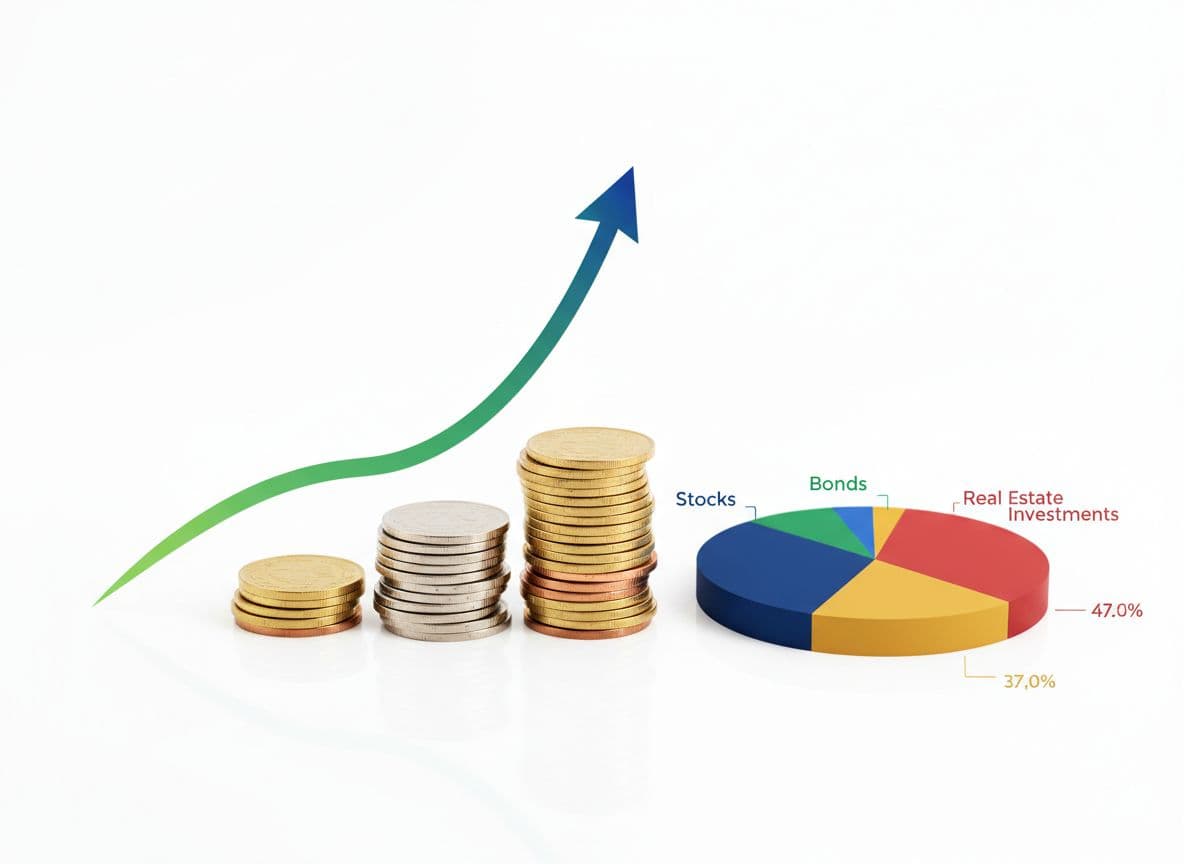
The difference between investing and not investing is staggering over time. A $10,000 initial investment with $500 monthly contributions at an 8% average annual return grows to approximately $352,000 in 20 years. But your total contributions were only $130,000. That means compound growth generated over $222,000 in free money. Extending to 30 years, the same parameters produce approximately $870,000, with $190,000 in contributions and $680,000 from compounding. Starting just 5 years earlier can add $200,000–$500,000 to your retirement nest egg. Yet the average American has only $65,000 in retirement savings, and 21% of Americans have no retirement savings at all. Many people don't invest because they underestimate the impact of small, regular contributions. $500/month ($17/day) can build generational wealth over 25–30 years. Investment fees also matter enormously: a 1% annual fee vs. a 0.1% fee on a $500,000 portfolio costs you $4,500 extra per year, or $135,000+ over 30 years. Our calculator helps you model different scenarios to make informed decisions about contribution levels, risk tolerance, and time horizons.
Key Factors That Affect Investment Portfolio Value
Understanding what drives the price of investment portfolio helps you get the most accurate valuation.
Initial Investment Amount
Your starting capital creates the foundation for compound growth. A larger initial investment generates more absolute returns from day one. $100,000 at 8% earns $8,000 in year one, while $10,000 earns only $800. However, even a small initial investment of $1,000–$5,000 becomes meaningful over long time periods. The key insight is that your initial investment matters most in the early years, while monthly contributions and compounding dominate long-term results.
Monthly Contribution Consistency
Regular monthly contributions through dollar-cost averaging are the engine of portfolio growth for most investors. Contributing $500/month adds $6,000/year in new capital, but with compound growth, those contributions accelerate in value over time. Early contributions are worth the most. A $500 contribution at age 25 is worth approximately $11,000 by age 65 at 8% returns, while the same contribution at age 55 grows to only $1,100. Automating contributions removes emotional decision-making and ensures consistency.
Expected Rate of Return
Your assumed return rate dramatically affects projections. Historical averages: US stocks (S&P 500) have returned approximately 10% annually before inflation (7% after inflation) since 1926. Bonds have returned 5–6% before inflation. A blended 60/40 portfolio typically returns 7–8%. Conservative estimates (4–6%) are appropriate for bond-heavy portfolios or shorter timeframes. Aggressive estimates (10–12%) reflect equity-heavy portfolios but carry higher volatility risk. Remember: these are averages. Actual year-to-year returns vary wildly.
Investment Time Horizon
Time is the most powerful variable in investing due to compound growth. The 'Rule of 72' provides a quick estimate: divide 72 by your annual return rate to find how many years it takes to double your money (72 ÷ 8% = 9 years to double). Over 10 years, compounding is noticeable; over 20 years, it's powerful; over 30+ years, it's transformative. This is why starting early. Even with small amounts. Matters more than starting later with larger amounts.
Tips for Valuing Investment Portfolio
Get the most accurate estimate by following these tips when evaluating your investment portfolio.
Use a conservative return estimate (6–7%) for long-term planning. It's better to be pleasantly surprised than to fall short of retirement goals
Try modeling different monthly contribution amounts to see how increasing your savings rate by even $100/month impacts your 20-year projection
Remember that this calculator shows nominal returns. Adjust for 2–3% annual inflation to estimate your portfolio's future purchasing power
Factor in investment fees and taxes when interpreting results. A 1% annual fee can reduce your ending balance by 20–30% over 30 years
Investment Portfolio Market Insights
The investment landscape has democratized significantly in the past decade. Low-cost index funds (Vanguard, Fidelity, Schwab) offer market-matching returns for fees as low as 0.03–0.10% annually, making sophisticated investing accessible to everyone. Robo-advisors (Betterment, Wealthfront) provide automated portfolio management for 0.25% annual fees. The rise of fractional share investing means you can start with as little as $1 on platforms like Fidelity, Schwab, and Robinhood. Target-date retirement funds offer one-fund solutions that automatically adjust asset allocation as you age. For most investors, a simple three-fund portfolio (US stocks, international stocks, bonds) in low-cost index funds outperforms 80% of actively managed funds over 15+ year periods. The key behavioral challenge is staying invested during market downturns. Investors who sold during the 2020 COVID crash missed a 70%+ recovery within 12 months. Dollar-cost averaging through regular contributions naturally buys more shares when prices are low and fewer when prices are high, reducing timing risk.
Notable Investment Portfolio Values
Real-world examples of what specific investment portfolio have sold for, so you can benchmark your own.
| Investment Portfolio | Condition | Typical Value |
|---|---|---|
| S&P 500 Index Fund (e.g., VOO/SPY) - Starter Portfolio | Active | $1,000 - $10,000 |
| Three-Fund Lazy Portfolio (Total Market + Intl + Bonds) | Active | $10,000 - $50,000 |
| Roth IRA Maxed Annually (7-Year Accumulation) | Tax-Advantaged | $50,000 - $90,000 |
| 401(k) with Employer Match - Mid Career | Active | $100,000 - $300,000 |
| Dividend Growth Portfolio (Blue Chips: JNJ, PG, KO) | Active | $50,000 - $200,000 |
| Concentrated Tech Growth Portfolio (FAANG-heavy) | Active | $25,000 - $500,000+ |
| Bond Ladder (5-Year, Investment Grade) | Active | $50,000 - $250,000 |
| Target-Date 2050 Fund - Millennial Accumulator | Active | $20,000 - $150,000 |
| Fully Diversified $1M+ Retirement Portfolio | Active | $1,000,000 - $3,000,000+ |
Based on Vanguard investor data, Fidelity retirement savings reports, IRS contribution limits, and widely cited personal finance benchmarks (Bogleheads, NerdWallet).
Find Out What Your Investment Portfolio Are Worth
Upload a photo now and get a free AI-powered valuation in seconds. No sign-up required.
Investment Portfolio Valuation FAQ
How much should I invest each month?
Financial advisors generally recommend saving 15–20% of your gross income for retirement, including any employer match. For someone earning $75,000, that's $938–$1,250/month. If that's not feasible now, start with whatever you can. Even $100–$200/month. And increase by 1% of salary each year. The most important step is to begin. A common framework: (1) Contribute enough to get your full employer 401(k) match (free money). (2) Max out a Roth IRA ($7,000/year in 2024). (3) Increase 401(k) contributions toward the annual limit ($23,000 in 2024). Any amount consistently invested will grow significantly over decades.
What rate of return should I expect from my investments?
Historical returns provide guidance but not guarantees. The S&P 500 has returned approximately 10% annually (before inflation) since 1926, including dividends. After adjusting for inflation, that's about 7%. A balanced portfolio (60% stocks, 40% bonds) has historically returned 7–8% before inflation. For planning purposes: use 6–7% for conservative estimates, 8–9% for moderate assumptions, and 10%+ only for aggressive all-stock portfolios. Remember that these are long-term averages. Individual years range from -37% (2008) to +38% (1995). The longer your time horizon, the more likely your actual returns will approach historical averages.
Is it better to invest a lump sum or make monthly contributions?
Statistically, lump-sum investing outperforms dollar-cost averaging (DCA) about 66% of the time because markets trend upward over time, so investing earlier captures more growth. However, DCA offers psychological benefits: it reduces the risk of investing everything at a market peak, provides discipline through automation, and matches most people's cash flow (receiving regular paychecks rather than lump sums). For most people receiving regular income, monthly investing is the practical and effective approach. If you receive a windfall ($10,000+), consider investing 50–75% immediately and the remainder over 3–6 months as a compromise between optimal math and emotional comfort.
How do taxes affect my investment returns?
Taxes can significantly reduce real returns if not managed properly. In a taxable brokerage account, you'll pay capital gains tax when selling (15–20% for long-term gains held over 1 year, up to 37% for short-term gains). Dividends are taxed annually (0–20% for qualified dividends). Tax-advantaged accounts dramatically improve after-tax returns: Traditional 401(k)/IRA contributions are tax-deductible now, growing tax-deferred, with withdrawals taxed as ordinary income in retirement. Roth 401(k)/IRA contributions are made after-tax, but all growth and withdrawals are tax-free. For a $500,000 portfolio growing at 8% over 20 years, the difference between a taxable and Roth account can exceed $200,000–$400,000 in additional wealth. Maximize tax-advantaged accounts before investing in taxable ones.
Similar Valuations
Value anything, anytime
Unlimited valuations, saved history and full reports in the free app.