Last updated: September 2026
How Much Is Vintage Pyrex Worth?
Check current market values, learn what affects pricing, and get tips for buying and selling.
← All Vintage Pyrex valuationsWhat do you want to value?
Get the free app for unlimited scans


Vintage Pyrex Patterns Price Guide
Current market values based on recent sales data and market trends.
| Item | Condition | Price Range |
|---|---|---|
| Lucky in Love (1959 promotional) | Excellent color | $2,500 - $6,000 |
| Pink Gooseberry cinderella bowl set | Excellent | $400 - $1,200 |
| Pink Daisy casserole | Excellent | $60 - $200 |
| Butterprint (Amish) mixing bowl set | Excellent color | $120 - $350 |
| Primary colors mixing bowl set | Excellent | $100 - $300 |
| Snowflake or Gooseberry casserole | Excellent | $30 - $90 |
| Golden Butterfly or gold pattern | Excellent | $20 - $70 |
| Rare test or promotional pattern | Excellent | $800 - $5,000 |
| Any piece with dishwasher fade | Faded | 20% - 40% of vivid |
| Chipped or cracked piece | Damaged | $3 - $15 |
What Determines Vintage Pyrex Patterns Value
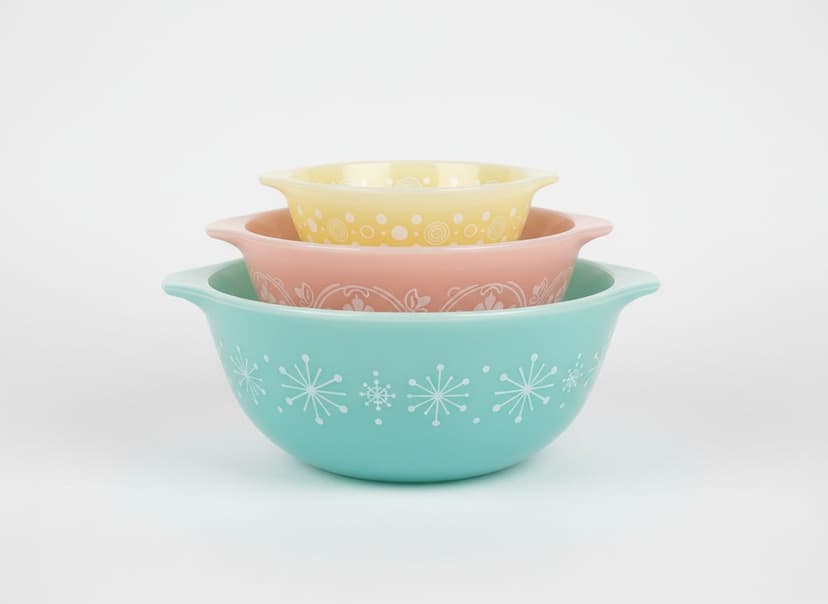
Vintage Pyrex collecting is organized entirely around pattern, and the price range within the category is one of the widest in kitchen collectibles. Common patterns produced for years, such as Butterprint and Snowflake, sell for twenty to sixty dollars a bowl. Promotional patterns produced for a single season or as a store premium can bring hundreds, and genuinely rare test patterns reach four figures. Lucky in Love, a 1959 promotional pattern featuring green clover and pink hearts, is the most famous example and has sold for thousands. The single most important condition concept is dishwasher damage. Vintage Pyrex was decorated with painted enamel that was never meant for modern dishwashers, and repeated cycles strip the color, leaving a dull, faded, or patchy surface. Collectors describe undamaged pieces as having good color or being dishwasher safe, and the price gap between a vivid piece and a faded one is often seventy percent.
Pattern is the dominant variable and the difference between common and rare patterns is two orders of magnitude. Color vividness is the primary condition measure, since dishwasher detergent strips the painted enamel and a faded piece sells for a small fraction of a vivid one. Completeness of sets matters enormously, and a full nesting bowl set in matching condition is worth well more than the sum of the individual bowls. Lid presence is critical for casseroles, since the clear glass lids break easily and a lidless casserole loses a large share of its value. Chips, cracks, and utensil scratches inside bowls all reduce value. Promotional and test patterns, produced in small numbers for specific retailers or as market tests, form the top tier and require documentation since fantasy pieces and repainted fakes exist. Finally, this market is trend-driven and has cooled somewhat from its peak.
Buying & Selling Tips
Buying
Judge color vividness first. A faded piece of a rare pattern can be worth less than a vivid piece of a common one.
Check that casseroles include their original clear lid. Lids are frequently broken and expensive to source separately.
Run a finger around the rim and base for chips. Even small chips eliminate most collector value.
Buy complete nesting sets rather than assembling them. Matching color and condition across a set is difficult.
Be cautious with rare patterns. Repainted and fantasy pieces exist, and unusually cheap rare patterns are a warning sign.
Selling
Never put vintage Pyrex in a dishwasher. A single cycle can strip color and destroy most of the value.
Photograph in natural light against white. Color saturation is what buyers are actually purchasing.
Include the lid with casseroles and say so in the title. Lidded pieces sell for substantially more.
Sell complete sets together. The set premium over individual pieces is significant.
Wrap each piece individually and double box. Glass shipping damage is common and eliminates the sale.
Vintage Pyrex Patterns FAQ
What is the rarest Pyrex pattern?
Lucky in Love, a 1959 promotional pattern with green clover and pink hearts, is the most famous rarity and has sold for $2,500 to $6,000. Various undocumented test patterns can reach similar levels.
Why is dishwasher damage such a problem for vintage Pyrex?
The patterns are painted enamel applied to the exterior, not fired into the glass the way modern decoration is. Modern dishwasher detergents strip that enamel, leaving faded or patchy color that cannot be restored.
How much is a Butterprint Pyrex bowl worth?
A single bowl with good color brings $30 to $90, and a complete nesting set reaches $120 to $350. Butterprint was produced for many years so supply is ample, but demand remains steady.
Does a missing lid affect Pyrex value?
Significantly. Clear glass lids broke easily and a casserole without its lid typically sells for forty to sixty percent of a complete one. Replacement lids are available but pattern-correct ones can be costly.
Is vintage Pyrex safe to use?
Yes for baking and serving, though it should be hand washed to preserve the pattern. Avoid extreme temperature changes, since older borosilicate and later soda-lime formulations both crack under thermal shock.
Got Vintage Pyrex Patterns to Value?
Upload a photo and get a free AI-powered valuation in seconds. No sign-up required.