Last updated: September 2026
How Much Are Vintage Levi's 501s Worth?
Check current market values, learn what affects pricing, and get tips for buying and selling.
← All Vintage Levi's valuationsWhat do you want to value?
Get the free app for unlimited scans


Vintage Levi's 501s Price Guide
Current market values based on recent sales data and market trends.
| Item | Condition | Price Range |
|---|---|---|
| 1940s-1950s 501XX with hidden rivets | Wearable, some repair | $3,000 - $20,000 |
| 1960s Big E, redline selvedge | Good | $700 - $2,500 |
| Big E, hidden rivets | Good | $1,500 - $6,000 |
| 1970s redline selvedge, small e | Good | $250 - $700 |
| 1980s selvedge 501 | Good | $150 - $400 |
| 1980s-90s Made in USA, non-selvedge | Good | $60 - $180 |
| 1990s 501, USA made, dark wash | Excellent | $80 - $250 |
| Deadstock 1990s with tags | New old stock | $200 - $600 |
| Levi's Vintage Clothing reproduction | Excellent | $120 - $300 |
| Modern 501, any | Used | $15 - $40 |
What Determines Vintage Levi's 501s Value
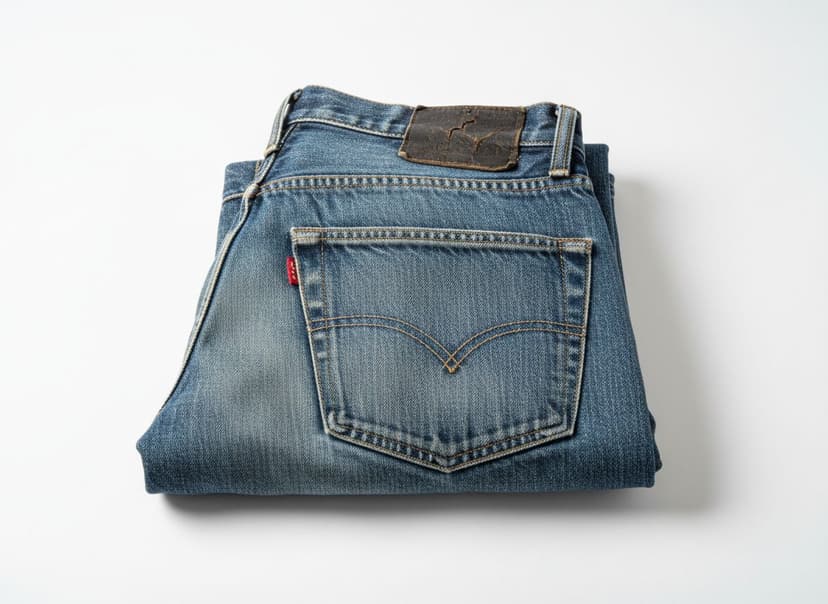
Vintage Levi's 501s are dated by a set of construction details, and knowing them turns a thrift store find into a valuation. The most valuable era is pre-1971, identifiable by the capital E in the LEVI'S red tab, which collectors call Big E. After 1971 the tab reads with a lowercase e. Selvedge denim, woven on narrow shuttle looms and identifiable by the clean self-finished edge inside the outseam, was used until the mid-1980s, and the red thread in that selvedge on earlier pairs gives the redline nickname. Other dating markers include hidden rivets on the back pockets, discontinued around 1966, the single-stitch versus double-stitch back pocket construction, and the care tag details that place a pair by decade. Prices range from thirty dollars for a common 1990s pair to five figures for genuine 1940s and 1950s examples, so the details matter more than the condition of the denim itself.
Era is everything, and it is determined by construction details rather than by how the jeans look. The Big E tab, hidden rivets, single-stitch back pockets, and selvedge outseams each move a pair into a higher bracket. Size matters unusually much in vintage denim because the surviving population skews toward small waists that were unpopular for decades, and mid-range sizes from 32 to 36 are the most in demand today. Condition is graded differently than in modern clothing: wear, fading, and repairs are acceptable and sometimes desirable, but crotch blowouts, missing belt loops, and damage that cannot be repaired reduce value substantially. Fade pattern is its own value driver, and evenly faded pairs with strong contrast sell above flat or overdyed ones. Finally, authenticity of the tab and buttons matters, since vintage details are sometimes transplanted onto later pairs.
Buying & Selling Tips
Buying
Check the red tab first. A capital E means pre-1971 and immediately moves the pair into a higher value bracket.
Turn the leg inside out and look at the outseam. A clean self-finished edge indicates selvedge denim; an overlocked serged edge does not.
Look under the back pocket corners for hidden rivets, which date a pair to before roughly 1966.
Measure the actual waist rather than trusting the tag. Vintage denim shrank and the tagged size is often two inches off.
Inspect the crotch and inner thigh for blowouts. It is the most common failure point and the most expensive repair.
Selling
Photograph the tab, the button back, the inner care tag, and the selvedge edge. Those four images establish the era for buyers.
State actual measurements, not the tagged size. Waist, inseam, rise, and thigh are all expected in vintage denim listings.
Do not wash vintage denim aggressively before selling. Harsh washing flattens the fade and can shrink the pair out of a desirable size.
Mention the button back number. Collectors use it to identify the factory and it adds credibility.
Sell high-end pairs through Japanese-facing vintage channels or specialist auctions where the top of this market actually sits.
Vintage Levi's 501s FAQ
What does Big E mean on Levi's?
It refers to the capital E in LEVI'S on the small red tab, used until 1971. After that the tab reads with a lowercase e. Big E pairs are pre-1971 and command substantially higher prices.
How can I tell if my Levi's are selvedge?
Turn the leg inside out and examine the outseam. Selvedge denim shows a clean, self-finished edge, often with a colored thread running through it. Non-selvedge has an overlocked serged edge.
What are hidden rivets on Levi's?
They are copper rivets placed under the fabric at the back pocket corners rather than on the surface, used until around 1966 to stop the rivets scratching furniture. Their presence dates a pair to the mid-1960s or earlier.
Are 1990s Levi's 501s worth anything?
Made in USA pairs from the 1990s sell for $60 to $250 depending on wash and condition, and deadstock examples with tags reach $200 to $600. Post-2000 production has little resale value.
Should I wash vintage Levi's before selling?
Only gently, if at all. Aggressive washing flattens the fade pattern that buyers pay for and risks shrinking the jeans out of a desirable size. A cold soak is usually the most you should do.
Got Vintage Levi's 501s to Value?
Upload a photo and get a free AI-powered valuation in seconds. No sign-up required.