Last updated: September 2026
How Much Are Vintage Amps Worth?
Check current market values, learn what affects pricing, and get tips for buying and selling.
← All Guitar Amplifiers valuationsWhat do you want to value?
Get the free app for unlimited scans


Vintage Amplifiers Price Guide
Current market values based on recent sales data and market trends.
| Item | Condition | Price Range |
|---|---|---|
| Fender Deluxe Reverb, blackface 1960s | Original, working | $3,500 - $7,000 |
| Fender Princeton Reverb, blackface | Original, working | $2,500 - $5,000 |
| Fender Twin Reverb, blackface | Original, working | $2,000 - $4,500 |
| Fender tweed Deluxe, 1950s | Original, working | $6,000 - $15,000 |
| Marshall plexi 1959 or 1987, 1960s | Original, working | $8,000 - $25,000 |
| Marshall JMP, 1970s | Original, working | $1,800 - $4,500 |
| Vox AC30, 1960s | Original, working | $4,000 - $12,000 |
| Fender silverface, 1970s | Original, working | $800 - $2,200 |
| Any amp with replaced transformers | Working | 50% - 70% of original |
| Vintage amp not working | Complete | $400 - $1,000 below working |
What Determines Vintage Amplifiers Value
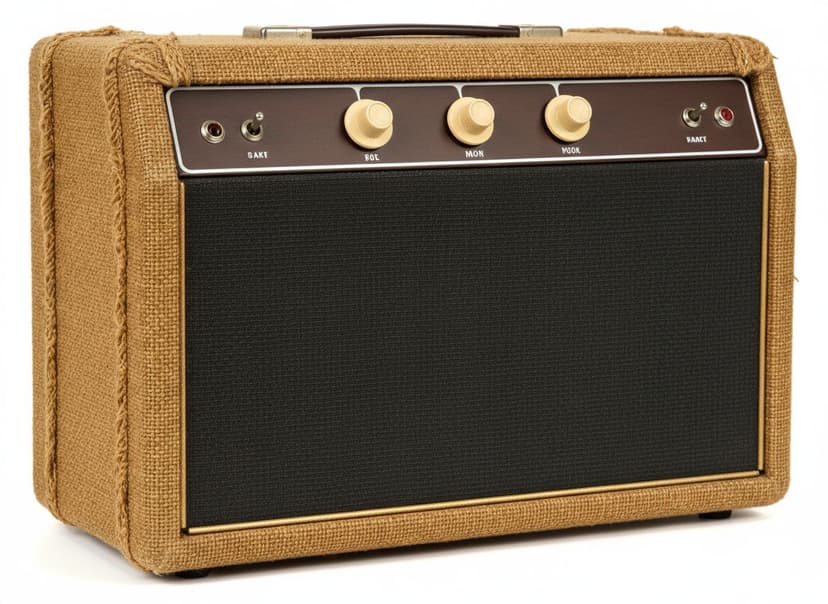
Vintage guitar amplifiers have appreciated substantially over the past two decades, driven by players who prefer tube circuits and by collectors chasing specific eras. Fender's tweed and blackface amps from the 1950s and 1960s form the core of the American market, with the Deluxe Reverb and Princeton Reverb being the most in-demand because their wattage suits modern recording and small venues. Marshall's plexi-panel amps from the 1960s lead the British side and reach five figures. Vox AC30s from the same era have their own following. The critical value variable across all vintage amps is originality of the transformers, speakers, and capacitors, since these components fail with age and replacements are routine. An amp with original transformers and speaker commands a large premium over one that has been rebuilt, even though the rebuilt amp may sound identical and be more reliable. Weight and shipping cost are real market frictions on large combos and heads.
Brand, model, and era set the framework, with Fender blackface and tweed, Marshall plexi, and Vox AC30 forming the blue chip categories. Originality of transformers is the single most checked variable, since output and power transformers fail and replacements are common, and buyers inspect date codes stamped on them. Original speakers matter almost as much, with correct Jensen, Oxford, or Celestion units adding significant value. Tube complement matters less because tubes are consumables, though original brand tubes add a small premium. Circuit modifications are generally a negative for collectors even when they improve tone, and reversible mods are preferred over permanent ones. Cosmetic condition covers tolex or tweed covering, grille cloth, and the faceplate, with original coverings preferred over recovering. Working condition is expected, and service by a competent tech with documentation is a positive.
Buying & Selling Tips
Buying
Check the transformer date codes. They confirm the era and reveal whether transformers have been replaced.
Verify the speaker is original by checking the code stamped on the frame. Correct speakers add real value.
Ask about circuit modifications. Even good-sounding mods reduce collector value, and reversibility matters.
Consider 1970s silverface Fenders for value. They are mechanically similar to blackface at a fraction of the price.
Factor in a tech service. Vintage amps typically need capacitor work and a safety check costing $200 to $600.
Selling
Photograph the chassis, transformer date codes, speaker frame, and tube chart. Buyers ask for all of them.
Disclose every modification. Vintage amp buyers open the chassis and undisclosed mods reliably cause disputes.
Have the amp serviced and safety checked before selling. A working, safe amp sells far faster.
Include an audio or video clip. Amps sell on tone and a demo converts buyers better than any description.
Sell locally for large combos. Shipping a Twin Reverb is expensive and transit damage is common.
Vintage Amplifiers FAQ
Why are vintage amps worth more than new ones?
Players value the tube circuits, original transformers, and speaker characteristics of 1950s and 1960s designs, and the supply is fixed. A blackface Deluxe Reverb brings $3,500 to $7,000 while a modern reissue costs around $1,200.
Does replacing transformers reduce an amp's value?
Yes, by roughly thirty to fifty percent. Original transformers are the most checked authenticity component in vintage amps, and buyers examine the date codes stamped on them.
Which vintage amp is the most valuable?
1960s Marshall plexi heads lead at $8,000 to $25,000, followed by 1950s Fender tweed Deluxe combos at $6,000 to $15,000 and 1960s Vox AC30 top boost models at $4,000 to $12,000.
Are silverface Fender amps worth buying?
They are the best value in vintage Fender. Mechanically similar to blackface models but selling for $800 to $2,200, they offer most of the same tone at a fraction of the collector price.
Do modifications hurt a vintage amp's value?
Yes, even when they improve the sound. Collectors pay for originality, so a modified amp sells below a stock one. Reversible modifications where original parts are retained are penalized less.
Got Vintage Amplifiers to Value?
Upload a photo and get a free AI-powered valuation in seconds. No sign-up required.