Last updated: September 2026
How Much Is a 2 Dollar Bill Worth?
Check current market values, learn what affects pricing, and get tips for buying and selling.
← All 2 Dollar Bill valuationsWhat do you want to value?
Get the free app for unlimited scans


Two Dollar Bills Price Guide
Current market values based on recent sales data and market trends.
| Item | Condition | Price Range |
|---|---|---|
| 1976 - present green seal | Circulated | $2 |
| 1976 green seal | Crisp Unc | $4 - $9 |
| 1976 Star Note | Crisp Unc | $20 - $60 |
| 1963 / 1963A Red Seal | VF | $6 - $14 |
| 1953 Red Seal | Crisp Unc | $25 - $45 |
| 1928 Red Seal | VF | $25 - $60 |
| 1928D / 1928G Red Seal | Crisp Unc | $90 - $200 |
| 1917 Large Size $2 | VF | $150 - $325 |
| 1896 $2 Educational Series | VF | $1,200 - $2,800 |
| Any year, Fancy Serial | Crisp Unc | $50 - $2,500 |
What Determines Two Dollar Bills Value
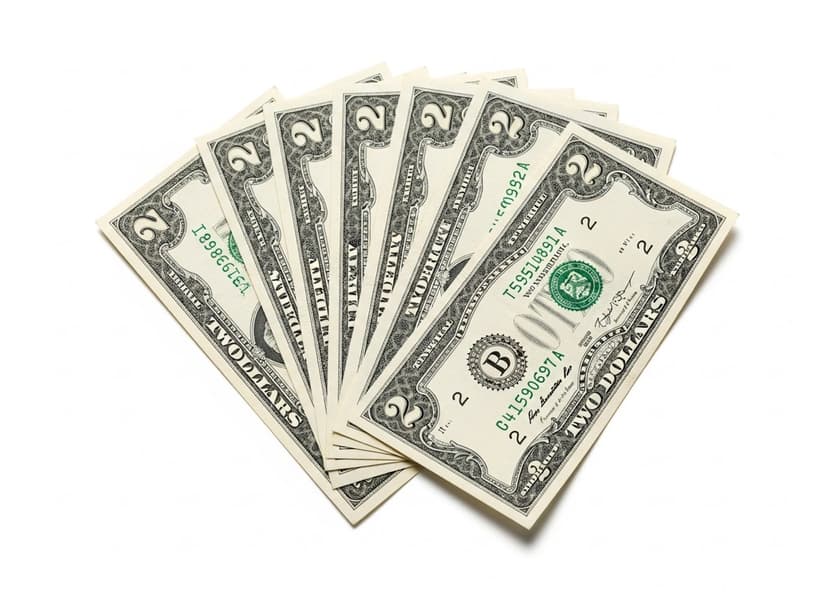
The two dollar bill is the most persistently overvalued note in American currency because people assume rarity from unfamiliarity. In reality the Bureau of Engraving and Printing has produced them continuously and they remain in production today, so a modern $2 bill from 1976 onward is worth exactly two dollars in circulated condition. The notes that are genuinely worth money fall into clear buckets: large-size notes from before 1929, red-seal United States Notes from 1928 through 1963, star notes, low or novelty serial numbers, and uncirculated notes from scarcer Federal Reserve districts. The 1976 bicentennial issue is the one people ask about most, and despite the widespread belief, roughly 590 million were printed. A first-day-of-issue 1976 note with an April 13, 1976 postmark is a collectible, but the plain note in a drawer is spending money.
Series year is the first filter and it splits the market hard: anything from 1976 forward is common, anything with a red seal has a modest premium, and large-size notes from 1928 and earlier are genuinely collectible. Condition is the second and it is unforgiving, since a note with a single fold moves from Crisp Uncirculated to About Uncirculated and loses a large share of its value. Star notes command a premium that varies enormously by print run, with some 1976 district stars printed in very small quantities. Serial number patterns form a parallel market where a $2 note with the serial 00000001 or 77777777 can be worth thousands regardless of series. First-day covers with the 1976 postmark are collectible as postal items rather than currency. Writing, stamps, folds, and tape all reduce value and cannot be reversed.
Buying & Selling Tips
Buying
Do not pay a premium for an ordinary circulated 1976 note. Hundreds of millions exist and banks still stock them.
Check the district letter and star status on 1976 notes before buying. Some star runs are 100 times scarcer than others.
For red seals, focus on crisp uncirculated examples. Circulated red seals are common enough to stay under $15.
Verify centering and margins on any uncirculated note. Poor centering is the most common reason a note grades below 65.
Ask your bank for sealed straps of new $2 bills to hunt serial numbers yourself at face value.
Selling
Look up your serial number pattern before selling. Buyers pay far more for a documented radar or repeater than for an unremarked note.
Store and ship notes flat in rigid currency holders. A crease created in transit destroys the premium you sold on.
Sell common 1976 notes in bundles rather than singly. The market for individual face-value notes barely covers postage.
Get any note you value above $150 graded by PMG. Raw high-grade notes are widely discounted by cautious buyers.
Include the Federal Reserve district in the title for 1976 star notes. Specialists search by district and will pay up for the ones they need.
Two Dollar Bills FAQ
Is a 1976 $2 bill worth anything?
In circulated condition it is worth $2. Roughly 590 million were printed. A crisp uncirculated example brings $4 to $9, and a star note from a scarce district can reach $20 to $60 or more.
Are $2 bills still printed?
Yes. The Bureau of Engraving and Printing produces them regularly, most recently in the 2017A and later series. They are simply requested less often by banks, which is why they feel rare.
What makes a $2 bill valuable?
A red Treasury seal, a large-size format from before 1929, a star at the end of the serial number, crisp uncirculated condition, or a novelty serial number such as a solid, ladder, or radar pattern.
How much is a red seal $2 bill worth?
Circulated red seals from 1953 and 1963 typically bring $6 to $14. Uncirculated examples run $25 to $45. Earlier 1928 series notes, especially the D and G sub-series, reach $90 to $200 in top condition.
Is my $2 bill worth more if the serial number is low?
Yes, and substantially so. Serial numbers under 100 are actively collected, and single-digit numbers can bring thousands. Solid numbers where all eight digits match are the most valuable pattern of all.
Got Two Dollar Bills to Value?
Upload a photo and get a free AI-powered valuation in seconds. No sign-up required.