Last updated: September 2026
How Much Are State Quarter Errors Worth?
Check current market values, learn what affects pricing, and get tips for buying and selling.
← All State Quarter Errors valuationsWhat do you want to value?
Get the free app for unlimited scans


State Quarter Errors Price Guide
Current market values based on recent sales data and market trends.
| Item | Condition | Price Range |
|---|---|---|
| 2004-D Wisconsin Extra Leaf High | MS-63 | $130 - $250 |
| 2004-D Wisconsin Extra Leaf Low | MS-63 | $110 - $220 |
| 2004-D Wisconsin Extra Leaf | MS-66 | $400 - $850 |
| 1999-P Delaware Spitting Horse | MS-63 | $15 - $30 |
| 2005 Minnesota Doubled Die Trees | MS-64 | $40 - $120 |
| 2005-P Kansas IN GOD WE RUST | MS-63 | $50 - $100 |
| 2000-P South Carolina Off-Center 40% | MS-62 | $100 - $220 |
| Any State Quarter on Nickel Planchet | MS-62 | $300 - $800 |
| Double-Struck State Quarter | MS-63 | $250 - $600 |
| 1999-P Georgia Experimental Planchet | MS-64 | $1,000 - $3,000 |
What Determines State Quarter Errors Value
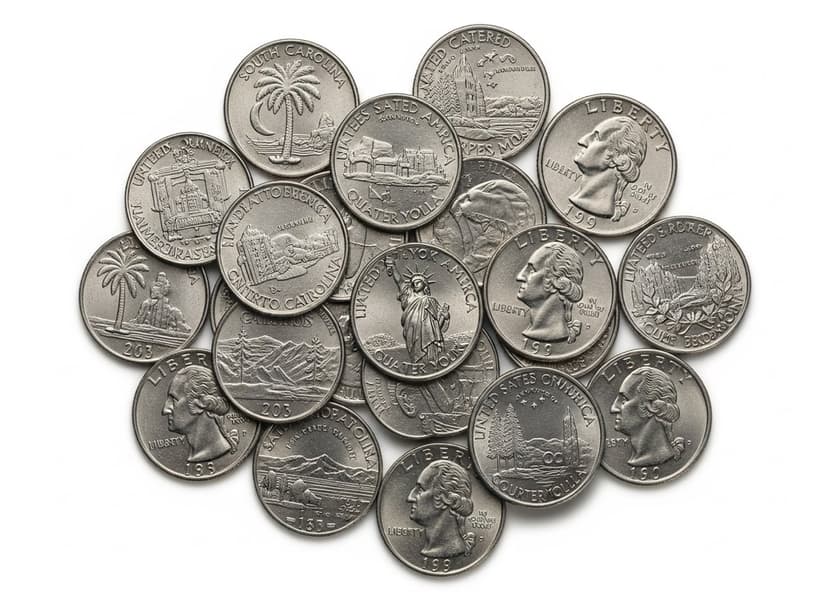
The 50 State Quarters program ran from 1999 to 2008 and produced roughly 34 billion coins, which is exactly why the errors from it are so widely hunted. High-speed production across two mints, fifty different reverse dies, and enormous public attention combined to make this the most error-rich modern series in US coinage. A handful of these errors have become genuinely famous and command real money: the 2004-D Wisconsin extra leaf, the 1999 Delaware spitting horse die crack, the 2005 Minnesota doubled die trees, and the 2005 Kansas IN GOD WE RUST grease-filled die. Most other reported errors are die deterioration, machine doubling, or post-mint damage, which are worth nothing. Knowing the difference between a genuine die variety and a damaged coin is the entire skill here.
The gap between a listed die variety and ordinary damage is the whole game. Genuine varieties like the Wisconsin extra leaf are cataloged, repeatable, and appear identically on every coin from that die, which is why they carry a market. Machine doubling, die deterioration doubling, and coins damaged in a vending machine look similar to a beginner and are worth face value. Beyond authenticity, grade drives price hard because most error coins were pulled from circulation already worn. Visual drama matters enormously for strike errors: a 40% off-center coin with a full date is worth many times a 5% off-center coin. Certification from PCGS, NGC, or ANACS is effectively required above $100, since buyers have been burned repeatedly by altered coins.
Buying & Selling Tips
Buying
Buy the certified coin, not the story. Any Wisconsin extra leaf over $100 should be in a PCGS or NGC holder with the variety attributed on the label.
Learn to recognize machine doubling before you buy anything described as a doubled die. Machine doubling looks flat and shelf-like, while true hub doubling has rounded, separated detail.
Check weight on every wrong-planchet claim. A digital scale accurate to 0.01 grams costs less than one mistake.
The Delaware spitting horse is common enough that you should never pay more than $25 for a circulated example.
Original bank rolls from 1999 to 2008 still turn up and are the cheapest way to hunt genuine finds yourself.
Selling
Get anything you believe is a Wisconsin extra leaf attributed before listing. Uncertified examples sell for a small fraction of certified ones.
Photograph the error area at high magnification and include a full-coin shot for context. Buyers will not bid on a close-up alone.
Use the correct variety terminology in your title, including the Cherrypickers or Wexler number when you have it.
Sell common errors like the spitting horse in group lots. Individually the shipping cost eats the profit.
Dramatic strike errors do better at specialist error auctions than on general marketplaces, where buyers undervalue them.
State Quarter Errors FAQ
What is the most valuable state quarter error?
The 1999-P Georgia struck on an experimental golden planchet is the top prize, selling in the $1,000 to $3,000 range. Among widely findable errors, the 2004-D Wisconsin extra leaf is the most valuable, reaching several hundred dollars in gem grades.
How do I know if my state quarter has a real error?
A genuine die error repeats identically on other coins from the same die and is cataloged in variety references. If the anomaly is unique to your coin, raised and shiny, or shows metal displaced rather than added, it is post-mint damage and carries no premium.
Are state quarters with no mint mark valuable?
No. State quarters struck at Philadelphia carry a P and Denver a D, and proofs from San Francisco carry an S. A quarter with a weak or grease-filled mint mark is a minor error worth a few dollars at most.
Is the Wisconsin extra leaf quarter still worth money?
Yes. It remains the flagship error of the series, with circulated examples bringing $80 to $150 and certified gems reaching $400 to $850. Both the high leaf and low leaf variants have active markets.
Can I still find state quarter errors in circulation?
Yes, though it takes volume. The series ended in 2008 but the coins still circulate heavily. Searching bank rolls is the standard approach, and the Kansas and Minnesota varieties turn up most often.
Got State Quarter Errors to Value?
Upload a photo and get a free AI-powered valuation in seconds. No sign-up required.