Last updated: September 2026
How Much Is an Opal Worth?
Check current market values, learn what affects pricing, and get tips for buying and selling.
← All Opals valuationsWhat do you want to value?
Get the free app for unlimited scans


Opals Price Guide
Current market values based on recent sales data and market trends.
| Item | Condition | Price Range |
|---|---|---|
| Black opal, 1 ct, bright multicolor | Lightning Ridge, solid | $1,000 - $6,000 per carat |
| Black opal, 1 ct, moderate color | Solid | $200 - $900 per carat |
| Boulder opal, 5 ct | Queensland, solid | $50 - $800 per carat |
| Crystal opal, 2 ct | Transparent, good color | $100 - $1,200 per carat |
| White / milky opal, 3 ct | Coober Pedy | $10 - $150 per carat |
| Ethiopian Welo opal, 3 ct | Bright, solid | $20 - $250 per carat |
| Fire opal, 2 ct | Mexican, faceted | $20 - $300 per carat |
| Opal doublet | Any size | $5 - $60 per carat |
| Opal triplet | Any size | $3 - $40 per carat |
| Synthetic opal | Any size | $2 - $20 per carat |
What Determines Opals Value
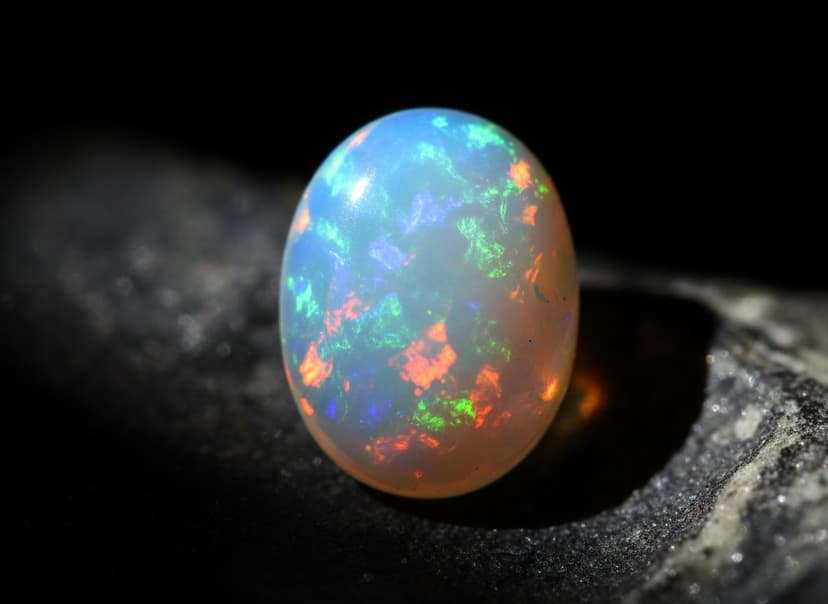
Opal is priced on entirely different criteria from other gemstones, because its value comes from play of color, the shifting spectral flashes produced by silica spheres diffracting light. Two opals of identical size and origin can differ in price by a hundred times based on how bright, complete, and directionally stable that play of color is. The type hierarchy runs black opal at the top, then boulder opal, then crystal, then white or milky opal at the bottom. Black opal from Lightning Ridge in New South Wales is the most valuable, because a dark body tone makes the color flashes appear far more vivid. Ethiopian Welo opal entered the market in quantity after 2008 and offers bright color at much lower prices, though it is hydrophane, meaning it absorbs water and can temporarily lose transparency or crack. Doublets and triplets, which are thin opal slices backed and capped with other materials, look impressive but are worth a small fraction of solid stones.
Play of color is the dominant variable and is assessed on brightness, the range of colors present, and whether the color holds from all viewing angles. Red is the rarest and most valuable flash color, followed by orange, then green, then blue, which is the most common. Body tone, graded on a scale from N1 for black to N9 for white, matters enormously because darker bodies make color appear more vivid. Pattern has its own hierarchy, with named patterns like harlequin, rolling flash, and Chinese writing commanding premiums over random pinfire. Solid versus doublet or triplet is a fundamental split that many buyers miss, and doublets are worth a small fraction. Origin matters, with Lightning Ridge black opal at the top. Finally, stability is a real concern: Ethiopian hydrophane opal can craze and crack, and any visible crazing eliminates most of the value.
Buying & Selling Tips
Buying
Check whether the stone is solid, doublet, or triplet by examining the side profile. A visible flat join line indicates an assembled stone.
View the opal from multiple angles under different lights. Play of color that disappears from one direction significantly reduces value.
Look for crazing, the fine network of surface cracks. It is progressive and there is no repair.
Prefer Australian solid opal for stability if the piece will be worn. Ethiopian hydrophane absorbs water and can change appearance temporarily.
Buy on brightness first. A small stone with vivid color outsells a large dull one at every size.
Selling
Photograph and video the opal in motion. Play of color cannot be conveyed in a still image and video measurably increases offers.
State clearly whether the stone is solid. Buyers assume doublet unless told otherwise and price accordingly.
Do not store opals in dry environments or under hot lights before sale. Dehydration can trigger crazing.
Have valuable black opals appraised with a body tone grade. Buyers use the N scale and a documented grade builds confidence.
Sell Australian opals through specialist dealers or Australian auction channels where the grading conventions are understood.
Opals FAQ
What makes an opal valuable?
Brightness and completeness of play of color first, then body tone, with darker bodies commanding higher prices. Red flashes are the rarest and most valuable, and named patterns like harlequin add substantial premiums.
Why is black opal the most expensive?
A dark body tone provides contrast that makes the spectral colors appear dramatically more vivid. Black opal comes almost exclusively from Lightning Ridge in Australia and fine examples reach $1,000 to $6,000 per carat.
What is the difference between a solid opal and a doublet?
A solid opal is one continuous piece of precious opal. A doublet is a thin slice of opal glued to a dark backing to enhance color, and a triplet adds a clear cap on top. Assembled stones are worth a small fraction of solids.
Do Ethiopian opals crack?
Ethiopian Welo opal is hydrophane, meaning it absorbs water and can temporarily turn transparent or, in some cases, craze permanently. It is beautiful and affordable but less stable than Australian opal for daily wear.
How can you tell a synthetic opal?
Under magnification synthetic opal shows a regular columnar or snakeskin structure, and the color patches often appear too uniform. Natural opal has irregular, organic patterning that synthetics do not reproduce convincingly.
Got Opals to Value?
Upload a photo and get a free AI-powered valuation in seconds. No sign-up required.