Last updated: September 2026
How Much Are Longaberger Baskets Worth?
Check current market values, learn what affects pricing, and get tips for buying and selling.
← All Longaberger Baskets valuationsWhat do you want to value?
Get the free app for unlimited scans


Longaberger Baskets Price Guide
Current market values based on recent sales data and market trends.
| Item | Condition | Price Range |
|---|---|---|
| J.W. Longaberger signed basket, 1970s | Excellent | $150 - $900 |
| Collectors Club exclusive edition | Excellent with accessories | $40 - $200 |
| Christmas Collection basket, 1980s | Excellent, complete | $30 - $120 |
| Large market or laundry basket | Excellent | $25 - $80 |
| Common medium basket, 1990s-2000s | Excellent | $10 - $30 |
| Small basket, common | Excellent | $6 - $18 |
| Basket with liner, protector, and lid | Complete | +$10 - $30 |
| Pottery or wrought iron accessories | Excellent | $15 - $60 |
| Large collection lot, 20+ baskets | Mixed | $100 - $400 |
| Any basket with stains or broken weave | Damaged | $2 - $8 |
What Determines Longaberger Baskets Value
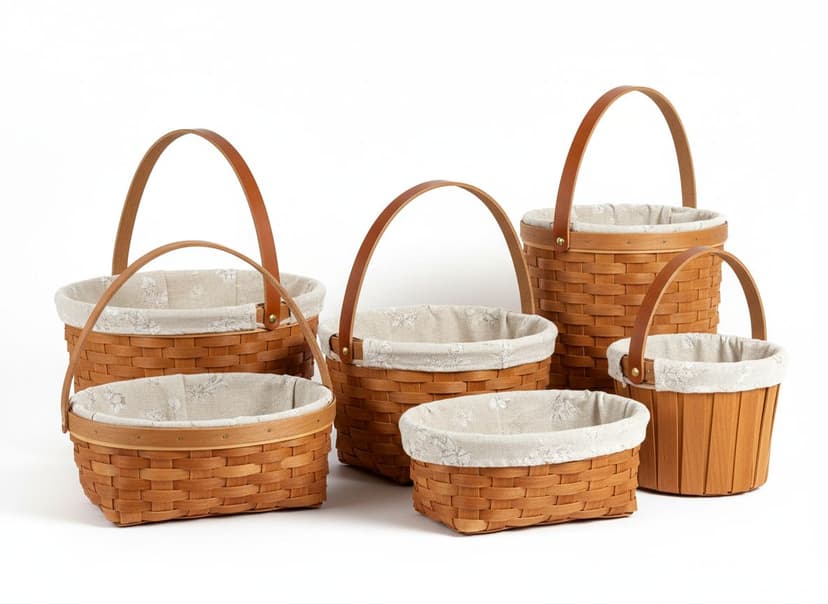
Longaberger baskets are the definitive cautionary tale of the direct-sales collectible. The company sold hand-woven maple baskets through home parties from the 1970s through the 2010s, and their marketing explicitly positioned them as heirloom investments, with signed and dated bottoms, annual editions, and a collectors club. Buyers paid forty to two hundred dollars per basket. Today a typical basket sells for eight to thirty dollars, and large collections routinely go unsold at estate sales. The reasons are the standard ones: enormous production, a collector base that aged out, and no demand from younger buyers who see them as decorative storage. Value survives in a narrow set of exceptions: the earliest hand-signed baskets by J.W. Longaberger, certain small-production collectors club editions, and complete sets with their original liners, protectors, and lids. The signature and date woven into or written on the bottom identifies the maker and year.
Age and signature drive the only genuinely valuable segment, since baskets signed by J.W. Longaberger himself in the 1970s predate mass production. Edition type matters, with collectors club exclusives and limited annual editions produced in smaller numbers than standard retail baskets. Completeness with the correct fabric liner, plastic protector, and lid adds real value because those accessories were sold separately and are frequently missing. Size and practical utility affect demand, with large market and laundry baskets selling better than small decoratives because buyers actually use them. Condition covers weave breaks, which are difficult to repair, staining of the maple, and any warping. The overarching factor is oversupply: the company produced baskets in enormous quantities and the original collector base is liquidating, which means realistic pricing is far below what owners paid.
Buying & Selling Tips
Buying
Check the bottom for a signature and date. J.W. Longaberger signed baskets from the 1970s are the only consistently valuable group.
Buy baskets with their liners and protectors. The accessories add value and are hard to source separately.
Prefer large practical sizes. Market and laundry baskets sell because people use them, while small decoratives do not.
Inspect the weave for breaks and the maple for staining. Both are difficult to repair.
Buy in bulk lots if you want inventory. Estate sale collections often go for a few dollars per basket.
Selling
Set expectations realistically. A basket that cost $90 new typically sells for $10 to $30 today.
Photograph the signed and dated bottom. It is the first thing informed buyers look for.
Include liners, protectors, and lids and mention them in the title. They add meaningfully to the price.
Sell in lots rather than individually. Shipping a single basket rarely justifies the effort.
Consider local sale or donation for large collections. The per-basket return often does not justify individual listings.
Longaberger Baskets FAQ
Are Longaberger baskets worth anything?
Most sell for $8 to $30 against original retail prices of $40 to $200. Baskets personally signed by J.W. Longaberger in the 1970s are the exception, bringing $150 to $900.
Why did Longaberger baskets lose value?
They were produced in enormous quantities and marketed as investments through home parties. The original collector base has aged out and is liquidating simultaneously, while younger buyers see them as ordinary storage baskets.
How do I find the year of my Longaberger basket?
Look at the bottom, where the weaver signed and dated the basket. Founder-signed examples from the 1970s carry the initials J.W. and are far more valuable than later production.
Do liners and protectors add value?
Yes, roughly $10 to $30 per basket. They were sold separately, are frequently missing, and complete sets sell noticeably better than bare baskets.
What is the best way to sell a large Longaberger collection?
Sell in bulk lots locally rather than listing individually. A twenty-basket lot typically brings $100 to $400, and the shipping cost of individual baskets usually exceeds their value.
Got Longaberger Baskets to Value?
Upload a photo and get a free AI-powered valuation in seconds. No sign-up required.