Last updated: September 2026
How Much Is Junk Silver Worth?
Check current market values, learn what affects pricing, and get tips for buying and selling.
← All Silver Coins valuationsWhat do you want to value?
Get the free app for unlimited scans


Junk Silver Coins Price Guide
Current market values based on recent sales data and market trends.
| Item | Condition | Price Range |
|---|---|---|
| Roosevelt / Mercury Dime (pre-1965) | Circulated | $2.50 - $3.20 |
| Washington Quarter (pre-1965) | Circulated | $6.20 - $8.00 |
| Franklin / Kennedy Half (1964) | Circulated | $12.50 - $16.00 |
| Morgan / Peace Dollar | Circulated | $26 - $34 |
| $1 Face Value, 90% mixed | Circulated | $25 - $32 |
| $10 Face Value Roll of Quarters | Circulated | $250 - $320 |
| $100 Face Value Bag | Circulated | $2,500 - $3,200 |
| Kennedy Half 1965-1970 (40%) | Circulated | $4.50 - $6.50 |
| War Nickel 1942-1945 | Circulated | $1.30 - $2.00 |
| Canadian Pre-1967 Silver | Circulated | $2.20 - $2.90 per dime |
What Determines Junk Silver Coins Value
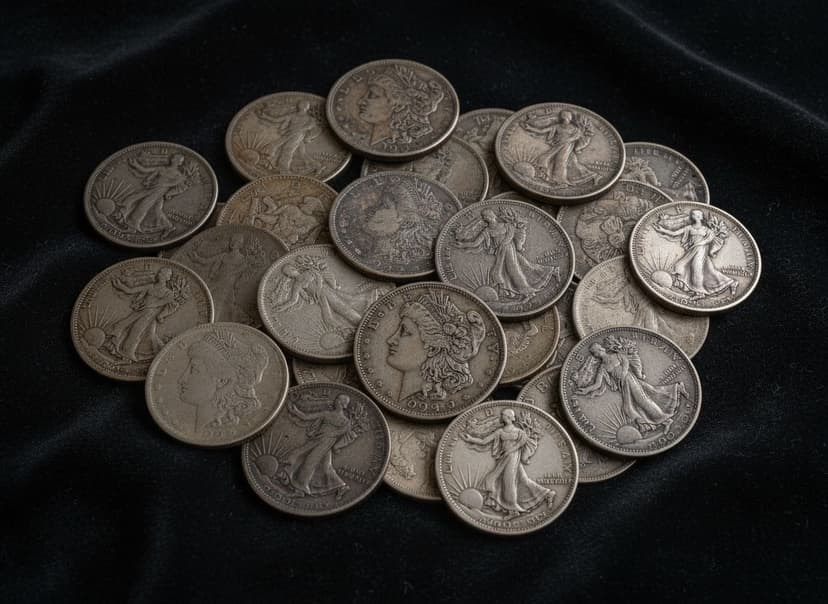
Junk silver is the trade name for pre-1965 US circulating coinage that contains 90% silver but carries no collector premium beyond its metal content. The term is not an insult; it simply means the coins are too worn or too common to interest numismatists, so they trade purely on weight. This is the cheapest way to own physical silver in small, divisible units, which is why it is a staple of both stackers and preparedness buyers. The math is simple and worth memorizing: one dollar of face value in 90% silver coins contains approximately 0.715 troy ounces of pure silver, accounting for typical circulation wear. That figure lets you value any bag instantly regardless of the mix of dimes, quarters, and halves inside it. The 40% silver Kennedy halves from 1965 to 1970 are a separate, lower-value tier and should never be mixed into a 90% lot.
Junk silver value is almost entirely a function of two numbers: the current silver spot price and the dealer premium over melt. That premium fluctuates with retail demand and has ranged from near zero to over 30% during buying panics, so timing matters as much as spot price. Composition determines which tier a coin falls into: 90% for pre-1965 dimes, quarters, halves, and dollars, 40% for 1965 to 1970 Kennedy halves, and 35% for 1942 to 1945 war nickels. Wear reduces silver content slightly, which is why the standard 0.715 troy ounces per dollar of face value is used instead of the theoretical 0.7234. Dollars are the exception to the junk silver rule since Morgan and Peace dollars carry a numismatic premium even in worn condition. Cull coins that are holed, bent, or heavily damaged trade at a discount to standard junk silver.
Buying & Selling Tips
Buying
Compare the premium per ounce, not the price per coin. Dividing the ask by the silver content is the only way to compare a dime roll against a half dollar bag.
Dimes and quarters usually carry the lowest premium and are the most divisible, making them the practical choice for stacking.
Buy during quiet markets. Premiums spike hardest during retail buying frenzies, often adding more cost than a spot price move.
Weigh any bag you receive. A $100 face bag should weigh close to 71.5 troy ounces of silver content, roughly 2,500 grams gross.
Sort before you buy in person. Key dates and mint marks occasionally hide in junk lots and cost the same as common coins.
Selling
Sort out anything with numismatic value first. Key dates, high-grade examples, and Morgan dollars should never be sold at melt.
Get quotes from at least three dealers. Buy prices on junk silver vary widely between shops on the same day.
Separate 90%, 40%, and 35% coins into different lots. Dealers price mixed bags at the lowest common denominator.
Sell in standard face-value increments such as $10, $50, or $100. Odd amounts get lowballed for the inconvenience.
Watch spot before you sell. Junk silver tracks the metal almost perfectly, so a good week can add ten percent to your total.
Junk Silver Coins FAQ
What coins count as junk silver?
US dimes, quarters, half dollars, and dollars dated 1964 or earlier are 90% silver. Kennedy halves from 1965 to 1970 are 40% silver, and Jefferson war nickels from 1942 to 1945 are 35% silver. All of these are traded as junk silver.
How much silver is in $1 face value of junk silver?
Approximately 0.715 troy ounces of pure silver after accounting for circulation wear. The theoretical figure for uncirculated coins is 0.7234 troy ounces, but the lower number is the industry standard for pricing.
Is junk silver a good way to buy silver?
It is one of the cheapest and most divisible ways to own physical silver, and it is instantly recognizable to any buyer. The trade-off is that premiums can spike sharply during high-demand periods, sometimes exceeding those on bullion rounds.
How do I tell if a coin is 90% silver?
Check the date first: dimes, quarters, and halves dated 1964 or earlier are 90% silver. Then look at the edge. A silver coin shows a solid gray edge with no copper stripe, which is the fastest visual confirmation.
Are silver dollars considered junk silver?
Not usually. Morgan and Peace dollars contain 0.7734 troy ounces of silver but carry a collector premium even in worn condition, so they trade above melt and are priced separately from junk silver bags.
Got Junk Silver Coins to Value?
Upload a photo and get a free AI-powered valuation in seconds. No sign-up required.