Last updated: September 2026
How Much Are Griswold and Wagner Skillets Worth?
Check current market values, learn what affects pricing, and get tips for buying and selling.
← All Cast Iron Skillets valuationsWhat do you want to value?
Get the free app for unlimited scans


Griswold & Wagner Skillets Price Guide
Current market values based on recent sales data and market trends.
| Item | Condition | Price Range |
|---|---|---|
| Griswold No. 3 small logo skillet | Excellent, flat | $40 - $110 |
| Griswold No. 8 large block logo | Excellent, flat | $90 - $220 |
| Griswold No. 10 large block logo | Excellent | $100 - $260 |
| Griswold No. 13 or larger | Excellent | $300 - $1,500 |
| Griswold No. 0 or No. 2 | Excellent | $120 - $500 |
| Wagner Ware Sidney O | Excellent | $45 - $150 |
| Griswold Dutch oven with lid | Excellent, matched | $150 - $600 |
| Unmarked vintage cast iron | Excellent | $20 - $60 |
| Any piece with a crack | Damaged | $5 - $25 |
| Warped or heavily pitted pan | Poor | $10 - $35 |
What Determines Griswold & Wagner Skillets Value
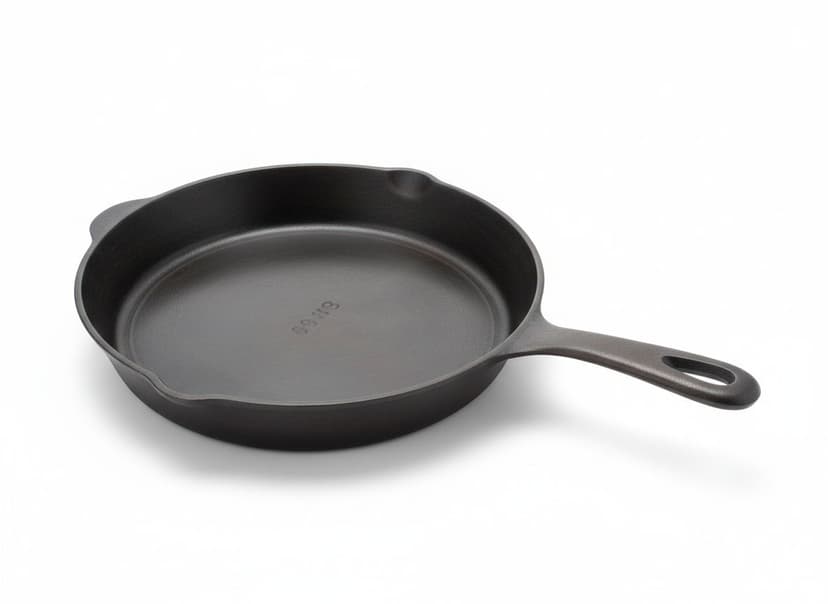
Vintage American cast iron from Griswold and Wagner is prized because pre-1950s manufacturing produced pans that were machined smooth on the cooking surface, unlike the rough sand-cast finish of modern cast iron. That difference is real and functional, which gives this market genuine users alongside collectors. Value is driven by maker, size number, logo era, and condition. Griswold used several logos over its production life, and the large block logo from the 1920s and the smaller block logo from the 1940s date pieces precisely. Size numbers are cast into the pan and run from 0 through 20, with the very small and very large sizes being far scarcer than the common 6, 8, and 10. Condition assessment is specific to cast iron: collectors check for cracks, which are fatal, warping tested by spinning the pan on a flat surface, and pitting from rust, which cannot be removed. Restored pans that have been properly stripped and re-seasoned sell well.
Maker and logo era establish the baseline, with Griswold commanding a consistent premium over Wagner for equivalent pieces, and both well above unmarked iron. Size number drives scarcity, and the extremes of the range are far rarer than the common cooking sizes. Condition is assessed on three specific criteria: cracks, which are fatal and often hide under seasoning at the handle join, warping, tested by spinning the pan or laying a straightedge across the base, and pitting from rust, which is permanent even after stripping. Heat ring presence on the bottom, a raised ring found on earlier pieces, is a dating marker collectors look for. Restoration quality matters, and a properly stripped and seasoned pan sells for more than a crusty untouched one, though over-aggressive grinding of the cooking surface reduces value. Matched lids on Dutch ovens add substantially since they are frequently separated.
Buying & Selling Tips
Buying
Spin the pan on a flat counter. Any wobble indicates warping, which cannot be corrected and affects cooking.
Inspect the handle join and rim carefully for cracks. They hide under seasoning and are the most common fatal defect.
Learn the logo eras. A large block logo Griswold is worth noticeably more than a later small logo version of the same size.
Check for pitting after stripping if buying a rusty pan. Pitting is permanent and is the main risk in a restoration purchase.
Consider Wagner for use rather than collecting. The cooking quality is comparable and the price is consistently lower.
Selling
Strip and season the pan properly before selling. A clean, well-seasoned pan sells for substantially more than a rusty one.
Photograph the bottom logo, the cooking surface, and the pan on a flat surface from eye level to show flatness.
Disclose any warping or pitting. Buyers test for both immediately and undisclosed issues cause returns.
Sell Dutch ovens with matched lids. A correct matching lid can double the value of the base.
State the size number and logo era in the title. Collectors search by both and generic listings get missed.
Griswold & Wagner Skillets FAQ
Why is old cast iron better than new?
Pre-1950s manufacturers machined the cooking surface smooth after casting, producing a glassy finish that releases food better. Modern cast iron is left with the rough sand-cast texture, which is why vintage pans command a premium.
How much is a Griswold skillet worth?
A common No. 8 with the large block logo in good flat condition brings $90 to $220. Very small sizes like the No. 0 and very large ones like the No. 13 and up reach $300 to $1,500 because of their scarcity.
How do I check if a cast iron pan is warped?
Spin it on a flat counter and watch for wobble, or lay a straightedge across the cooking surface and look for light underneath. Warping is permanent and affects cooking on flat and induction ranges.
Is Wagner cast iron as good as Griswold?
Functionally yes. Wagner Ware pans from the same era have comparable machining and cooking performance but sell for roughly half the price, which makes them the better buy for actual cooking.
Does rust ruin a cast iron pan?
Surface rust is removable by stripping and re-seasoning. Deep pitting left behind after rust removal is permanent and reduces both cooking performance and value, so inspect carefully before buying a rusty pan.
Got Griswold & Wagner Skillets to Value?
Upload a photo and get a free AI-powered valuation in seconds. No sign-up required.