Last updated: September 2026
How Much Is Fine China Worth?
Check current market values, learn what affects pricing, and get tips for buying and selling.
← All China & Porcelain valuationsWhat do you want to value?
Get the free app for unlimited scans


Fine China Price Guide
Current market values based on recent sales data and market trends.
| Item | Condition | Price Range |
|---|---|---|
| Common Noritake or Mikasa service for 12 | Excellent | $100 - $300 |
| Lenox service for 12, gold rim | Excellent | $200 - $600 |
| Wedgwood bone china service for 12 | Excellent | $300 - $900 |
| Royal Doulton or Royal Albert set | Excellent | $200 - $700 |
| Discontinued pattern, per dinner plate | Excellent | $15 - $60 |
| Serving pieces (teapot, tureen) | Excellent | $40 - $250 |
| Hand-painted Limoges, artist signed | Excellent | $150 - $2,000 |
| Meissen or Sevres, 19th century | Excellent | $500 - $20,000 |
| Any set with chips or gold wear | Good | 30% - 50% of perfect |
| Unmarked or unidentified china | Excellent | $40 - $150 per set |
What Determines Fine China Value
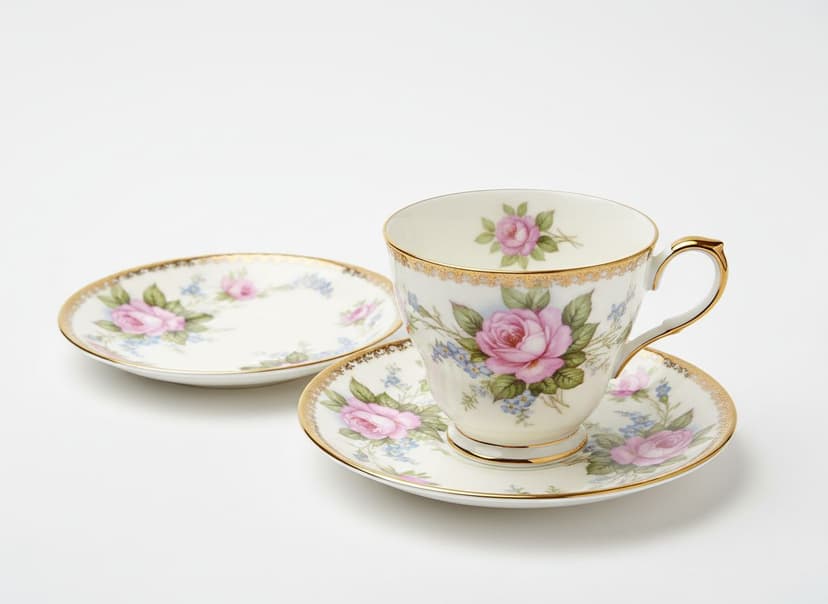
Fine china is the clearest example of a collapsed category in household antiques, and setting expectations correctly is the most useful thing this guide can do. A twelve-place formal service that cost three thousand dollars in 1985 typically sells for two hundred to six hundred today. The cause is straightforward: formal dining has declined, younger households do not want hand-wash-only dishware, and estates are liquidating simultaneously as the generation that received china as wedding gifts downsizes. Value survives in specific pockets. Discontinued patterns still needed by people replacing broken pieces command real prices per item through replacement services. Heavily gilded and hand-painted patterns from Meissen, Sèvres, and top-tier Limoges are genuine antiques rather than tableware and price accordingly. Serving pieces, especially teapots, covered vegetable dishes, and large platters, are worth several times a dinner plate because they broke more often and fewer were bought.
Maker and pattern determine almost everything, and the difference between a mass-market Japanese pattern and nineteenth-century Meissen is three orders of magnitude. Pattern discontinuation is a positive factor for per-piece value, because people who own the pattern need replacements and pay well above the set-price-per-item rate. Completeness of a service matters less than people expect, since buyers rarely want twelve place settings, and selling individual pieces to replacement buyers often realizes more than selling the set. Serving pieces command large premiums over flatware. Condition centers on gold rim wear, which comes from dishwasher use and utensil contact and cannot be restored, and on chips and crazing. Hand-painted versus transfer-printed decoration is a major distinction, with artist-signed hand painting worth many times a printed pattern. Finally, the maker's mark on the base is essential, and unmarked china is difficult to value at all.
Buying & Selling Tips
Buying
Check the backstamp first. Maker and pattern name determine the value range before anything else.
Look for gold rim wear by tilting the piece under light. Worn gold cannot be restored and is very common.
Buy serving pieces rather than place settings if buying for value. The scarcity ratio strongly favors them.
Distinguish hand-painted from transfer-printed decoration. Hand painting shows brush texture and slight variation between pieces.
Use replacement services to check per-piece values. They reveal which patterns have real ongoing demand.
Selling
Sell to replacement services or individually rather than as a full set. Per-piece sales to people replacing breakage realize far more.
Identify the pattern name precisely. Buyers search by pattern and an unidentified set is nearly unsellable.
Photograph the backstamp, a plate face, and any serving pieces separately.
Do not put china with gold decoration in a dishwasher. A single cycle can wear the gold and cost most of the value.
Set realistic expectations with family. Inherited formal china almost never approaches its original retail price.
Fine China FAQ
Why is fine china worth so little now?
Formal dining has declined sharply, younger households avoid hand-wash-only dishware, and estates are liquidating simultaneously. A service that cost $3,000 in the 1980s commonly sells for $200 to $600 today.
Is it better to sell china as a set or by the piece?
By the piece, in most cases. People replacing broken items from their own pattern pay $15 to $60 per dinner plate, which usually exceeds what a full twelve-place service brings as a single lot.
Which china patterns are actually valuable?
Nineteenth-century Meissen and Sèvres, artist-signed hand-painted Limoges, and certain discontinued patterns with active replacement demand. Mass-market twentieth-century patterns are worth the least.
Does gold rim wear affect china value?
Significantly. Worn gold banding cannot be restored and typically reduces value by half. It comes from dishwasher detergent and utensil contact, which is why collectors insist on hand washing.
How can I identify my china pattern?
Check the backstamp on the underside, which usually gives the maker and often the pattern name. If the pattern name is absent, replacement services maintain searchable visual databases organized by maker.

Got Fine China to Value?
Upload a photo and get a free AI-powered valuation in seconds. No sign-up required.