Last updated: September 2026
How Much Is Depression Glass Worth?
Check current market values, learn what affects pricing, and get tips for buying and selling.
← All Depression Glass valuationsWhat do you want to value?
Get the free app for unlimited scans


Depression Glass Price Guide
Current market values based on recent sales data and market trends.
| Item | Condition | Price Range |
|---|---|---|
| Cherry Blossom pitcher, pink | Excellent | $80 - $250 |
| Royal Lace cobalt blue pitcher | Excellent | $200 - $600 |
| Royal Lace cobalt dinner plate | Excellent | $40 - $90 |
| American Sweetheart pink plate | Excellent | $12 - $35 |
| Mayfair Open Rose blue pitcher | Excellent | $150 - $450 |
| Common pattern dinner plate, pink or green | Excellent | $6 - $20 |
| Butter dish with lid, any pattern | Excellent | $50 - $400 |
| Cookie jar with lid | Excellent | $60 - $350 |
| Complete service for 8 | Excellent, matched | $150 - $900 |
| Reproduction piece | Any | $3 - $15 |
What Determines Depression Glass Value
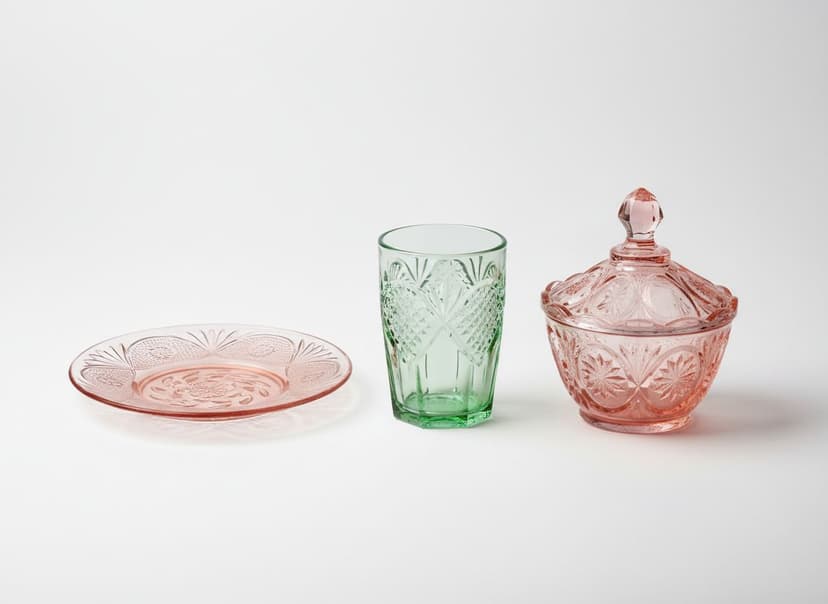
Depression glass was machine-pressed colored glassware given away free or sold very cheaply during the 1920s and 1930s, often as a promotion in cereal boxes or at movie theaters. Its inexpensive origin is exactly why collectors value it, since the glass was used, broken, and discarded rather than preserved, making complete sets scarce despite enormous original production. Value depends on pattern, color, and form, and those three variables interact in ways that surprise newcomers. Pink and green were the most common colors and are worth the least; cobalt blue, amethyst, and certain yellows are far scarcer. Within any pattern, unusual serving forms like pitchers, butter dishes, and cookie jars are worth many times the plates and cups. The most important practical concern is reproductions, which have been produced since the 1970s in many popular patterns, and learning the specific tells for each pattern is essential before buying anything expensive.
Pattern is the framework and reference guides catalog hundreds of them, with a small number carrying most of the value. Color is a large multiplier within any pattern, since manufacturers produced far more pink and green than cobalt, amethyst, or delphite. Form rarity often outweighs both, because pitchers, butter dishes, cookie jars, and covered pieces were used hardest and broke most, while plates survived. Condition matters and depression glass collectors accept minor manufacturing flaws like straw marks and mold seams as authentic, but chips, cracks, and cloudiness from dishwasher use all reduce value substantially. Reproductions are the dominant practical risk, and each reproduced pattern has known tells involving weight, mold detail sharpness, and slight color differences. Completeness of sets adds a premium, and matching color across a set is harder than it sounds because production varied between runs.
Buying & Selling Tips
Buying
Learn the reproduction tells for any pattern you collect. Cherry Blossom and Mayfair in particular have been reproduced extensively.
Weigh a piece in your hand. Reproductions are typically heavier and have sharper, cleaner mold detail than originals.
Check for dishwasher cloudiness by holding the piece to light. It is permanent etching and cannot be polished out.
Buy scarce forms rather than plates. Pitchers and covered pieces carry the value in every pattern.
Prioritize cobalt, amethyst, and unusual colors. They were produced in far smaller quantities than pink and green.
Selling
Identify the pattern precisely and name it in the title. Collectors search by pattern name and generic listings get overlooked.
Photograph in natural light against white to show true color. Depression glass color is the main value variable after pattern.
Run a finger around every rim and check for chips. Undisclosed chips are the top cause of returns.
Sell rare forms individually and common plates in sets. The value spread justifies different approaches.
Pack each piece separately with generous cushioning. Thin pressed glass breaks easily in transit.
Depression Glass FAQ
What is depression glass?
It is machine-pressed colored glassware made in the 1920s and 1930s and distributed very cheaply, often free in cereal boxes or at movie theaters. Its low original cost meant it was used and broken rather than saved, which makes complete sets scarce today.
Which depression glass colors are the most valuable?
Cobalt blue, amethyst, and certain yellows and delphite blues are the scarcest and command the highest prices. Pink and green were produced in the largest quantities and are worth the least.
How can I tell if depression glass is a reproduction?
Reproductions are usually heavier, have sharper and cleaner mold detail, and show slightly different color saturation. Each reproduced pattern has specific tells documented in collector guides, so pattern-specific research is essential.
Does dishwasher use ruin depression glass?
Yes. Modern dishwasher detergent etches the glass surface, producing a permanent cloudiness that cannot be polished out. Cloudy pieces sell for a fraction of clear ones.
Which depression glass pieces are worth the most?
Pitchers, butter dishes with lids, cookie jars, and other covered serving forms in scarce colors bring the most, often $150 to $600. Plates and cups in common colors are worth $6 to $20.
Got Depression Glass to Value?
Upload a photo and get a free AI-powered valuation in seconds. No sign-up required.