Last updated: September 2026
How Much Is a Bicentennial Quarter Worth?
Check current market values, learn what affects pricing, and get tips for buying and selling.
← All Bicentennial Quarter (1776-1976) valuationsWhat do you want to value?
Get the free app for unlimited scans


Bicentennial Quarters Price Guide
Current market values based on recent sales data and market trends.
| Item | Condition | Price Range |
|---|---|---|
| 1976 Clad (no mint mark) | Circulated | $0.25 |
| 1976-D Clad | Circulated | $0.25 |
| 1976 Clad | MS-66 | $18 - $35 |
| 1976-D Clad | MS-67 | $200 - $450 |
| 1976-S Silver (40%) | MS-65 | $8 - $14 |
| 1976-S Silver Proof | PR-69 DCAM | $25 - $50 |
| 1976-S Clad Proof | PR-69 DCAM | $10 - $20 |
| 1976-D Doubled Die Obverse | AU-50 | $40 - $90 |
| Struck on Wrong Planchet | MS-62 | $400 - $1,500 |
| Double Struck / Off-Center 50% | MS-63 | $250 - $700 |
What Determines Bicentennial Quarters Value
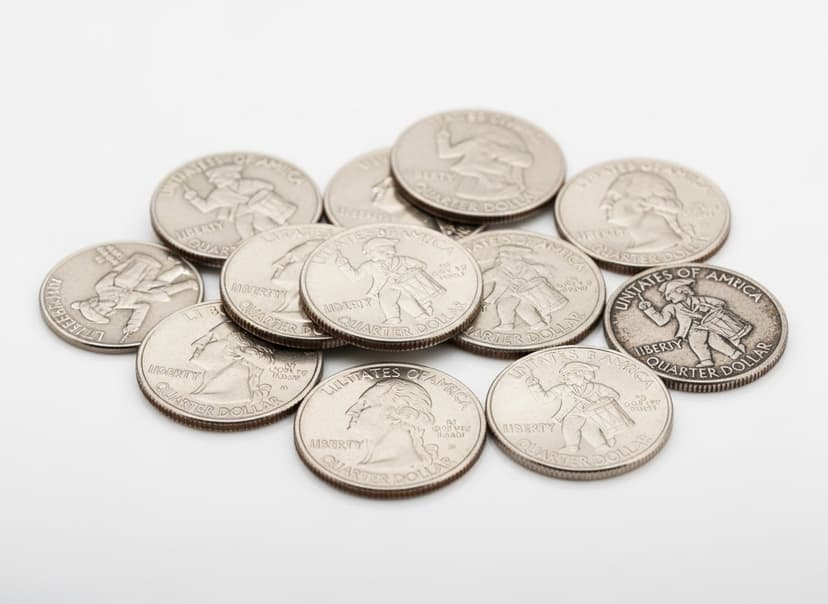
The dual-dated 1776-1976 quarter with the Colonial drummer boy reverse is the single most misidentified coin in America. Well over 1.6 billion were struck for circulation, which means the ordinary one in your change jar is worth exactly 25 cents and always will be. What people are actually searching for are the three exceptions: the 40% silver collector versions sold by the Mint in three-piece sets, the high-grade gems that grade MS-67 or above, and genuine mint errors. The silver versions were never released into circulation and are identifiable by an S mint mark and a silver-gray edge with no copper stripe. Everything else is a common clad quarter, no matter how many social media videos suggest otherwise.
Composition is the first split: a 40% silver S-mint coin has intrinsic metal value, a clad coin does not. After that, grade is the only lever that matters for normal coins, and the curve is brutally steep. An MS-65 clad Bicentennial quarter is worth a couple of dollars while an MS-67 of the same date can bring several hundred, because almost none survived that well in a coin nobody bothered to protect. Strike quality on the drummer boy's fingers and the drum rope separates gems from average coins. Genuine mint errors carry their own market and are priced by dramatic visual impact, not by date. Toning, doubling from die deterioration, and post-mint damage are routinely mistaken for value and are worth nothing.
Buying & Selling Tips
Buying
Do not pay a premium for a raw Bicentennial quarter described as rare. Certified population data makes clear that only the top grades are scarce.
Buy silver S-mint examples in original Mint packaging. The set premium is small and the packaging proves composition instantly.
If you are chasing MS-67 clad coins, buy the coin and not the holder. Look for full drum rope detail and clean fields under a loupe.
For error coins, weight is your authentication tool. A standard clad quarter weighs 5.67 grams and a 40% silver one weighs 5.75 grams.
Avoid coins advertised as struck-through, doubled, or clipped without third-party certification. Post-mint damage is extremely common.
Selling
Be realistic about circulated coins. Listing a common clad quarter for hundreds of dollars wastes your time and gets no bids.
Sell silver S-mint quarters in lots by weight when silver is high. Individually they carry too little premium to justify separate listings.
Submit only coins you believe will grade MS-66 or above. Grading fees exceed the value of anything lower.
Photograph errors on a neutral gray background with raking light. Off-center strikes and planchet errors sell almost entirely on image quality.
Original three-piece silver sets sell better intact than broken up, especially with the outer envelope in clean condition.
Bicentennial Quarters FAQ
Is my 1776-1976 quarter worth anything?
Almost certainly 25 cents. Over 1.6 billion were struck for circulation and they were saved in huge numbers. Only 40% silver S-mint versions, coins grading MS-66 or higher, and genuine mint errors are worth more than face value.
How do I tell if my Bicentennial quarter is silver?
Check for an S mint mark below Washington's ponytail and look at the edge. Silver versions show a solid gray edge, while clad coins show a copper-colored stripe. Silver examples also weigh 5.75 grams versus 5.67 for clad.
Why do people say Bicentennial quarters are worth thousands?
Those claims almost always come from viral videos citing auction records for a handful of certified MS-68 coins or dramatic mint errors. Those specific coins are real, but they represent a tiny fraction of one percent of the mintage.
Are there Bicentennial quarters with no mint mark that are valuable?
A missing mint mark on a Bicentennial quarter just means it was struck in Philadelphia, which produced over 800 million of them. It is not an error and adds no value on its own.
Should I get my Bicentennial quarter graded?
Only if it is uncirculated with sharp drummer boy detail and clean fields, or if it shows a dramatic error. Grading costs $25 to $40 per coin, which exceeds the value of any circulated example.
Got Bicentennial Quarters to Value?
Upload a photo and get a free AI-powered valuation in seconds. No sign-up required.