Last updated: September 2026
How Much Are Basketball Rookie Cards Worth?
Check current market values, learn what affects pricing, and get tips for buying and selling.
← All Basketball Cards valuationsWhat do you want to value?
Get the free app for unlimited scans


Basketball Rookie Cards Price Guide
Current market values based on recent sales data and market trends.
| Item | Condition | Price Range |
|---|---|---|
| 1986-87 Fleer Michael Jordan #57 | PSA 10 | $250,000 - $500,000 |
| 1986-87 Fleer Michael Jordan #57 | PSA 8 | $11,000 - $19,000 |
| 1996-97 Topps Chrome Kobe Bryant #138 | PSA 10 | $30,000 - $65,000 |
| 2003-04 Topps Chrome LeBron James #111 | PSA 10 | $14,000 - $28,000 |
| 2003-04 Upper Deck Exquisite LeBron RPA /99 | BGS 9 | $1,500,000 - $2,700,000 |
| 2009-10 Topps Stephen Curry #321 | PSA 10 | $1,800 - $4,000 |
| 2018-19 Prizm Luka Doncic Silver | PSA 10 | $3,500 - $8,000 |
| 2023-24 Prizm Victor Wembanyama Silver | PSA 10 | $1,200 - $3,500 |
| 1969-70 Topps Lew Alcindor #25 | PSA 8 | $9,000 - $18,000 |
| 1987-1995 star rookies | PSA 9 | $10 - $80 |
What Determines Basketball Rookie Cards Value
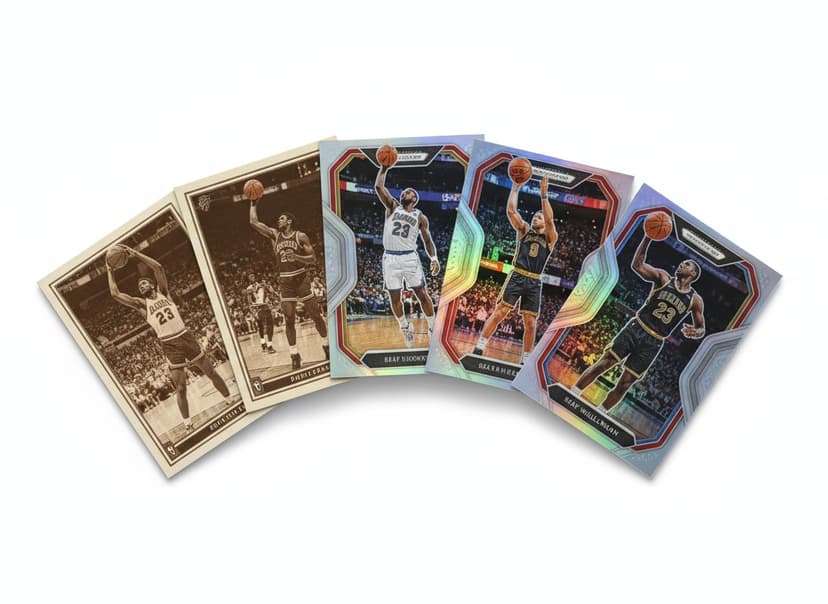
Basketball rookie cards are the most volatile major sport in the card market, swinging harder on player performance than baseball or football because a single superstar can carry an entire era of prices. The market splits into three distinct periods. Vintage runs through 1986, where the 1986-87 Fleer Michael Jordan is the anchor of the entire hobby. The junk wax era from 1987 to about 1995 produced so many cards that even star rookies from those years are inexpensive unless graded PSA 10. The modern era from 2003 onward is defined by parallel and insert scarcity, where a numbered refractor or an autographed patch card is worth hundreds of times the base rookie. Understanding which of the three you are holding is the first step, because the same player can have a $20 rookie and a $200,000 rookie in the same year.
Player legacy is the dominant variable and it is not static, which is why basketball prices move more than any other sport. A finals run or an injury visibly repriced entire rookie markets within weeks. Grade is the second lever and its effect is extreme on chrome and prizm surfaces, where a PSA 10 can be worth ten to thirty times a PSA 9 because print lines and surface scratches are so common. Scarcity of the specific parallel matters enormously in the modern era: a base Prizm, a Silver Prizm, and a numbered color parallel of the same card occupy three different price tiers. Set prestige matters too, with Topps Chrome, Prizm, and Upper Deck Exquisite carrying premiums over lower-tier products. Finally, autographs and game-worn patches add multiples, and on-card autographs consistently outsell sticker autographs.
Buying & Selling Tips
Buying
Decide whether you are buying the player or the card. Speculating on a rookie's career is a different risk than buying an established legend's cornerstone card.
For modern chrome and prizm, only buy PSA 10 or BGS 9.5 if you care about resale. The gap below gem is severe.
Check the card number against the checklist. Many players have multiple rookie-year cards and only one is considered the true rookie.
Ignore junk wax era rookies unless they are gem graded. Print runs from 1987 to 1995 are effectively unlimited.
Buy during the offseason. Prices consistently soften between June and September and spike during playoff runs.
Selling
Sell into performance. The best exits for modern rookies come during a playoff run or an award announcement, not months afterward.
Grade before selling anything you believe is gem quality. Raw modern rookies sell at roughly a quarter of graded prices.
Use auction format for cards over $500 and fixed price below it. Thin markets need bidding competition to find true value.
Photograph corners and surface under angled light. Chrome and prizm scratches are invisible in flat lighting and cause returns.
List with the full card identifier including year, set, parallel, and card number. Buyers search by exact string.
Basketball Rookie Cards FAQ
What is the most valuable basketball rookie card?
The 2003-04 Upper Deck Exquisite LeBron James rookie patch autograph numbered to 99 holds the record, selling for $5.2 million in one private sale. Among mass-produced cards, a PSA 10 1986-87 Fleer Michael Jordan leads at $250,000 to $500,000.
Are basketball cards from the 1990s worth anything?
Most are not. The junk wax era from 1987 to 1995 produced cards in enormous quantities, so even star rookies from those years sell for $10 to $80 in PSA 9. The exceptions are premium inserts and refractors, which had far smaller print runs.
Is the 1986 Fleer Jordan his only rookie card?
It is his only recognized NBA rookie card, though he appeared on a 1984-85 Star Company card that predates it. The Star card is not universally accepted as a rookie because of distribution issues and widespread counterfeiting.
What does Silver Prizm mean?
Silver Prizm is the base refractor parallel in Panini Prizm sets. It is unnumbered but far scarcer than the base card, and for most modern rookies it is the card the market actually prices as the key rookie.
Should I grade my basketball rookie cards?
Grade if the card is a recognized rookie of a star player and looks near mint with sharp corners and good centering. For chrome and prizm cards the gem premium easily covers the fee, but common base cards of role players are not worth submitting.
Got Basketball Rookie Cards to Value?
Upload a photo and get a free AI-powered valuation in seconds. No sign-up required.