Last updated: September 2026
How Much Are Antique Clocks Worth?
Check current market values, learn what affects pricing, and get tips for buying and selling.
← All Clocks valuationsWhat do you want to value?
Get the free app for unlimited scans


Antique Clocks Price Guide
Current market values based on recent sales data and market trends.
| Item | Condition | Price Range |
|---|---|---|
| American shelf clock, Seth Thomas or Ansonia | Running, original | $80 - $250 |
| American kitchen or gingerbread clock | Running | $60 - $200 |
| French carriage clock, striking | Running, original | $400 - $2,500 |
| English bracket clock, 18th-19th c. | Running, original | $1,200 - $10,000 |
| Vienna regulator, weight driven | Running, complete | $400 - $3,000 |
| Black Forest carved cuckoo clock | Running, elaborate carving | $300 - $3,000 |
| Modern tourist cuckoo clock | Running | $40 - $150 |
| French marble mantel clock | Running | $150 - $700 |
| Any clock not running | Complete | 30% - 50% of working |
| Clock with replaced dial or hands | Running | 50% - 70% of original |
What Determines Antique Clocks Value
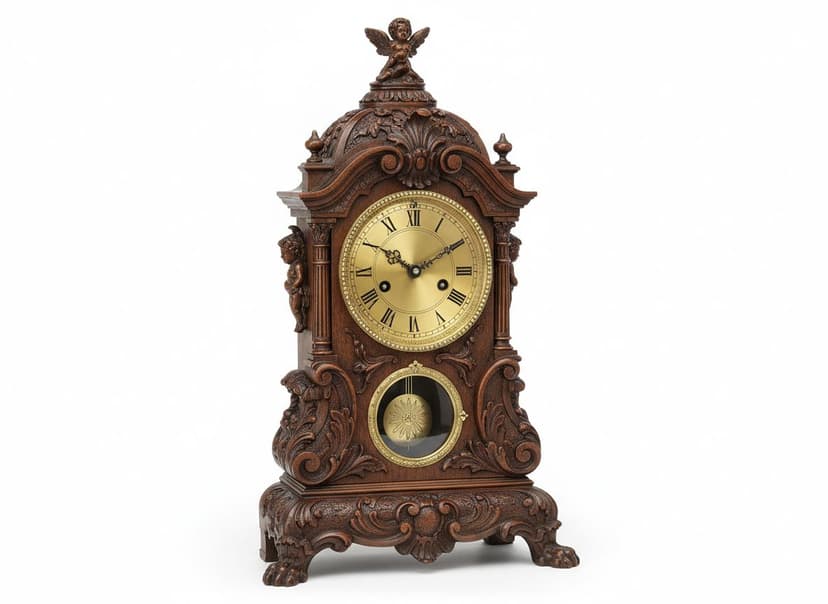
Antique clocks divide into categories that price very differently, and the most useful first question is what type of clock you have. American shelf and mantel clocks from Seth Thomas, Ansonia, and Gilbert were produced in the millions between 1850 and 1930, and a typical example brings sixty to two hundred dollars. French carriage clocks and English bracket clocks are finer and worth considerably more. Vienna regulators, built for accuracy, have a dedicated following. Black Forest cuckoo clocks range from tourist souvenirs worth almost nothing to elaborate carved pieces worth thousands. The critical economic reality across all of them is that a full movement service costs $250 to $700, which exceeds the total value of most common American clocks. That single fact explains why so many antique clocks sit unsold: buyers will not pay for a clock that needs work when the repair costs more than the clock. Original dials, hands, and finish matter enormously in the higher tiers.
Type and maker set the tier, and the gap between a mass-produced American shelf clock and an English bracket clock by a named maker is enormous. Movement quality is the underlying driver: eight-day movements outrank thirty-hour, striking and chiming movements outrank time-only, and repeater and complicated movements outrank simple ones. Running condition matters more for lower-value clocks, because service cost is fixed while clock value varies, so a $150 clock that needs $400 of work is functionally worthless. Originality of the dial, hands, glass, and finish is critical in the higher tiers, and replaced components reduce value by thirty to fifty percent. Case condition covers veneer loss, cracks, and refinishing, with original finish preferred. Completeness with pendulum, weights, key, and any original documentation matters, and missing pendulums are a common and costly gap. Size and weight are practical constraints that suppress prices on large marble and long-case clocks.
Buying & Selling Tips
Buying
Ask whether the clock runs and keeps time. A non-running clock needs $250 to $700 of work, which exceeds the value of most common examples.
Check that the pendulum, weights, and key are present. Sourcing correct replacements is difficult and expensive.
Look at the dial for repainting. Original painted dials show age crazing that replacements lack.
Buy the movement, not the case. Case damage is repairable while a worn or replaced movement is the real problem.
Avoid heavy marble clocks unless you can collect locally. Shipping cost frequently exceeds their value.
Selling
Get the clock running if the repair is modest relative to value. A working clock sells at roughly double a silent one.
Photograph the dial, the movement through the back door, and the case from all sides.
Include the pendulum, weights, and key in the photos. Buyers assume they are missing if not shown.
Name the maker and movement type in the title. Collectors search by maker and by strike or chime configuration.
Pack the pendulum and weights separately and secure the movement. Clocks shipped assembled routinely arrive damaged.
Antique Clocks FAQ
How much is an antique mantel clock worth?
A common American shelf or mantel clock by Seth Thomas or Ansonia brings $80 to $250 running. French carriage clocks reach $400 to $2,500 and English bracket clocks by named makers go substantially higher.
Does an antique clock need to run to sell?
It helps enormously for lower-value clocks, because a full service costs $250 to $700 regardless of the clock's worth. A common clock needing repair is often unsellable, while a running one finds buyers readily.
Are cuckoo clocks valuable?
Hand-carved Black Forest examples with elaborate detail bring $300 to $3,000. Machine-made tourist cuckoo clocks from the later twentieth century sell for $40 to $150.
What is a Vienna regulator?
It is a weight-driven wall clock built for accuracy, made mainly in Austria and Germany from the 1830s onward. They have a dedicated collector following and bring $400 to $3,000 complete and running.
Does refinishing an antique clock case hurt its value?
Yes, typically by thirty to fifty percent in the collectible tiers. Original finish and patina are value components, and a stripped and re-varnished case is immediately obvious to buyers.
Got Antique Clocks to Value?
Upload a photo and get a free AI-powered valuation in seconds. No sign-up required.