Last updated: September 2026
How Much Are Vintage Board Games Worth?
Check current market values, learn what affects pricing, and get tips for buying and selling.
← All Board Games valuationsWhat do you want to value?
Get the free app for unlimited scans


Vintage Board Games Price Guide
Current market values based on recent sales data and market trends.
| Item | Condition | Price Range |
|---|---|---|
| McLoughlin Brothers game, 1880s-1900s | Complete, good litho | $400 - $4,000 |
| Early Monopoly, 1935 first edition | Complete | $500 - $3,500 |
| 1930s-40s Parker Brothers game | Complete | $40 - $250 |
| 1960s TV tie-in game | Complete | $25 - $150 |
| 1970s-80s horror or sci-fi game | Complete | $30 - $200 |
| Common mass-market game, any era | Complete | $5 - $25 |
| Dark Tower (1981) | Working, complete | $250 - $700 |
| Early Dungeons & Dragons boxed set | Complete | $400 - $5,000 |
| Any game missing pieces | Incomplete | 20% - 40% of complete |
| Game with water damage or tape repair | Poor | $3 - $20 |
What Determines Vintage Board Games Value
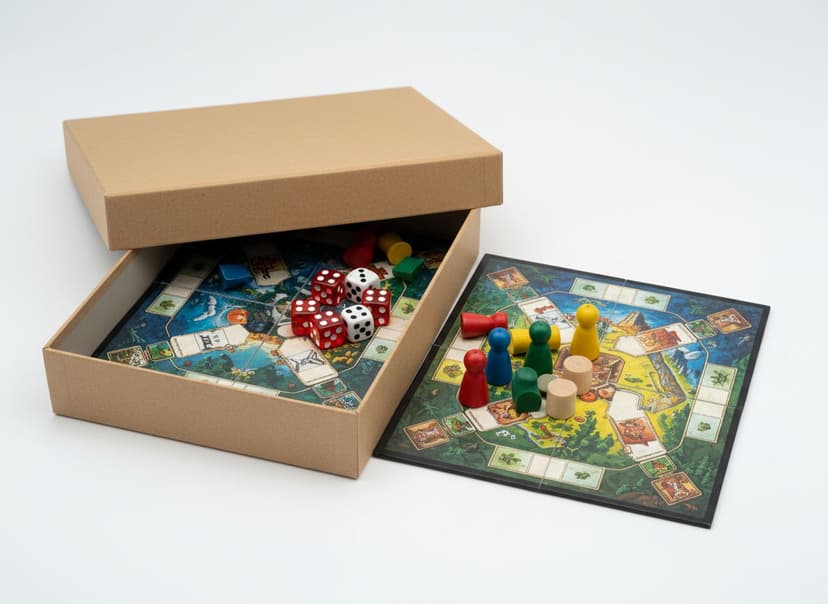
Vintage board games are valued on a logic closer to graphic art than to toys, because for most of the collectible examples the box lid is the product. Nineteenth-century American games produced by McLoughlin Brothers, with elaborate chromolithographed boxes, are the top of the market and can bring thousands purely for their artwork. Twentieth-century mass-market games from Milton Bradley and Parker Brothers were produced in the millions and are worth very little, with the common exceptions being early Monopoly editions, television tie-in games with strong nostalgia, and horror or science fiction titles with striking artwork. Completeness is the defining condition variable, and a game missing pieces or its rules sheet drops sharply in value because collectors want playable, display-ready examples. Box condition matters more than the components, since the box is what gets displayed, and edge splits, water staining, and tape repairs all reduce value considerably.
Age and artwork together drive the top of the market, since nineteenth-century lithographed boxes are collected as graphic art independent of playability. Completeness is the primary condition variable and buyers expect every piece, card, and the rules sheet. Box condition outranks component condition because the box is the display object, and splits at the corners, water staining, and previous tape repairs each reduce value substantially. Licensed properties create demand spikes, with television and film tie-ins from the 1960s through 1980s benefiting from nostalgia. Electronic games from the late 1970s and 1980s have a specific risk since their electronics frequently fail, and a working example commands a large premium. Print run size matters, and games that flopped commercially can be scarcer than successful ones. Finally, shipping cost is a real market drag on large heavy games and suppresses prices for anything bulky.
Buying & Selling Tips
Buying
Inventory the contents against the rules sheet before buying. Missing pieces are the most common and most value-destroying issue.
Inspect the box corners and edges. Splits and tape repairs are the primary condition problems and are usually hidden in listing photos.
For electronic games, confirm the electronics work. Repair is often impossible due to unavailable parts.
Buy for the artwork if buying nineteenth-century games. That segment is collected as graphic design rather than as games.
Factor in shipping. Large vintage games are heavy and shipping can exceed the game's value.
Selling
Inventory and photograph every component laid out. Complete inventory photos are what separate a serious listing from a guess.
Photograph all six sides of the box. Buyers assess condition from the corners and edges specifically.
State clearly whether the game is complete. Uncertainty leads buyers to assume the worst and bid accordingly.
Test electronic components and say so. A confirmed working Dark Tower or similar sells at multiples of an untested one.
Sell locally for large heavy games. Shipping cost often exceeds the value of common titles.
Vintage Board Games FAQ
What vintage board games are worth the most?
Nineteenth-century McLoughlin Brothers games with chromolithographed box art lead at $400 to $4,000, and the 1974 white box Dungeons & Dragons set reaches $5,000. Early 1935 Monopoly editions bring $500 to $3,500.
Does a board game need all its pieces to be valuable?
Yes. Collectors want complete, playable, display-ready examples. A game missing pieces or the rules sheet typically sells for twenty to forty percent of a complete one.
Are 1980s board games worth anything?
Most are worth $5 to $25. The exceptions are electronic games like Dark Tower, which brings $250 to $700 working, and titles with strong horror or science fiction artwork that appeal to poster collectors.
Why does the box matter more than the pieces?
Because the box lid is what gets displayed, and for nineteenth and early twentieth-century games the lithographed artwork is the collectible object. Corner splits, water stains, and tape repairs reduce value more than a missing token would.
Is my old Monopoly set valuable?
Only if it is a genuine early edition. The 1935 first editions with wooden pieces and a patent pending box bring $500 to $3,500. Sets from the 1950s onward were produced in the millions and are worth $10 to $30.
Got Vintage Board Games to Value?
Upload a photo and get a free AI-powered valuation in seconds. No sign-up required.