Last updated: September 2026
How Much Are Vintage Band T-Shirts Worth?
Check current market values, learn what affects pricing, and get tips for buying and selling.
← All Vintage Band T-Shirts valuationsWhat do you want to value?
Get the free app for unlimited scans


Vintage Band T-Shirts Price Guide
Current market values based on recent sales data and market trends.
| Item | Condition | Price Range |
|---|---|---|
| 1980s metal tour tee (Metallica, Iron Maiden) | Good, single stitch | $300 - $2,500 |
| 1990s hip-hop bootleg tee (rap tee) | Good | $200 - $1,800 |
| 1990s grunge tour tee (Nirvana, Soundgarden) | Good | $250 - $2,000 |
| 1980s hardcore / punk tee | Good | $200 - $1,500 |
| 1970s rock tee, iron-on | Good | $300 - $3,000 |
| 1990s classic rock reissue | Excellent | $40 - $150 |
| 1980s-90s pop tee | Good | $40 - $200 |
| Rare festival or one-off tee | Good | $500 - $5,000 |
| Modern band merch | Excellent | $10 - $40 |
| Any vintage tee with holes or fading | Poor | 30% - 50% of good |
What Determines Vintage Band T-Shirts Value
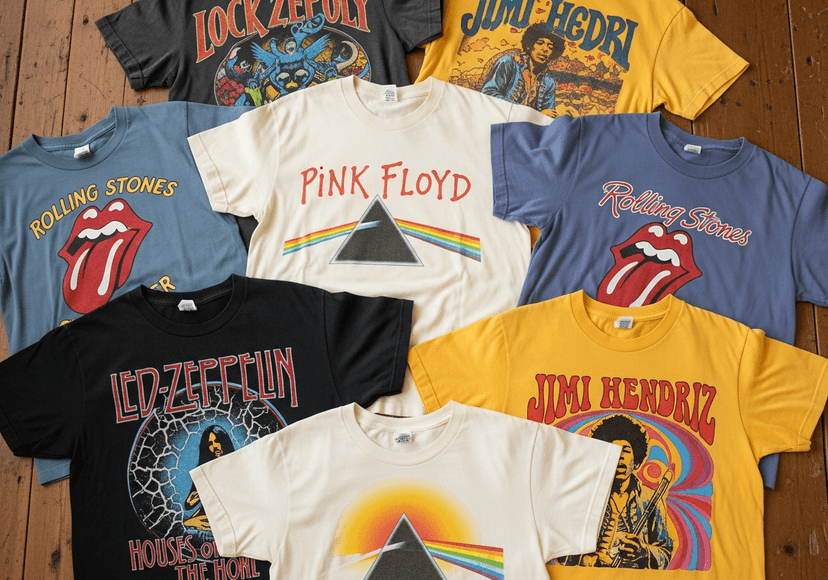
Vintage band t-shirts have become one of the strongest segments in used clothing, with rare 1980s and 1990s tour shirts selling for thousands. Dating a shirt is the first skill, and the most useful marker is the sleeve and hem stitching: single-stitch construction, where one row of stitching finishes the hem, was standard until roughly the mid-1990s, after which double-stitch became universal. Tag identification refines it further, with Screen Stars, Brockum, Giant, and Hanes Beefy-T all corresponding to specific production periods. Genre drives price enormously. Metal, hardcore, and hip-hop shirts from the 1980s and early 1990s command the most, followed by grunge and alternative, while pop and classic rock shirts from the same era are far more common and cheaper. Bootlegs from the period have become collectible in their own right, which confuses new buyers who assume official licensing is required for value.
Era is the first filter and single-stitch construction is the fastest way to establish it. Artist and genre drive demand, with metal, hardcore, and 1990s hip-hop commanding the highest prices and mainstream pop and classic rock the lowest. Print condition matters far more than fabric condition, since collectors accept holes and thinning in the cotton but heavily penalize cracked, faded, or peeling graphics. Tour dates printed on the back significantly increase value because they document a specific event and confirm the shirt is period-correct. Size follows the usual apparel curve with medium and large leading, though vintage sizing runs small and a tagged large often measures like a modern medium. Tag brand helps establish authenticity and era. Finally, official versus bootleg matters less than most expect, since period bootlegs are collected alongside licensed merchandise.
Buying & Selling Tips
Buying
Check the hem and sleeve stitching. A single row of stitching indicates pre-mid-1990s production and a real vintage premium.
Identify the tag brand. Screen Stars, Brockum, and Giant correspond to specific eras and help confirm the shirt is not a reprint.
Assess the print rather than the fabric. Cracked or flaking graphics reduce value far more than a small hole in the cotton.
Measure pit to pit. Vintage sizing runs much smaller than modern and tagged sizes are unreliable.
Learn the common reprints for your favorite bands. Officially licensed modern reissues of vintage designs are everywhere and worth a fraction.
Selling
Photograph the tag, the hem stitching, and the print close up. Those three images establish era and condition for serious buyers.
Provide pit-to-pit and length measurements. Buyers will not bid on vintage apparel without them.
Do not iron the print or wash on hot. Heat cracks vintage screen prints permanently and destroys most of the value.
List the tour year and venue if printed. Documented tour shirts consistently outsell generic band graphics.
Sell high-value pieces through specialist vintage platforms or auctions rather than general marketplaces, where they get overlooked.
Vintage Band T-Shirts FAQ
What is a single stitch t-shirt?
It refers to hems and sleeves finished with one row of stitching, standard in US t-shirt production until roughly the mid-1990s. It is the quickest way to confirm a shirt is genuinely vintage rather than a modern reprint.
Which band t-shirts are worth the most?
1980s metal tour shirts, 1990s hip-hop memorial and bootleg tees, and early hardcore punk shirts lead, with strong examples reaching $1,500 to $2,500. Rare 1970s iron-on rock tees can go higher.
Are bootleg band shirts worth anything?
Yes, often as much as official merchandise. Period bootlegs from the 1980s and 1990s, especially rap tees, are collected on their own terms and some designs are more sought after than licensed versions.
Do holes reduce a vintage tee's value?
Less than you would expect. Collectors accept fabric wear and small holes as part of vintage character. Cracked or missing print, by contrast, reduces value dramatically because the graphic is what buyers are purchasing.
How do I know if a band tee is a reprint?
Check the stitching, the tag brand, and the print texture. Modern reprints use double stitching, current-era tags, and often a smoother plastisol print. Period shirts have softer, sometimes cracked prints and era-correct tags.
Got Vintage Band T-Shirts to Value?
Upload a photo and get a free AI-powered valuation in seconds. No sign-up required.