Last updated: September 2026
How Much Is a Tiffany Lamp Worth?
Check current market values, learn what affects pricing, and get tips for buying and selling.
← All Tiffany Lamps valuationsWhat do you want to value?
Get the free app for unlimited scans


Tiffany Lamps Price Guide
Current market values based on recent sales data and market trends.
| Item | Condition | Price Range |
|---|---|---|
| Tiffany Studios Wisteria lamp | Original, excellent | $150,000 - $800,000 |
| Tiffany Studios Dragonfly lamp | Original, excellent | $80,000 - $500,000 |
| Tiffany Studios geometric shade lamp | Original, excellent | $15,000 - $60,000 |
| Tiffany Studios desk lamp, small | Original | $8,000 - $35,000 |
| Tiffany Studios base only | Marked, excellent | $2,500 - $20,000 |
| Handel lamp, signed | Excellent | $2,000 - $25,000 |
| Duffner & Kimberly or Bradley & Hubbard | Excellent | $1,500 - $12,000 |
| Unsigned period leaded glass lamp | Excellent | $400 - $4,000 |
| Modern reproduction, quality glass | Excellent | $200 - $900 |
| Cheap import reproduction | Any | $40 - $180 |
What Determines Tiffany Lamps Value
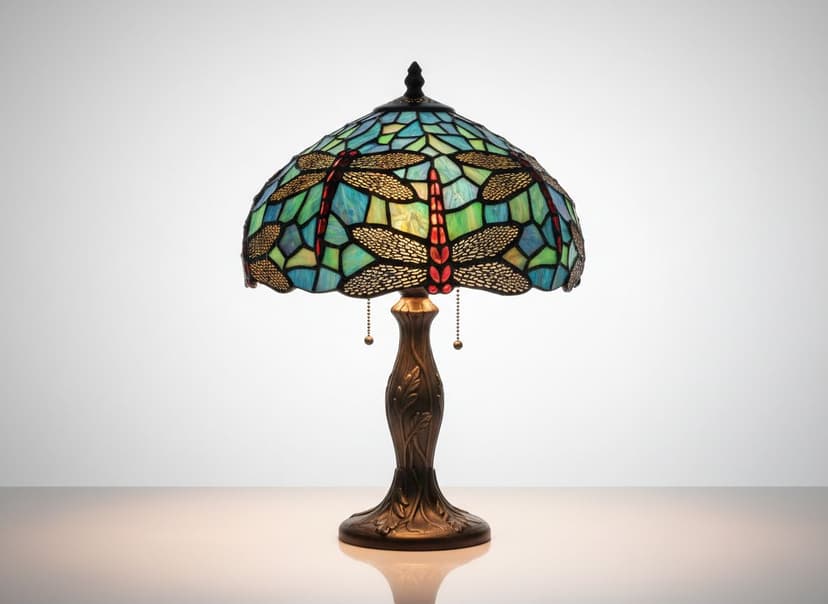
The word Tiffany is used loosely enough that most people who believe they own a Tiffany lamp own a reproduction, and the price difference is between a few hundred dollars and several hundred thousand. Authentic lamps were made by Tiffany Studios in New York between roughly 1895 and 1930, using hand-selected favrile glass and bronze bases, and they are marked on both the shade rim and the base with Tiffany Studios New York and a model number. Reproductions range from cheap modern imports with plastic or thin machine-cut glass to high-quality period-style lamps by other makers such as Duffner and Kimberly or Handel, which are genuine antiques in their own right and worth thousands. The variables that determine an authentic lamp's value are pattern rarity, glass quality and color, base design, and condition of the leading. Dragonfly, Wisteria, and Peony patterns lead, and exceptional examples have exceeded a million dollars at auction.
Authenticity is the entire question, and everything else is secondary. Genuine Tiffany Studios lamps carry stamped marks on both shade and base with matching model numbers, use favrile glass with visible internal variation and iridescence, and have heavy cast bronze bases with a distinctive patina. Pattern rarity is the primary driver among authentic lamps, with complex naturalistic designs like Wisteria and Dragonfly at the top and simple geometrics at the bottom. Glass quality within a pattern varies because shades were assembled individually, and exceptional color selection commands premiums. Condition of the leading matters greatly, since lead lines fatigue and sag over a century, and replaced glass panels are detected by color and texture mismatch. Base and shade must be an original pairing, and married lamps assembled from unrelated parts are worth far less. Provenance and auction history add real value at the top.
Buying & Selling Tips
Buying
Check for stamped marks on both the shade rim and the base. Authentic Tiffany Studios pieces are marked on both with model numbers.
Examine the glass for internal variation and iridescence. Favrile glass has depth and color shifts that machine-cut reproduction glass lacks.
Feel the weight of the base. Authentic bronze bases are extremely heavy, while reproductions use resin or thin cast metal.
Have any potential authentic lamp appraised before purchase. The price gap between real and reproduction makes expert opinion essential.
Consider Handel and other period makers. They are genuine antiques at a fraction of Tiffany prices.
Selling
Get a formal authentication before selling anything you believe is genuine. Buyers at that level will not proceed without it.
Photograph both marks, the full shade lit and unlit, and the base from multiple angles.
Sell authentic lamps through a major auction house. The buyer pool for six-figure lamps exists only there.
Do not clean the bronze patina. Original patina is a value component and cleaning it is irreversible.
Be honest about reproductions. Describing a reproduction as Tiffany style rather than Tiffany avoids disputes and still finds buyers.
Tiffany Lamps FAQ
How can I tell if a Tiffany lamp is real?
Authentic Tiffany Studios lamps are stamped on both the shade rim and the base with Tiffany Studios New York and a model number. The glass shows internal color variation and iridescence, and the bronze base is extremely heavy. Professional authentication is essential given the price gap.
How much is a real Tiffany lamp worth?
Simple geometric shades start around $15,000 and complex naturalistic patterns like Dragonfly and Wisteria reach $80,000 to $800,000. Exceptional examples have exceeded a million dollars at auction.
Are Tiffany style lamps worth anything?
Quality hand-leaded reproductions bring $200 to $900, and period lamps by other makers such as Handel, Duffner and Kimberly, and Bradley and Hubbard are genuine antiques worth $1,500 to $25,000.
What is favrile glass?
Favrile is the iridescent art glass Louis Comfort Tiffany patented, made by adding metallic oxides while the glass is molten. It has internal color variation and a surface iridescence that reproduction glass does not replicate.
Does a Tiffany lamp lose value if the shade and base do not match?
Yes, substantially. A married lamp assembled from an authentic shade and an unrelated base is worth far less than an original pairing, and model numbers on the two components are checked for consistency.
Got Tiffany Lamps to Value?
Upload a photo and get a free AI-powered valuation in seconds. No sign-up required.