Last updated: September 2026
How Much Is Scrap Metal Worth?
Check current market values, learn what affects pricing, and get tips for buying and selling.
← All Scrap Metal valuationsWhat do you want to value?
Get the free app for unlimited scans


Scrap Metal Prices Price Guide
Current market values based on recent sales data and market trends.
| Item | Condition | Price Range |
|---|---|---|
| Bare bright copper wire | Clean, stripped | $3.40 - $4.20 per lb |
| #1 copper (clean tubing) | Clean | $3.20 - $3.90 per lb |
| #2 copper (with solder or paint) | Dirty | $2.90 - $3.60 per lb |
| Insulated copper wire | With jacket | $1.00 - $2.40 per lb |
| Yellow brass | Clean | $1.90 - $2.60 per lb |
| Aluminum, clean sheet or extrusion | No steel attached | $0.55 - $0.90 per lb |
| Aluminum cans | Loose | $0.45 - $0.75 per lb |
| Stainless steel 304 | Clean, non-magnetic | $0.45 - $0.80 per lb |
| Lead | Clean | $0.55 - $0.95 per lb |
| Ferrous steel and iron | Any | $120 - $240 per ton |
What Determines Scrap Metal Prices Value
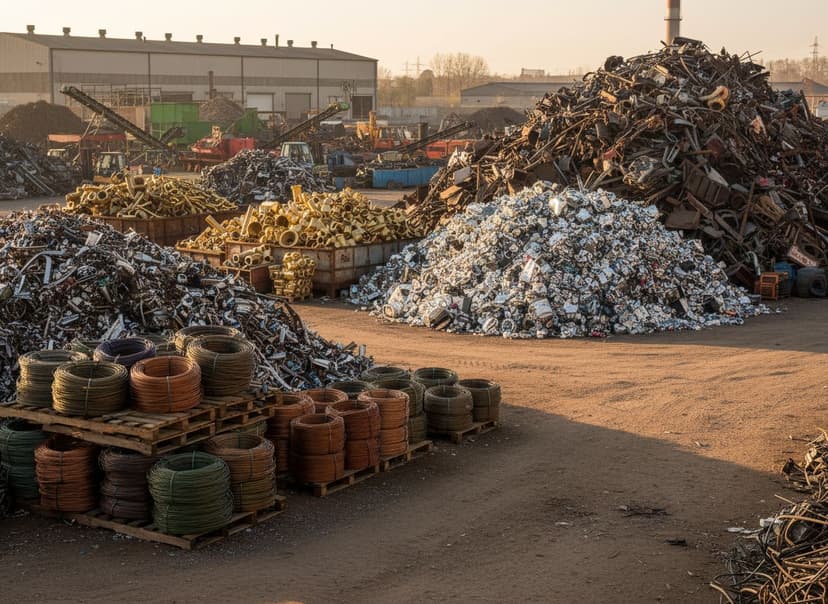
Scrap metal prices are set by global commodity markets and passed down to consumers through a chain of yards that each take a margin, which means the price you receive is well below the exchange price for the metal. The single largest thing you control is sorting. A yard buying a mixed load pays the rate for the lowest-value metal in it, so separating copper from brass from aluminum before you arrive can double or triple the payout on the same material. The second lever is cleanliness, since grades are defined by contamination: bare bright copper wire pays substantially more than insulated wire, and clean aluminum pays more than aluminum with steel attachments. Prices move daily with commodity markets and vary regionally based on transport distance to processors, so calling two or three yards before loading is standard practice. Ferrous metals, meaning steel and iron, pay by the ton and are worth handling only in volume.
The underlying commodity price sets the ceiling and moves daily with global markets, so timing matters more than most people expect. Grade within a metal type is the largest thing a seller controls, and the definitions are contamination-based: bare bright copper is the top grade and each added contaminant moves the material down a tier with a real price consequence. Sorting is the second lever, because a mixed load is paid at the lowest rate present. Volume affects the rate, with yards paying better per pound on larger quantities, which is why ferrous metal is only worth handling by the ton. Regional variation is significant and depends on distance to the nearest processor, so prices in port cities and industrial regions run higher. Yard margin varies, and calling several yards on the same day routinely reveals spreads of fifteen to thirty percent on identical material.
Buying & Selling Tips
Buying
Call two or three yards on the same day before loading. Spreads of fifteen to thirty percent on identical material are common.
Learn the grade definitions for copper specifically. The gap between bare bright and number two is over fifty cents per pound.
Use a magnet to separate ferrous from non-ferrous. It is the fastest sorting tool and prevents mixed-load pricing.
Weigh your load before arriving if you can. It lets you verify the yard's scale and catch errors.
Ask whether the yard pays different rates for larger volumes. Many have tiered pricing that is not posted.
Selling
Sort everything by metal type before you go. A mixed load is paid at the rate of the lowest-value metal in it.
Strip insulated wire if the gauge is heavy. Thick cable pays back the labor; thin wire usually does not.
Remove steel screws, brackets, and attachments from aluminum. Contamination moves the material down a grade.
Bring identification. Most jurisdictions require ID for scrap transactions and some restrict cash payment.
Watch commodity prices before a large sale. Copper in particular moves enough week to week to change the payout meaningfully.
Scrap Metal Prices FAQ
What scrap metal is worth the most?
Bare bright copper wire pays the most among common scrap at $3.40 to $4.20 per pound. Clean copper tubing follows closely, then brass at $1.90 to $2.60 per pound.
Why does sorting scrap metal matter?
Yards pay a mixed load at the rate of the lowest-value metal in it. Separating copper, brass, aluminum, and steel before you arrive can double or triple the payout on the same material.
Is it worth stripping copper wire?
For heavy gauge cable, yes. Bare bright copper pays $1.50 to $2.00 more per pound than insulated wire, so thick cable repays the labor quickly. Thin gauge wire usually does not.
How much is a pound of aluminum cans worth?
Roughly $0.45 to $0.75 per pound, which is about thirty cans. In states with container deposit laws, redeeming cans individually pays substantially more than scrapping them by weight.
How can I tell stainless steel from regular steel?
Use a magnet. Common 304 stainless is non-magnetic or only weakly magnetic, while carbon steel is strongly magnetic. Stainless pays $0.45 to $0.80 per pound against about $0.06 to $0.12 for steel.
Got Scrap Metal Prices to Value?
Upload a photo and get a free AI-powered valuation in seconds. No sign-up required.