Last updated: September 2026
How Much Is a Pearl Necklace Worth?
Check current market values, learn what affects pricing, and get tips for buying and selling.
← All Pearl Necklace valuationsWhat do you want to value?
Get the free app for unlimited scans


Pearl Necklaces Price Guide
Current market values based on recent sales data and market trends.
| Item | Condition | Price Range |
|---|---|---|
| Freshwater strand, 7-8mm, 18 inch | Good luster | $60 - $300 |
| Freshwater strand, 9-10mm, round | Excellent luster | $250 - $900 |
| Akoya strand, 6.5-7mm, 18 inch | AA quality | $400 - $1,100 |
| Akoya strand, 8-8.5mm, 18 inch | AAA quality | $1,800 - $4,500 |
| Tahitian strand, 9-11mm | Good match | $1,800 - $6,000 |
| South Sea strand, 10-12mm | Good match | $5,000 - $18,000 |
| South Sea strand, 13-15mm | Excellent, matched | $20,000 - $70,000 |
| Natural pearl strand (pre-1930) | Certified natural | $25,000 - $500,000+ |
| Mikimoto Akoya strand | With box and papers | $2,500 - $12,000 |
| Imitation / glass pearls | Any | $10 - $60 |
What Determines Pearl Necklaces Value
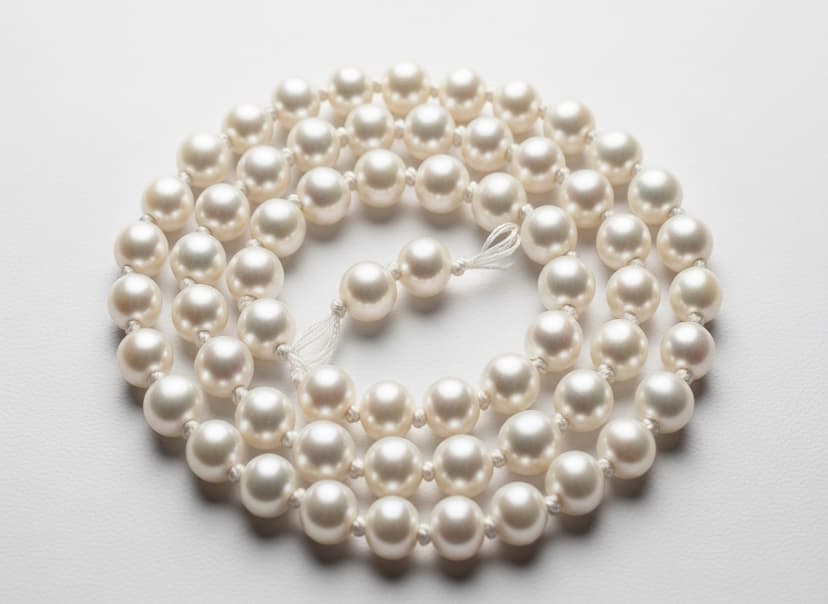
Pearl values span four orders of magnitude, from twenty dollars for a freshwater strand to six figures for a matched natural pearl necklace, and the distinctions that create that range are not obvious to a casual observer. The first and largest split is between natural pearls, formed without human intervention and extraordinarily rare, and cultured pearls, which account for essentially all pearls sold today. Among cultured pearls the hierarchy runs freshwater at the bottom, then Akoya, then Tahitian, then South Sea at the top. Size drives price steeply within each type, and matching across a strand matters enormously because assembling a hundred pearls of identical size, shape, and luster is far harder than finding one good pearl. Luster is the quality that separates a beautiful strand from a dull one and is what jewelers assess first. Imitation pearls, made of glass or plastic with a coating, are common in estate lots and worth essentially nothing.
Pearl type sets the tier, with South Sea and Tahitian above Akoya and freshwater far below both. Size drives price exponentially within each type, since larger pearls take longer to culture and suffer higher failure rates. Luster is the quality jewelers weigh most heavily and describes how sharply the pearl reflects light; a high-luster pearl shows crisp reflections while a dull one looks chalky. Surface cleanliness matters, with blemishes, pits, and rings reducing value substantially. Shape follows a hierarchy from round through near-round, oval, drop, and baroque, and perfectly round commands large premiums. Matching across a strand is a major cost driver and is why a necklace costs far more than the sum of comparable loose pearls. Nacre thickness determines durability and is a specific concern with Akoya pearls, where thin nacre eventually peels. Finally, natural versus cultured is the largest single distinction and requires laboratory X-ray to confirm.
Buying & Selling Tips
Buying
Rub two pearls gently against each other. Real pearls feel slightly gritty while imitations feel smooth as glass.
Assess luster by looking for a sharp reflection of a light source. Chalky or milky surfaces indicate thin nacre or low quality.
Check the drill holes for chipping and for a visible nucleus, which indicates thin nacre on cultured pearls.
Buy knotted strands. Silk knots between pearls prevent loss if the strand breaks and indicate quality stringing.
For anything claimed as natural, require a GIA or SSEF report. Natural pearl certification requires X-ray imaging and cannot be judged by eye.
Selling
Have valuable strands appraised before selling. Buyers routinely misidentify Akoya as freshwater and price accordingly.
Restring old strands before sale if the silk is discolored or stretched. It costs $50 to $150 and visibly improves presentation.
Include original boxes and papers, especially for Mikimoto, where documentation adds substantial value.
Photograph the strand against a neutral background in natural light. Luster is the main selling point and artificial light flattens it.
Sell natural pearls at auction. Specialist buyers exist and general jewelers will price them as cultured, costing you most of the value.
Pearl Necklaces FAQ
How can I tell if pearls are real?
Rub two pearls together lightly or against a tooth. Real pearls feel gritty due to the crystalline nacre structure, while glass and plastic imitations feel perfectly smooth. Real pearls also feel cool at first touch and have slight surface irregularities.
What is the difference between freshwater and Akoya pearls?
Freshwater pearls are cultured in mussels in lakes and rivers, are usually solid nacre, and cost less. Akoya pearls are cultured in saltwater oysters around a bead nucleus, are rounder with sharper luster, and cost several times more for equivalent size.
How much is a natural pearl necklace worth?
Certified natural pearl strands start around $25,000 and can exceed $500,000 for well-matched historic examples. They require X-ray certification from a lab such as GIA or SSEF, since natural and cultured pearls look identical externally.
Do pearls lose value over time?
Pearls can degrade if stored improperly, since nacre reacts to acids, perfumes, and dry air. Well-maintained strands hold value, but yellowing, cracked nacre, and dull surfaces reduce it substantially and cannot be reversed.
Are Mikimoto pearls worth more?
Yes, typically fifty to one hundred percent more than an equivalent unbranded Akoya strand, provided the original box and certificate are present. Mikimoto grades strictly and the brand carries genuine resale recognition.
Related Articles
Got Pearl Necklaces to Value?
Upload a photo and get a free AI-powered valuation in seconds. No sign-up required.