Last updated: September 2026
How Much Are Indian Head Pennies Worth?
Check current market values, learn what affects pricing, and get tips for buying and selling.
← All Indian Head Penny valuationsWhat do you want to value?
Get the free app for unlimited scans


Indian Head Pennies Price Guide
Current market values based on recent sales data and market trends.
| Item | Condition | Price Range |
|---|---|---|
| 1877 | G-4 | $700 - $1,000 |
| 1877 | VF-20 | $1,800 - $2,600 |
| 1909-S | G-4 | $450 - $650 |
| 1908-S | G-4 | $80 - $130 |
| 1872 | G-4 | $60 - $95 |
| 1869 | VF-20 | $180 - $280 |
| 1859 (copper-nickel) | VF-20 | $60 - $95 |
| 1864 Bronze with L | F-12 | $85 - $140 |
| 1880-1907 common dates | G-4 | $1.50 - $4 |
| 1880-1907 common dates | MS-63 RB | $65 - $120 |
What Determines Indian Head Pennies Value
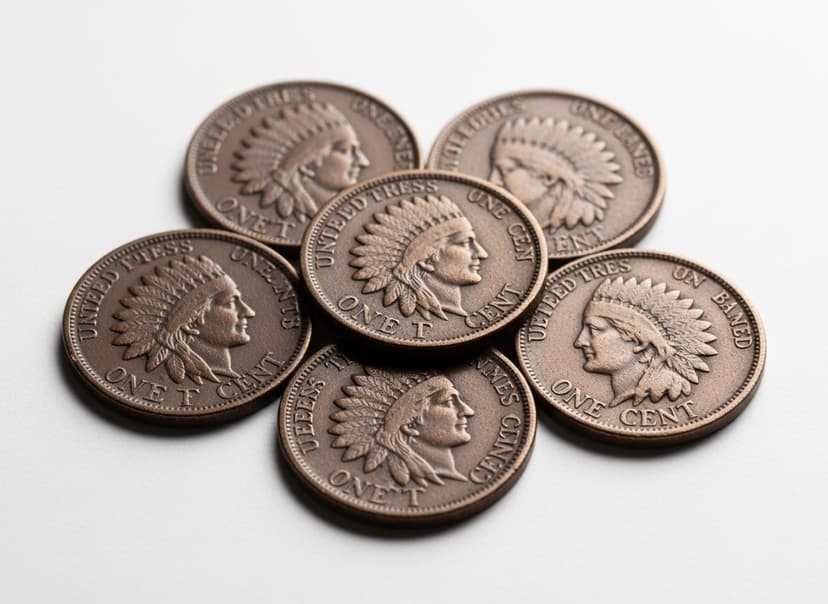
James Longacre's Indian Head cent ran for fifty years, from 1859 to 1909, and spans two distinct compositions. The 1859 to 1864 issues are copper-nickel, thick and pale, while everything from mid-1864 onward is bronze and noticeably darker. The series has a clean value structure: three key dates carry almost all the money, a small group of semi-keys carry moderate premiums, and everything else is a common date whose worth depends entirely on how much of the word LIBERTY survives on the headdress band. The 1877 is the undisputed king with a mintage of roughly 852,500. The 1909-S and 1908-S are the only San Francisco issues in the entire series and are scarce as a result. Cleaning is endemic in this series, so original brown surfaces command a real premium over harshly cleaned coins.
Date and mint mark come first, and the gap is enormous: an 1877 in the same grade as an 1897 is worth three hundred times as much. After date, the single most important grading checkpoint is the word LIBERTY on the headdress band, since the market splits sharply between coins showing partial letters and coins showing all seven. Color matters for uncirculated coins, where the ladder runs brown, red-brown, and full red, with full red examples worth several multiples of brown ones. Surface originality is critical because so many Indian cents were cleaned in the twentieth century; a coin with unnatural pink or orange tone reads as cleaned and loses a large share of its value. Corrosion and porosity from ground finds also reduce value substantially.
Buying & Selling Tips
Buying
For the 1877, buy certified only. It is one of the most counterfeited US coins and altered dates from 1878 are common.
Learn the LIBERTY grading standard before buying mid-grade coins. It is the difference between a Good and a Fine price on every date.
Prefer original chocolate brown surfaces over bright coins. A cleaned Indian cent may look nicer but sells for far less later.
Buy common dates in bulk rolls if you are assembling a date set. Cherry-picking from rolls is cheaper than buying singles.
Check the 1888 and 1894 for known overdate varieties, which trade well above the base date price.
Selling
Never clean an Indian Head penny before selling. Removing the patina can cut the value by half or more.
Sell key dates through auction rather than a local dealer. Competitive bidding on the 1877 and 1909-S routinely beats dealer buy prices.
Group common dates into date-run lots. Buyers assembling albums pay more for organized groups than for random handfuls.
Describe color honestly using the brown, red-brown, and red convention. Overstating color is the fastest way to get a return request.
If you have a full album or Whitman folder, sell it complete. Partial sets lose the completion premium immediately.
Indian Head Pennies FAQ
What is the rarest Indian Head penny?
The 1877 is the key date, with a mintage of about 852,500. Even in heavily worn Good condition it brings $700 to $1,000, and mint state examples reach five figures. The 1909-S is second with 309,000 struck.
How much is a common Indian Head penny worth?
Common dates from 1880 to 1907 in circulated condition are worth roughly $1.50 to $4 each. The same dates in uncirculated red-brown condition jump to $65 to $120, so condition matters far more than age.
What does the L on an Indian Head penny mean?
The L is Longacre's initial on the ribbon of the headdress, added in 1864. An 1864 bronze cent with the L is worth several times more than one without it, so it is always worth checking with a loupe.
Are Indian Head pennies made of copper?
The 1859 to 1864 issues are 88% copper and 12% nickel, giving them a pale color and heavier feel. From mid-1864 through 1909 they are bronze, which is 95% copper with tin and zinc.
Should I clean my Indian Head penny?
No. Original surfaces are worth substantially more than cleaned ones, and collectors identify cleaning instantly by unnatural color and hairlines. A dirty original coin outsells a shiny cleaned one every time.
Got Indian Head Pennies to Value?
Upload a photo and get a free AI-powered valuation in seconds. No sign-up required.