Last updated: September 2026
How Much Are Hummel Figurines Worth?
Check current market values, learn what affects pricing, and get tips for buying and selling.
← All Hummel Figurines valuationsWhat do you want to value?
Get the free app for unlimited scans


Hummel Figurines Price Guide
Current market values based on recent sales data and market trends.
| Item | Condition | Price Range |
|---|---|---|
| Crown mark (1935-49), common model | Mint | $150 - $600 |
| Crown mark, rare model | Mint | $800 - $6,000 |
| Full Bee (1950-59) | Mint | $60 - $300 |
| Stylized Bee (1960-72) | Mint | $30 - $120 |
| Three Line Mark (1964-72) | Mint | $30 - $110 |
| Last Bee / Missing Bee (1972-90) | Mint | $20 - $80 |
| Post-1990 marks | Mint | $15 - $60 |
| Large format figurine (10 inch+) | Mint, early mark | $400 - $3,000 |
| Adventure Bound or similar large group | Mint | $600 - $2,500 |
| Any figurine with chips or repair | Damaged | $5 - $30 |
What Determines Hummel Figurines Value
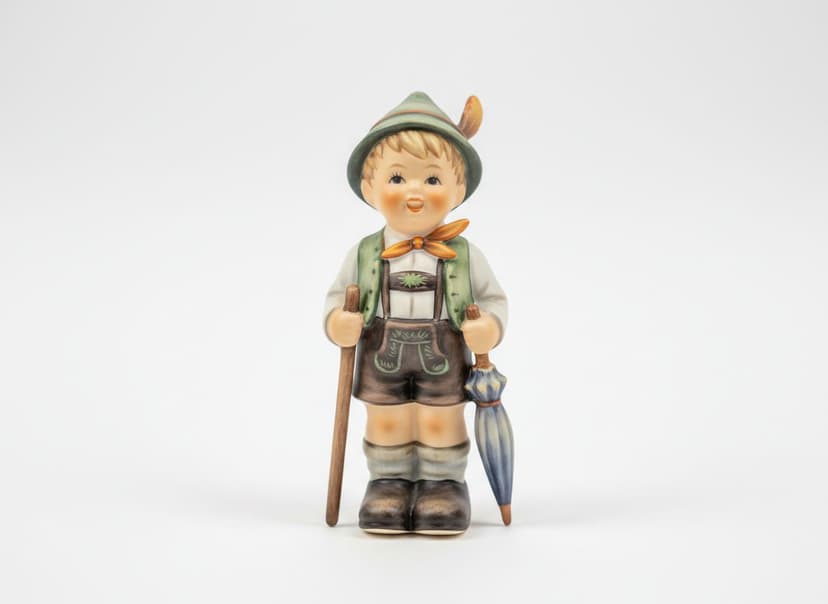
M.I. Hummel figurines have been produced by Goebel in Germany since 1935, based on drawings by Sister Maria Innocentia Hummel, and their value is determined primarily by the trademark stamped on the base. That trademark changed several times over the decades and dates the piece to a specific era. The Crown mark from 1935 to 1949 is the earliest and most valuable, followed by the Full Bee from 1950 to 1959, then a series of progressively simplified bee and Goebel marks through to the present. The market has followed the same trajectory as most twentieth-century figurine collecting, declining substantially since the 1990s as the original collector base aged. A common figurine that retailed for $200 in 1990 might bring $40 today. Value survives in early trademark pieces, rare and withdrawn models, unusually large figurines, and documented factory samples and errors. Damage is fatal in this category because Hummel collectors are exacting.
Trademark era is the dominant driver and should always be checked first, since a Crown mark example of a given model can be worth ten times a modern one. Model number and rarity come next, and withdrawn or short-production designs carry the largest premiums within any era. Size matters substantially because larger figurines were produced in far smaller numbers and are harder to find undamaged. Condition must be perfect, since Hummel collectors reject chips, hairline cracks, and repairs outright, and even a repaired flower petal can eliminate most of the value. Original box adds a modest premium but matters less than in some collectibles because the figurines themselves were displayed. Color variations and mold changes across production runs create sub-markets for specialists. Finally, the overall market decline means realistic pricing must be based on recent sold results rather than published guides.
Buying & Selling Tips
Buying
Check the trademark on the base before considering anything else. It determines the era and most of the value.
Inspect under a bright light and with a loupe for hairline cracks, especially at fingers, hats, and flower details.
Buy early trademark pieces if collecting for value. Crown and Full Bee marks are the only eras with meaningful appreciation.
Look for large-format figurines. Their scarcity relative to the standard sizes is significant.
Use recent auction results rather than published price guides. Guide values overstate the current market considerably.
Selling
Photograph the base mark and the model number clearly. Buyers identify and price from those two details.
Disclose any damage explicitly, including restoration. Hummel buyers check carefully and returns are common otherwise.
Sell rare early pieces individually and common later ones in lots. The value spread is too wide to bundle.
Pack with extreme care using double boxing. Protruding elements break easily and a broken figurine is worthless.
Consider a specialist auction for Crown mark and large pieces. General marketplaces do not reach serious Hummel collectors.
Hummel Figurines FAQ
How do I date a Hummel figurine?
Check the trademark stamped on the base. The Crown mark indicates 1935 to 1949, Full Bee 1950 to 1959, Stylized Bee 1960 to 1972, and later marks continue through to modern production. The mark is the primary dating tool.
Are Hummel figurines still valuable?
Early trademark pieces are. Crown mark figurines bring $150 to $600 for common models and up to $6,000 for rare ones. Post-1972 pieces typically sell for $15 to $80, well below their original retail.
Why have Hummel values dropped?
The original collector base has aged and estates are liquidating at the same time, flooding the market. Meanwhile younger buyers have not adopted the category, so supply far exceeds demand for later production.
Does damage affect Hummel value?
Severely. Hummel collectors reject chips, hairline cracks, and repairs, and even minor damage to a flower or finger can reduce a piece to a fraction of its value. Always inspect under magnification.
Which Hummel figurines are the rarest?
Withdrawn designs from the Crown and Full Bee eras and large-format pieces over ten inches are the scarcest. Complex multi-figure groups like Adventure Bound also bring strong prices at $600 to $2,500.
Got Hummel Figurines to Value?
Upload a photo and get a free AI-powered valuation in seconds. No sign-up required.