Last updated: September 2026
How Much Is an Emerald Worth Per Carat?
Check current market values, learn what affects pricing, and get tips for buying and selling.
← All Emerald valuationsWhat do you want to value?
Get the free app for unlimited scans


Emeralds Price Guide
Current market values based on recent sales data and market trends.
| Item | Condition | Price Range |
|---|---|---|
| 1 ct, commercial quality | Included, moderate oil | $200 - $800 per carat |
| 1 ct, good green, minor oil | Zambian | $1,200 - $3,500 per carat |
| 1 ct, fine green, minor oil | Colombian, certified | $4,000 - $10,000 per carat |
| 2 ct, fine green, insignificant oil | Colombian, certified | $12,000 - $30,000 per carat |
| 3 ct+, vivid Muzo green, no oil | Certified | $40,000 - $150,000 per carat |
| 5 ct, fine Colombian | Minor oil, certified | $30,000 - $80,000 per carat |
| Brazilian emerald, 1 ct | Good color | $400 - $1,800 per carat |
| Trapiche emerald | Distinct spokes | $500 - $5,000 per carat |
| Lab-created emerald | Any size | $10 - $80 per carat |
| Emerald with significant resin | Any size | 20% - 40% of minor oil |
What Determines Emeralds Value
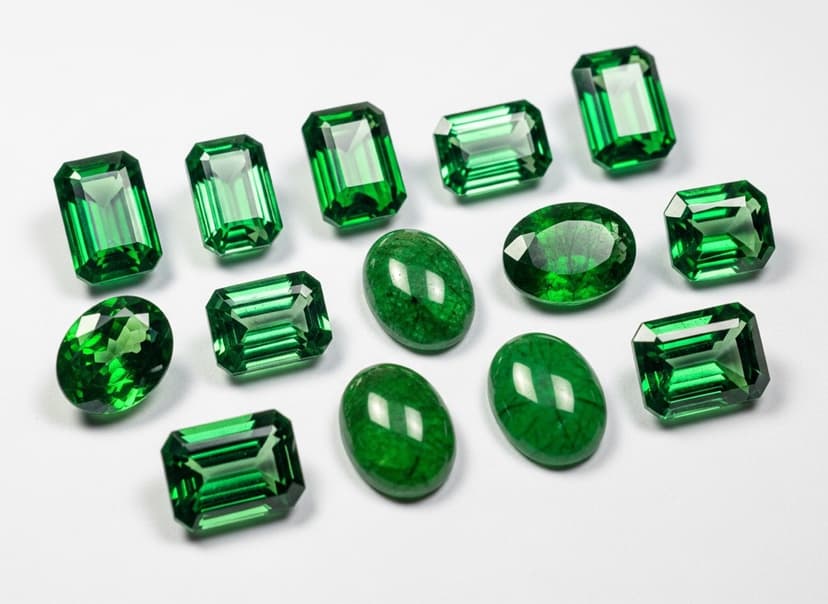
Emerald pricing works differently from ruby and sapphire because emeralds are almost universally included, and the trade accepts that reality rather than penalizing it the way it would in other stones. The industry term is jardin, meaning garden, describing the internal fissures and inclusions that virtually every natural emerald contains. What matters instead is color, which must be a saturated green with a slight blue undertone rather than a yellowish or pale green. Origin carries real premiums, with Colombian material from the Muzo and Chivor mines commanding the highest prices and Zambian stones, which tend toward a bluer green with better clarity, following closely. The variable most buyers do not understand is oil treatment. Nearly all emeralds are treated with cedar oil or resin to fill surface-reaching fractures and improve apparent clarity, and the degree of that treatment, graded from none through minor, moderate, and significant, dramatically affects value.
Color is the dominant driver and the market pays for saturated, slightly bluish green with medium to medium-dark tone. Origin matters substantially, with Colombian stones carrying premiums for their characteristic warm green and Zambian stones valued for saturation and clarity. Treatment level is the variable that most affects price for a given appearance, since a stone graded insignificant or none by a laboratory sells for multiples of the same-looking stone with significant filling. Clarity is judged relative to expectations for emerald rather than absolutely, and a stone that is eye-clean is exceptional. Cut quality matters because the emerald cut was developed specifically to reduce stress on this fragile material, and poor proportions cause windowing. Size drives price steeply. Because emeralds are brittle and fracture-prone, condition and any evidence of chipping or damage to the girdle reduce value more than in harder stones.
Buying & Selling Tips
Buying
Ask for the treatment grade in writing. The difference between minor and significant oil can change the price by three to five times.
Get a laboratory report from GIA, GRS, SSEF, or Gübelin on any significant stone. Both origin and treatment need certification.
Inspect the girdle and corners for chips. Emerald is brittle and damage there is common and expensive to address.
Never clean an emerald in an ultrasonic machine. It removes the oil and can worsen fractures, permanently reducing value.
Consider Zambian stones for value. They offer strong color and better clarity at meaningfully lower prices than Colombian.
Selling
Have the stone recently examined and documented. Oil treatment can dry out over decades, and a current report reassures buyers.
Do not re-oil a stone before selling without disclosure. Undisclosed treatment discovered later leads to reversed sales.
Sell fine emeralds through auction or a colored stone specialist. General jewelers discount heavily due to treatment uncertainty.
Photograph in indirect daylight against white. Emerald green shifts noticeably under warm indoor lighting.
Mention the origin and treatment grade in the listing title. Serious buyers filter on both before looking at anything else.
Emeralds FAQ
Why do emeralds have so many inclusions?
Emeralds form under geological conditions that create internal fractures and mineral inclusions, collectively called jardin. Virtually all natural emeralds have them, and the trade accepts inclusions that would be unacceptable in ruby or sapphire.
Are all emeralds oiled?
The great majority are. Cedar oil or polymer resin fills surface-reaching fractures and improves apparent clarity. Laboratories grade the extent as none, insignificant, minor, moderate, or significant, and value falls sharply as the grade rises.
Which emeralds are the most valuable?
Colombian stones from the Muzo and Chivor mines with vivid green color and minimal treatment are the most valuable, reaching $40,000 to $150,000 per carat for exceptional untreated examples above three carats.
Can you clean an emerald ring at home?
Only with warm water, mild soap, and a soft brush. Never use ultrasonic or steam cleaners, since both strip the oil treatment and can propagate existing fractures, causing permanent damage.
Are Zambian emeralds worth less than Colombian?
Generally yes, though the gap has narrowed. Zambian stones tend toward a bluer green with fewer inclusions and typically sell at $1,200 to $3,500 per carat for good quality against $4,000 to $10,000 for comparable Colombian material.
Got Emeralds to Value?
Upload a photo and get a free AI-powered valuation in seconds. No sign-up required.